Ethena: Stressing the Importance of the Insurance Fund

Many industry participants are comparing Ethena’s USDe and its 20%+ yield to Terra’s fallen UST, but we do not believe this is an apt comparison. We do see plenty of risks in the design of USDe, albeit not to the same degree as a fully algorithmic stablecoin backed solely by a protocol’s native token (LUNA). The Ethena team has outlined a comprehensive list of risks in the protocol documentation, which includes smart contract, liquidation, exchange counterparty, custodial, collateral, and funding rate risks. There is also a dashboard to track the solvency of USDe in real time, giving USDe holders a source of truth during times of uncertainty. Transparency is not lacking in the Ethena protocol, another crucial difference between the former LUNA/UST bubble.
USDe maintains its peg to $1 by relying on arbitrageurs. If USDe is trading below $1 onchain, a user can buy USDe at a discount from their pool of choice and subsequently redeem it for more dollars worth of stETH from Ethena and convert it to USDC to complete the arbitrage. Conversely, if USDe is trading at a premium to $1 onchain, whitelisted users can mint USDe directly from Ethena by depositing stETH, and subsequently sell the USDe for more USDC and purchase more stETH than what was originally deposited into Ethena to complete the arbitrage. It is worth noting that many of Ethena’s investors are large market makers and CEXs, so we expect them to actively participate in the process of maintaining the USDe peg.
Most of the public concerns with USDe are centered around funding/basis risk, but we hold a different view. Our primary worry with the design of Ethena boils down to the insurance fund and the studies conducted that guided the Ethena team on how to appropriately size it in relation to the outstanding USDe supply. The insurance fund will be secured by a 7/12 multisig which holds uncorrelated collateral such as USDC/USDT, stETH, and various USDe LP positions that can be viewed as an additional margin of safety for USDe holders during periods of negative funding, or act as a bidder of last resort on the open market if USDe depegs beyond its true level of solvency.
Ethena published research including simulations on USDe supply growth and the required insurance fund size/take rate using historical funding/basis figures. The historical figures include events like the ETH PoW-to-PoS trade, the collapse of 3AC, Terra, FTX, and others, and the general bear market trends from 2022, so it is a solid baseline for formulating conservative projections. The below chart from their research assumes an initial insurance fund balance of $20M, early exponential growth to $2B of TVL in a year, 50 bps of annual fees to maintain this collateral, and a 50% protocol revenue take rate at various funding rate scenarios. The “standard regime” is the mean funding rate for ~2.5 years between 2021 and 2023, while the “conservative regime” and the “aggressive regime” subtract 2% and 4% respectively from the mean to express excessive caution in the simulation.
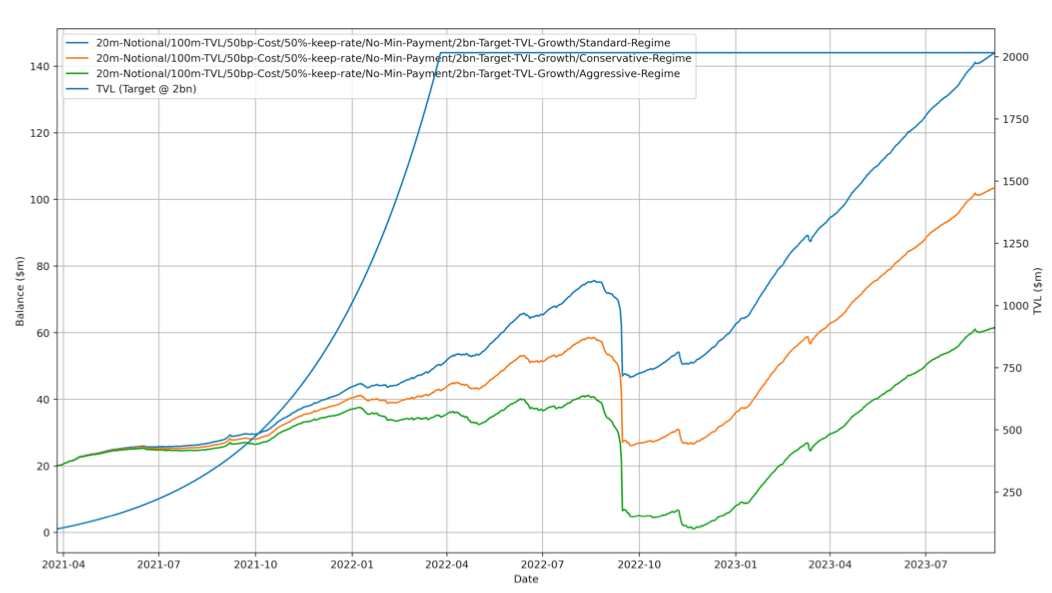
Ethena’s USDe has ballooned to over $410M of supply just days after public launch, so we chose this simulation as our base case out of all the simulations conducted within their research. Under the “aggressive regime”, the insurance fund is almost entirely drained ~1.5 years into operations. It is important to note that there is no guarantee that the insurance fund will have a full 18 months to accrue protocol revenue prior to a black swan event occurring, which is why in our view it is so important to be as aggressive as possible early on with the insurance fund take rate. Additionally, the insurance fund currently only holds $2M, and based on primary sources, $10M of their team’s recent raise will also go into the insurance fund. This $12M is less than the original $20M that was included in the simulations, which makes us lean even heavier into believing the take rate should be 50% at a minimum.
Chaos Labs also conducted research on the initial insurance fund sizing and take rate, which concluded that $33M of capital is required assuming an initial USDe supply of 100M and a 10% take rate with a 300% average linear annual growth rate on the stablecoin supply. Chaos Labs believes this would be sufficient for up to 1B of USDe supply, but warns that if growth ends up being faster than that, the take rate would need to be increased accordingly to slow growth. Similar to Ethena’s internal research, the assumptions on funding rates are quite conservative, which used the worst case scenario as the base case. We are seeing this play out in real time, as Ethena announced on February 22, 2024 that only ~40% of the revenue earned between February 15-21 would be returned to sUSDe holders, with the remainder to either go to the insurance fund or to be redistributed to sUSDe holders at a later date. On the morning of February 23, they retracted the move as a result of complaints from the community and stated that all revenue would be returned to sUSDe holders instead of building up the insurance fund more aggressively.

Sam leads coverage on Ethereum, L2s, Aave, Compound, as well as NFTs and gaming. Previously worked on a hedge desk at UGC.