EigenLayer: Supercharging ETH Through Restaking

One of Ethereum’s most important components is its security. Through proof of stake, it is able to take advantage of its large market capitalization and slashing penalties in order to fully secure its network from malicious actors. EigenLayer is a new service meant to utilize Ethereum’s robust security. EigenLayer allows ETH validators to “restake” their ETH into a new smart contract on Ethereum, with that stake now securing a brand new project. Through this simple mechanism, EigenLayer allows for much quicker innovation at different levels of the blockchain stack, and could foster an explosion of new projects built on and around Ethereum and its ecosystem.
EigenLayer: One Trust Network
Every time someone builds a new decentralized network, whether that be a Layer-1 or an oracle network, they must establish their own level of security or what EigenLayer refers to as a “trust layer”. For example, Bitcoin’s security and trust layer comes through proof of work mining, where anyone using the network can trust the information and state contained on the Bitcoin blockchain because they can trust that someone did the necessary computation. For Ethereum, this security and trust layer is done through proof of stake, where any user and application on top of the network can trust every transaction because of the security incentives that come with proof of stake consensus, such as slashing. When an application uses information that comes from a different source than the Ethereum protocol and data availability, such as a set of oracles, they need to adopt a different set of trust for that specific network.
By having both middleware and alternative Layer-1s run on different trust networks, this slows down potential innovation by increasing the cost of capital and labor to create this brand new layer of trust and security. In addition, these protocols must accrue large amounts of value in order to have sufficient security and trust, especially for a proof of stake network whose security is directly tied to the value of the token. Finally, there is little incentive alignment between different networks, which paves the way for negative value extraction.
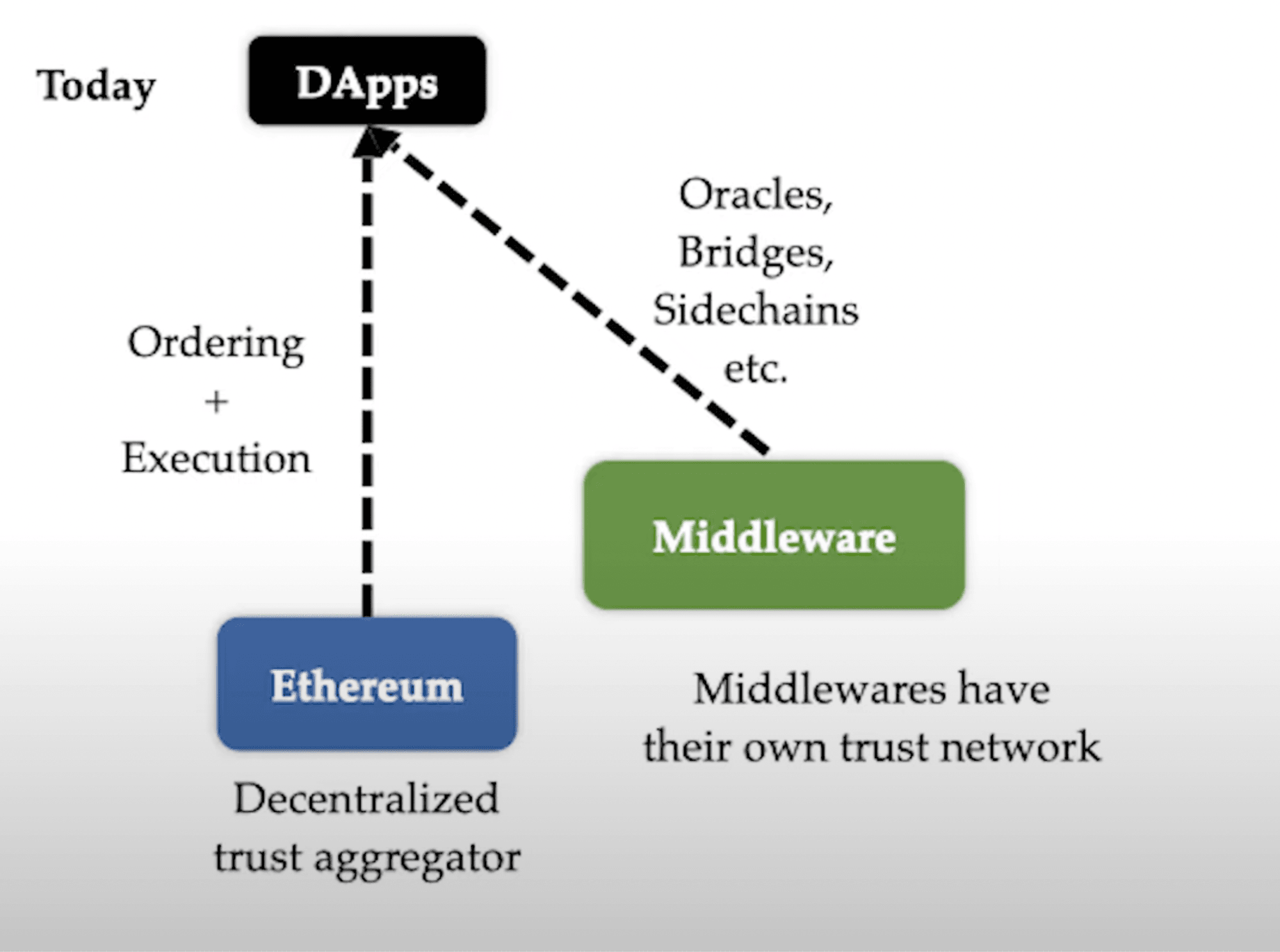
*Source: *https://youtu.be/-V-fG4J1N_M
EigenLayer is meant to solve the issues of fragmented trust networks by offering a service in which users who have locked their ETH in staking can “restake” their ETH in a separate smart contract. This essentially means putting up the same capital for additional slashing risk. This restaked capital is then used to secure any new application or middleware created with EigenLayer. Stakers will be able to choose which projects they want to restake and provide security to, therefore giving stakers the opportunity to take on the amount of risk they are comfortable with while providing an incentive for these projects to compensate restakers for their security.

Westie leads coverage on Ethereum, L2s, and Synthetix. Previously he worked in public sector technology Consulting at Guidehouse.