EIGEN Token Model: Will it Work?


Prompt
EigenLayer, the Ethereum restaking protocol, recently announced the EIGEN token and its distribution to points holders via stakedrop. Despite being one of the most sought-after airdrops this cycle, the token and its distribution have ensnared the crypto community in heated debates.
With over $160M in venture funding raised and over $15B in TVL amassed over a few months, EigenLayer’s momentum has been consistently moving in one direction. They have also been consequential in launching the Liquid Restaking Token (LRT) space, which has amassed over $9B in TVL. These signals have made expectations for the EIGEN token and its airdrop high enough to drive interest toward protocols like Pendle to create venues for users to farm points.
But just a few days ago, the whitepaper on the details of the EigenLayer token and stakedrop was released, and crypto twitter is divided on the token design and distribution. This begs the question of the efficacy of their design and how it impacts their long-term success.
Primer
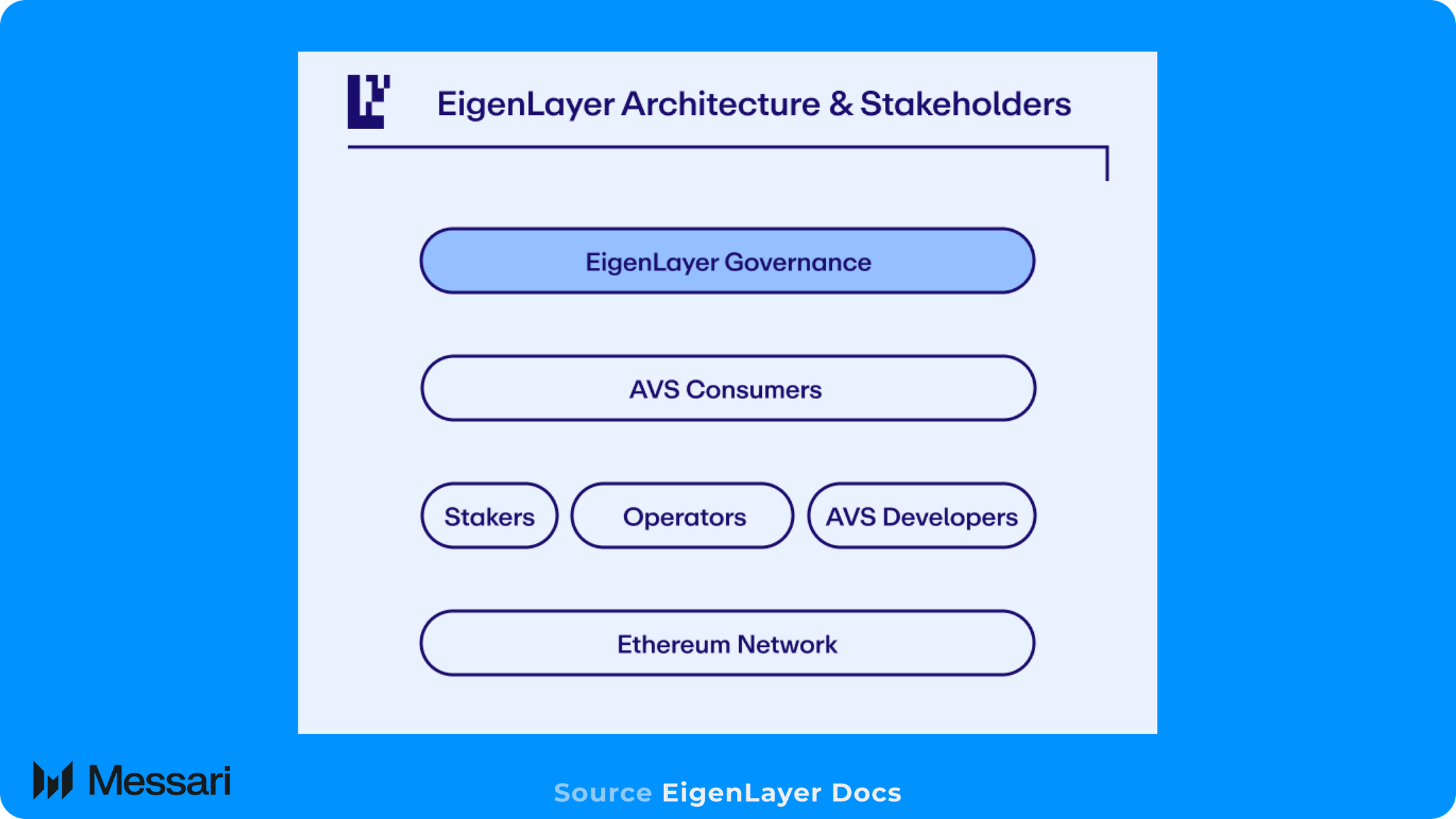
EigenLayer is a protocol that enables the reuse of Ethereum-staked security to external applications and services rather than fragmenting security and having to bootstrap it from scratch. The protocol consists of four main components: Stakers, Actively Validated Services (AVSs), Operators, and Governance.

Nikhil is a Researcher focused on Web3 Infrastructure and Decentralized AI. Previously he was leading BD at Upshot and prior to that was working on growing Avalanche at Ava Labs.

Kunal previously worked in equity research and now considers himself a financial analyst in crypto. He specializes in valuation and bottom-up analysis for Layer-1 and DeFi protocols because he has yet to learn of a way to value NFTs.

Prior to joining Messari, Seth worked in traditional finance software and services, and has a MSc in Applied Mathematics. Seth is a Senior Research Analyst on the Enterprise Research team, and focuses on infrastructure, verifiable compute, and the AI x Crypto intersection.