Economic Security and its Memes


This is not an Ethereum versus Solana debate. But Ethereum supporters typically tend to fall into the camp that economic security matters while Solana supporters do not. So, like most things, this is a bit of an Ethereum versus Solana debate.
Primer
Cryptoeconomic security is a foundational idea in blockchain design where token incentives help coordinate selfishly motivated entities to create a stable game-theoretic outcome. Bitcoin pioneered this through its Proof-of-Work consensus algorithm, where miners solve cryptographic puzzles for BTC rewards which secures the blockchain from 51% attacks. Research by Amina Group on mining parity empirically establishes that mining hash rate (security) and price are directly linked in Proof-of-Work blockchains.
In Proof-of-Stake (PoS) blockchains, the behavior of validators is similarly aligned towards a common good through token rewards (carrot) and slashing (stick). In Ethereum, proposing and voting on valid blocks generates rewards, whereas missing votes or double voting incurs a penalty. Some PoS blockchains forego slashing as a disincentive, instead relying on missed rewards as the penalty.
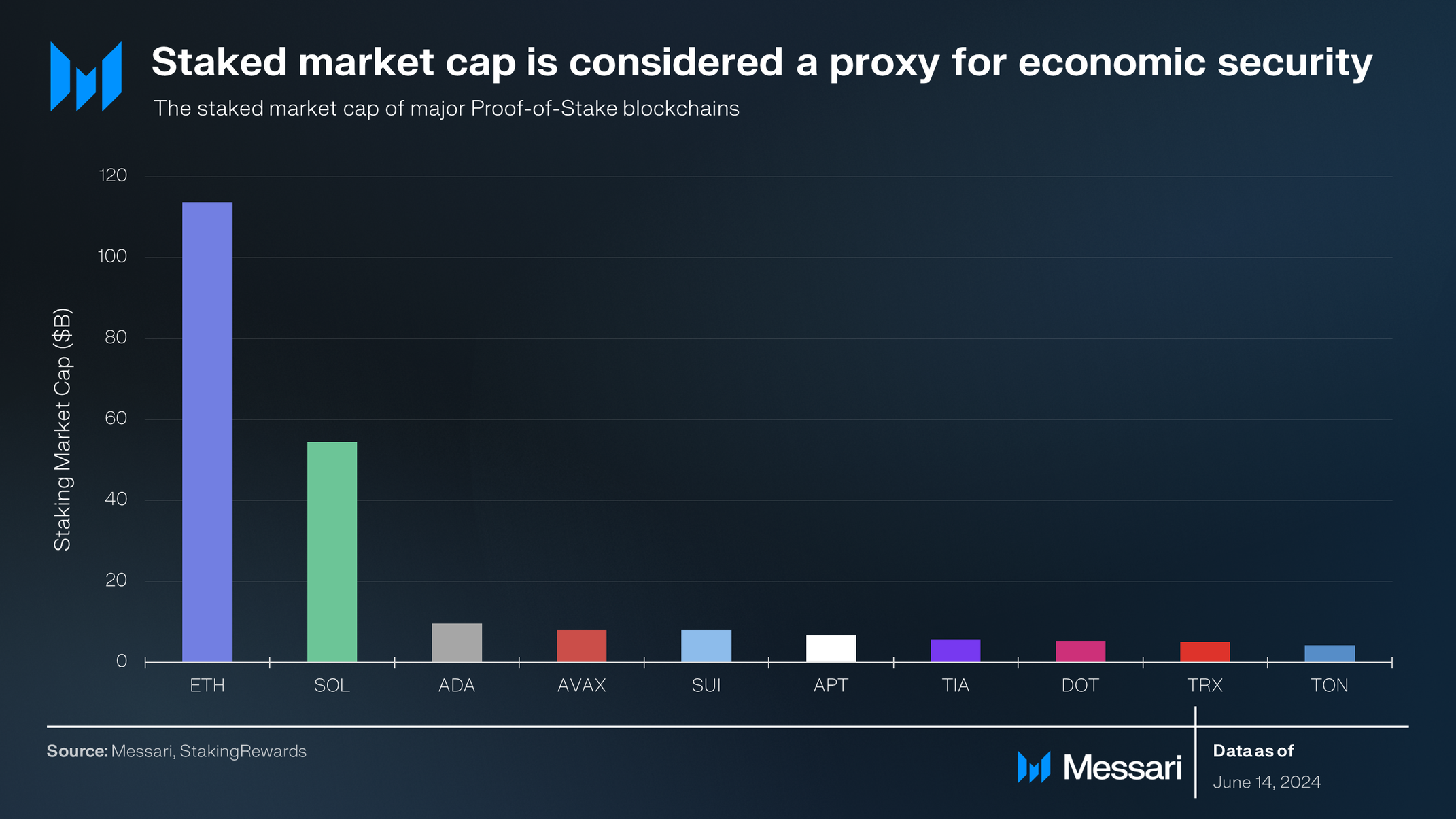
However, the revolution in smart contracts has created out-of-protocol incentives for validators. These opportunities may be clubbed under the broad umbrella of maximally extractable value (MEV). At typical levels of stake distribution, validators earn MEV for one block at a time, which is usually not high enough to justify an attack. However, if a malicious validator gains control of more than 50% of the stake, they can handpick which transactions are processed in perpetuity and thereby generate significant MEV. Therefore, a network’s staked capital is typically considered its “economic security” as an offending validator will have to acquire and risk a portion of this value to fully take over block production. The primary argument against economic security is that in case of such an attack, the social layer, i.e., the honest users, will coordinate to remove the offending validator and slash their stake.

Kunal previously worked in equity research and now considers himself a financial analyst in crypto. He specializes in valuation and bottom-up analysis for Layer-1 and DeFi protocols because he has yet to learn of a way to value NFTs.

Peter is a Research Analyst in Protocol Services focused on Layer-1s. He recently graduated from Boston College where he studied economics and computer science and led the school's blockchain club.