dYdX regains steam after large liquidations and MCD upgrade hurt volumes

Open Finance Fundamentals
This report is part of a weekly series where we will explore the mechanics behind major Open Finance protocols and evaluate them on a fundamental basis. You can view prior reports here.
The predominant use case of DeFi lending is to lever up existing positions to heighten returns. Rather than just buying and holding ETH you can use that ETH to take a loan out in DAI to purchase more ETH. This can be done by using a loan protocol such as MakerDAO or Compound and a decentralized exchange such as Uniswap, or it can be simplified to a one-step process using dYdX.
After launching the new dYdX protocol in April, there was consistent growth in volume for most of the year, reaching a peak of nearly $1 million USD averaged out over the month. In September they launched their own native order books to improve the trade experience by providing faster matching, tighter spreads, and less slippage. In November, there was a consistent decline which was likely the result of a few factors. For one, the launch of multi-collateral dai led some users with positions in DAI to close them in anticipation of the upgrade. Major upgrades such as this create uncertainty since no one knows exactly how the transition will occur. Given DAI trading pairs account for over 90% of volume, this likely had a dramatic impact on volume.
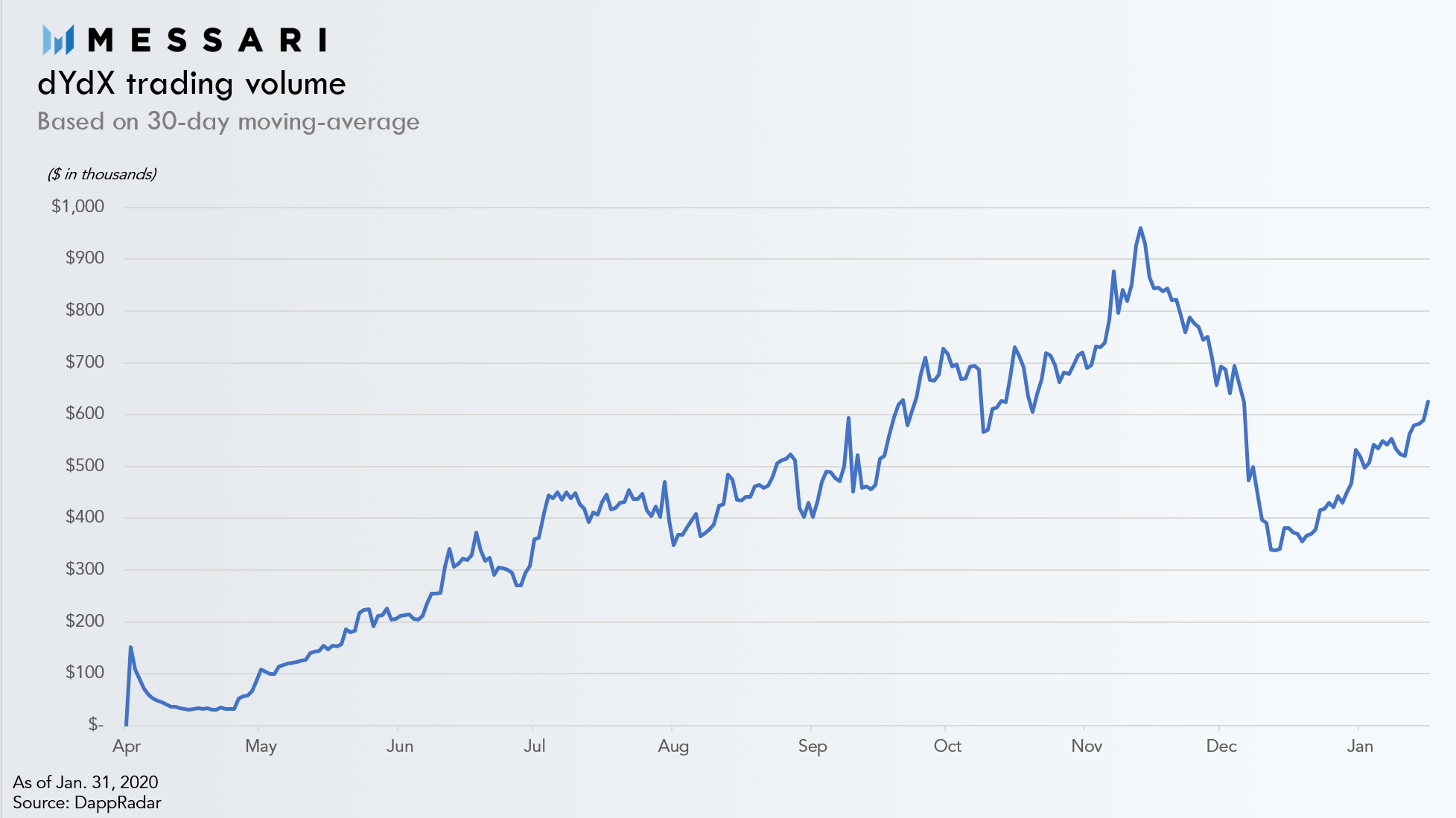
Another reason is the drastic decrease in the price of ETH that occurred in November where the price dropped 25% in the span of a week. This triggered some large liquidations, as evidenced by the amount of ETH locked in dYdX.
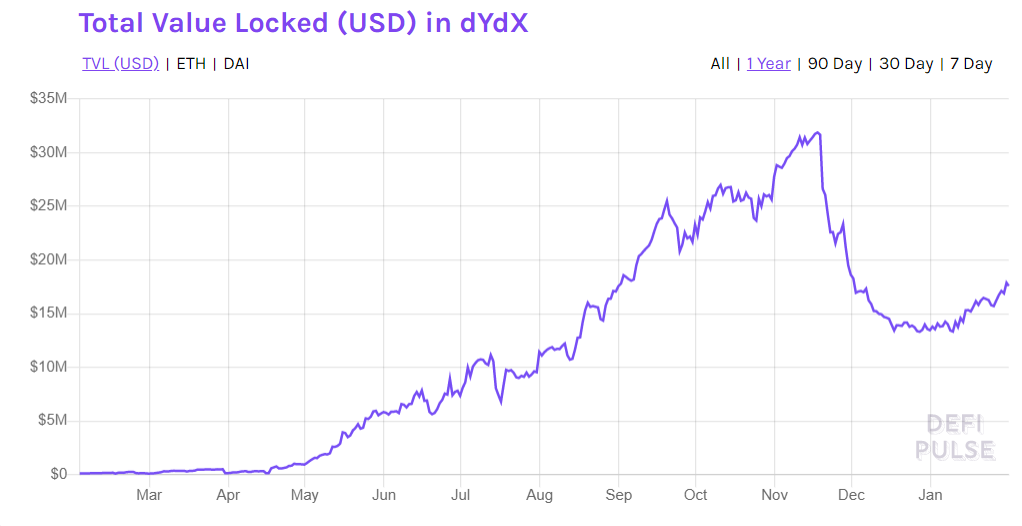
There is now 4x the amount of Dai than Sai showing that most traders have migrated their positions. Now that Dai seems to be in a stable state more loans have been taken out with it over the last few weeks. As the price of ETH has been rising as well, these factors are now leading to an increase in volume on dYdX. This trend is expected to continue as decentralized margin trading continues playing a pivotal role for traders in the Open Finance space.
