Deri Protocol: The Future of Derivatives and On-Chain Market-Making

The following report was written by Messari Hub Analyst(s) and commissioned by Deri Protocol, a member of Messari Hub. For additional information, please see the disclaimers following the article
Derivative exchanges have been a significant driving force for the mass adoption of cryptocurrencies. The promise of gains with seemingly endless leverage and the availability of nuanced financial instruments by exchanges has created a substantial influx of newcomers in
recent years.
Derivatives are not new, and have been used for decades in traditional markets. Derivatives provide tools for traders and investors to hedge positions, speculate on the movement of an underlying asset, and provide margin to holdings. The basis of derivatives is to provide specific risk exposures in a capital-efficient method. Traditionally, centralized exchanges (CEX) maintain the responsibility of providing liquidity and holding/securing the user’s positions. However, with the introduction of Uniswap’s Automatic Market Maker (AMM) mechanism, which allowed liquidity pools to act as counterparties to trader’s positions instead of a CEX, the decentralization of traditional financial contracts has accelerated.
Decentralized exchanges (DEXs) not only provide an innovative mechanism for trades to be executed, they also bolster composability and cooperation within the DeFi ecosystem. With this added feature, derivatives contracts, once isolated within a centralized entity, can now interact with third party protocols, allowing for diversification of risk management instruments.
About: Deri Protocol
Deri Protocol is a decentralized derivatives exchange averaging over $70 million in daily trading volume in Q4. Currently, the platform provides two products to traders: perpetual swaps and everlasting options. The protocol is dependent on AMM mechanics where trader’s positions are tokenized as composable NFTs. The tokenization of positions grants for ease of storing valuable information pertaining to each position opened. In addition, Deri is able to accept multiple base tokens as collateral and/or settlement from traders and liquidity providers (LP). This property increases the use and interaction of non-cash types of tokens between Deri and third party DeFi protocols. The team believes this characteristic will expand the definition of the liquidity token in the DeFi ecosystem, boosting its range of use and improving capital efficiency. In recent months, the platform has also introduced everlasting options, a method which allows traders to keep options positions open regardless of their expiration.
How does it work?
Liquidity and position tokens as NFTs:
A contract represents a short or long position of an underlying asset. For example, a futures contract represents an agreement to buy or sell a particular asset at a predetermined price at a specified time in the future. These contracts are unique to each long and/or short position for each trader. In addition, the counterparty’s position on a CEX must also be represented in a similar manner. In a traditional order-book based CEX each order-book can only support one trading pair per order-book. This limits the exchanges capabilities to accommodate user preference.
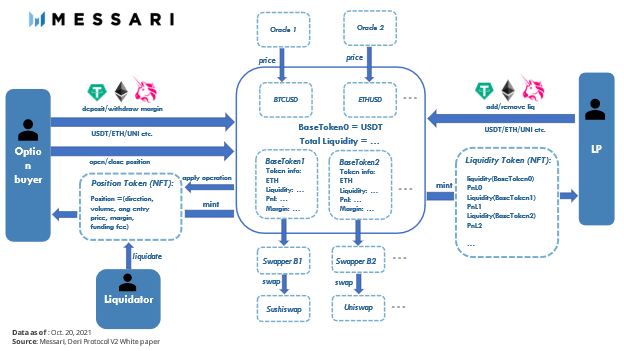
Deri protocol utilizes NFTs to represent a trader’s position. Once a trade is opened, the pool mints an NFT to record the position’s information such as direction (long or short), funding fees incurred, entry price, volume, and margin borrowed.
Deri protocol futures dashboard:
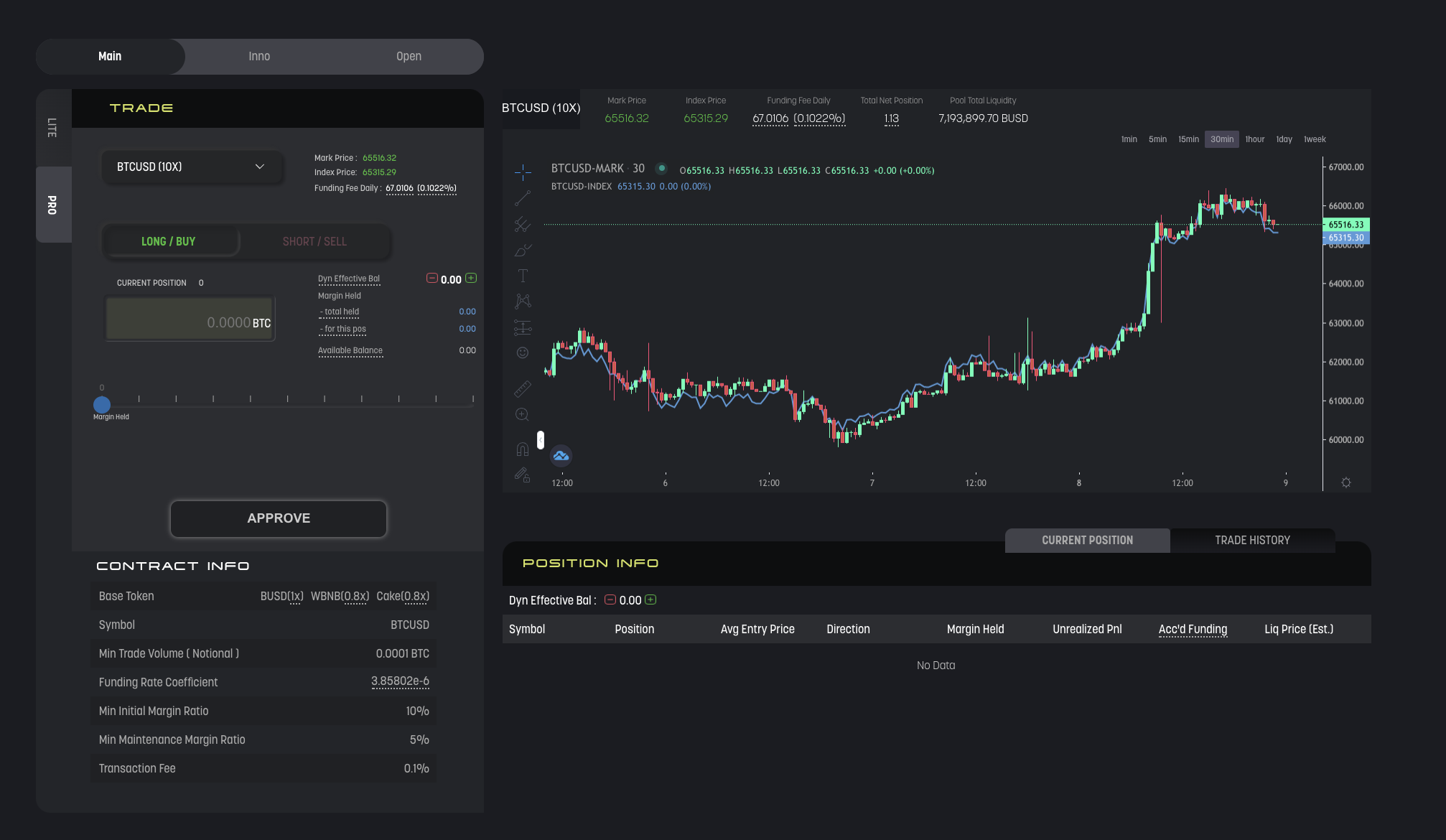
Source: Deri website
In the same manner, LPs also create NFTs named liquidity tokens that act as a carrier of the base token’s information with which the trader and/or LP use. This allows for multiple base tokens or trading symbols/pairs to be present in one pool, something which cannot be done with a traditional order-book based derivatives exchange. Furthermore, LPs are incentivized to interact with liquidity pools to farm the various fees available from transactions, funding, trader’s PnL, and liquidated positions.
Liquidation and funding:
Liquidations occur when a long or short position, tied to a certain amount of margin, is forcefully closed by the exchange due to its high-risk exposure. Leverage is used when a trader borrows capital from the exchange to take advantage of the underlying assets price movement. Liquidation engines are therefore necessary for the exchange to minimize its losses in the event the underlying asset’s price becomes volatile in the opposite direction of the position opened.
Funding fees are also a key feature in derivatives exchanges. These fees are paid by the majority-side of the market to the minority-side in order to help balance out leverage within the system. Deri’s funding fee mechanism differs from CEX as the fee is paid periodically per second for both swaps and everlasting options, instead of every 8 hours. In order to control funding from reaching high levels, arbitrageurs would step in and take the minority-side of the market to level out the fees paid by the majority-side.
Dynamic mixed margin
In Deri’s updated V2 whitepaper, the team made significant alterations to its margin providing mechanism. Dynamic mixed margin accommodates the margin fluctuations amongst multiple base tokens to exist within the protocol’s framework. Since there are other distinct base tokens being used simultaneously in the liquidity pools, the prices of those tokens against the settlement token (i.e. base token used by the trader) are constantly changing. This puts the trader’s margin in constant fluctuation. In order to mitigate issues due to the complexity of the system, the protocol appoints liquidators to routinely update their algorithms to properly monitor the margin positions of open trades. Additionally, if a position is closed LP pools may need to convert tokens to the settlement token on spot AMMs if the position’s margin and the settlement token are different.
DERI token
As with the majority of DeFi products, Deri also utilizes its own native token $DERI to create an ecosystem surrounding the exchange and incentivize its holders. Several use cases have been established the most significant being:
- Rewards in DERI for base token liquidity providers
- Decision-making opportunities to the protocol for DERI token holders
- Liquidator authority for those who stake DERI in the liquidator pool
- Reduced transaction fees for traders staking DERI in specific liquidity pools
With a total supply of 1 billion tokens of which 400 million were minted during the genesis block and allocated to the team and investors. From that initial supply:
- 260 million tokens are locked in a vesting vault with a two-year linear release plan
- 140 million tokens unlocked since day one are to be allocated to the treasury of which 100 million DERI are used for fundraising and promotional community activities. The remaining 40 million DERI are allocated to the treasury accordingly.
The remaining 600 million tokens are to be mined via LP rewards on the Deri exchange as well as staking rewards from Pancake’s Syrup pool and Sushiswap’s Onsen pool.
Recent updates
Everlasting Options:
Deri has launched its everlasting options beta product which gives traders the opportunity to maintain an options position without the need to roll forward if it expires. Traditional options derivatives have an expiration date and in order for traders to keep their options positions open they have no choice but to incur additional costs from the exchange by opening an additional options trade with a longer expiration. Everlasting options integrates the funding-fee-based instrument, pioneered by BitMex for perpetual swaps, to options. Therefore, traders can keep their options position open as long as the funding fee is paid on a per-block basis.
Proactive Market Making (PMM):
The current AMM architecture relies on “plug-in” mechanisms to synchronize token prices and avoid inefficiencies. This mechanism is carried out by arbitrageurs who converge prices relative to external markets for a fee. However, impermanent loss and slippage issues remain present in the AMM’s framework. In order for Deri to provide adequate market efficiency the Proactive Market Maker (PMM), first introduced by DODO, was adopted for the everlasting options product. The PMM provides a compressed virtual order-book with which a liquidity pool can execute trades against, mimicking the behavior of a CEX. The parameters that comprise the PMM are sustained by two inputs:
- An oracle to reflect external market information in order to shift buy and sell orders accordingly
- The controller, who determines the depth of each bid and ask price
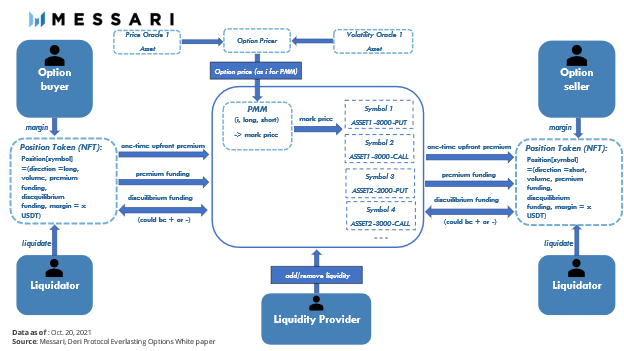
Liquidations of everlasting options on the PMM operate similarly to Deri’s perpetual future mechanism. The PMM also allows for put and call options at different strikes or of different underlying assets to be traded against one liquidity pool. This function helps avoid liquidity fragmentation and improves the everlasting option’s exchange performance.
Perpetual Futures DPMM:
In an effort to unify it’s derivatives product’s mechanisms, Deri recently updated their perpetual swaps model by replacing the current AMM architecture with the Deri Proactive Market Maker (DPMM). Similar to the PMM discussed above for everlasting options, the DPMM creates a virtual order-book for trades to be executed on. The fundamental incentive for the update is to simplify the funding mechanism to resemble that of a CEX’s such as BitMex. The same funding fee system is used for everlasting options therefore, unifying the products for ease of use and understanding from traders and LPs.
Traction
Interest in Deri has been slowly increasing with its most notable and recent investors being WOO Network, a centralized trading platform funded by Kronos Research and QCP Capital, one of the largest market makers for crypto options. Furthermore, Deri has seen an increase in total value locked (TVL) this past month, rising just over 900% in Q4 of 2021.
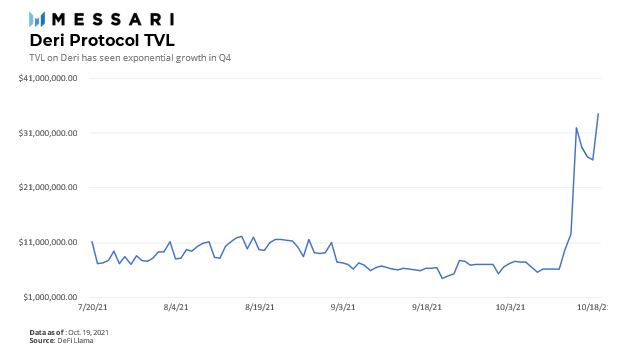
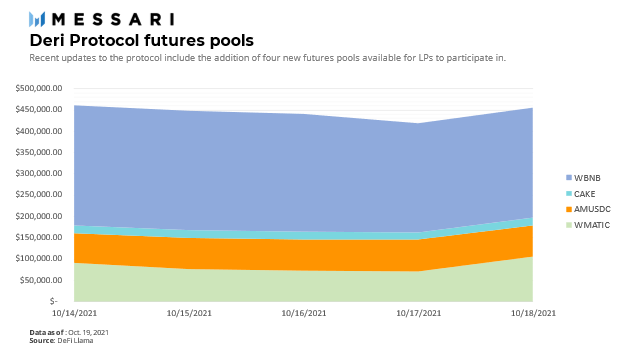
The protocol also has also made an effort to diversify its futures pools, adding five new tokens to its existing BUSD and USDT pools.
Competition & Risks
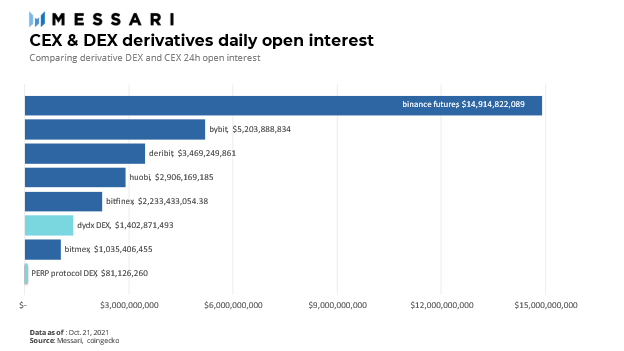
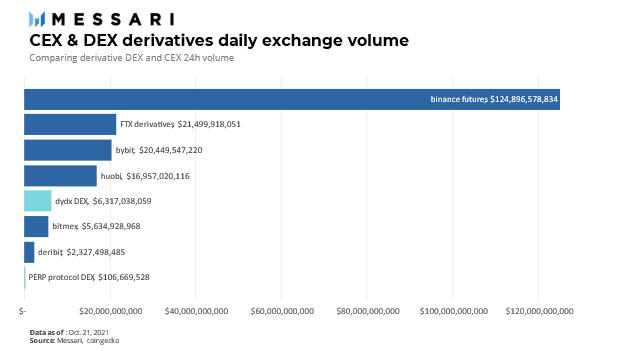
As previously stated, Uniswap’s AMM structure opened the floodgates to innovations in the DEX sector. One notable competitor is dYdX, a derivative DEX utilizing a hybrid on and off chain implementation first introduced by 0x. The exchange has managed to maintain over $5 billion in daily volume in Q4 overcoming CEXs such as BitMex and Deribit.
Deri also has to compete with current CEXs that provide futures and options trading. Centralized exchanges still retain a significant share of market participants with exchanges such as Bybit, BitMex, Binance, BitFinex, FTX etc. Not only is Deri having to compete with CEXs but the entire DEX space. According to coingecko, the DEX total market cap is about 30% less when compared to CEX.
Comparing open interest and trading volume of derivatives exchanges gives a clear picture as to how much catching up DEXs have to do compared to their CEX counterparts:
Furthermore, the crypto space has witnessed an increase in regulations particularly for DeFi protocols. The SEC had recently stated it would begin looking into Uniswap and other DeFi platforms. The main issue being some of these products may be deemed securities exchanges and ultimately shut down by the SEC. As regulations and crypto evolve, we can only wait and see what will become of Deri and similar DEXs as regulators begin to investigate these protocols and hopefully don’t hinder innovation within the space.
From a functional standpoint, Deri may encounter issues in price fluctuations by basing its perpetual swaps exchange on an AMM framework. The problem is mentioned in 0x’s
whitepaper and states how AMM’s are useful for providing constant liquidity. However, that may develop the protocol into becoming apathetic towards market fluctuations of the
underlying asset. In addition, scaling Deri’s DEX may also face challenges due to the increase in gas fees experienced by traders over the past year. The Ethereum network is also slow to process transactions, currently being able to process only 15 transactions per second. Even with Ethereum 2.0 on the horizon, theoretically providing up to 100,000 transactions per second, it still would not compare to current CEX performance. In order for Deri to perform efficiently in such a competitive landscape, concerns regarding transaction fees and speed will need to be taken under consideration.
Conclusion
Deri is able to bring nuanced and refreshing products to the derivative DEX ecosystem. The project’s long-term vision to integrate itself as a capital-efficient risk management tool with DeFi protocols is ambitious. Its everlasting options product aims to pioneer the derivatives environment as a new breed of DeFi protocols. Deri also continues to update and support more base tokens and become available on additional chains as the protocol develops. Also, taking into consideration the current speed of Layer 2 applications and the introduction of Ethereum 2.0, we can anticipate an increase in DEX efficiency and speed. I believe the future of exchanges will be found in DEXs, the multitude of solutions to consolidating liquidity in a market-efficient manner proves they can compete with centralized exchanges and in time outperform them.
