DeFining L1 DeFi

Smart contracts networks have had a wild past 100 days. ETH price appreciated 69% from August to mid-November. Now, while 69% is nothing to scoff at for a 100-day return of a half-a-trillion asset, the stars of the price appreciation show have been alternative layer-1s: AVAX, SOL, FTM, and others. These assets have outperformed ETH by 7-15x in the same period doing 635%, 496%, and 1,006% respectively.
Big numbers for a touch over 100 days. When valuations race ahead at such speed, it’s important to blink twice to make sure fundamentals are following suit. So the question to tackle is first and foremost what are the key valuation metrics for Layer-1s? And then it becomes how fast are key metrics growing as well as how sustainable those growth rates are.
Valuing Smart Contract Networks
Smart contract networks are valued through one main metric — the anticipated future economic activity of the network. While the asset associated with the network can receive additional value through use as money, it can only achieve this state if the future anticipated economic activity of its network is probabilistically high. Therefore, the anticipated economic activity is the core value driver of the network (and its token). Even including the security budget (gas fees) as a value add at this stage is errant since it introduces an additional variable of how efficient the blockchain is at funding security which has no direct effect on the core value driver which is economic activity. Gas fees relate to economic activity insomuch as they attract or dissuade potential usage which would be reflected in the resulting economic activity.
So how do we measure economic activity? How should it be defined?
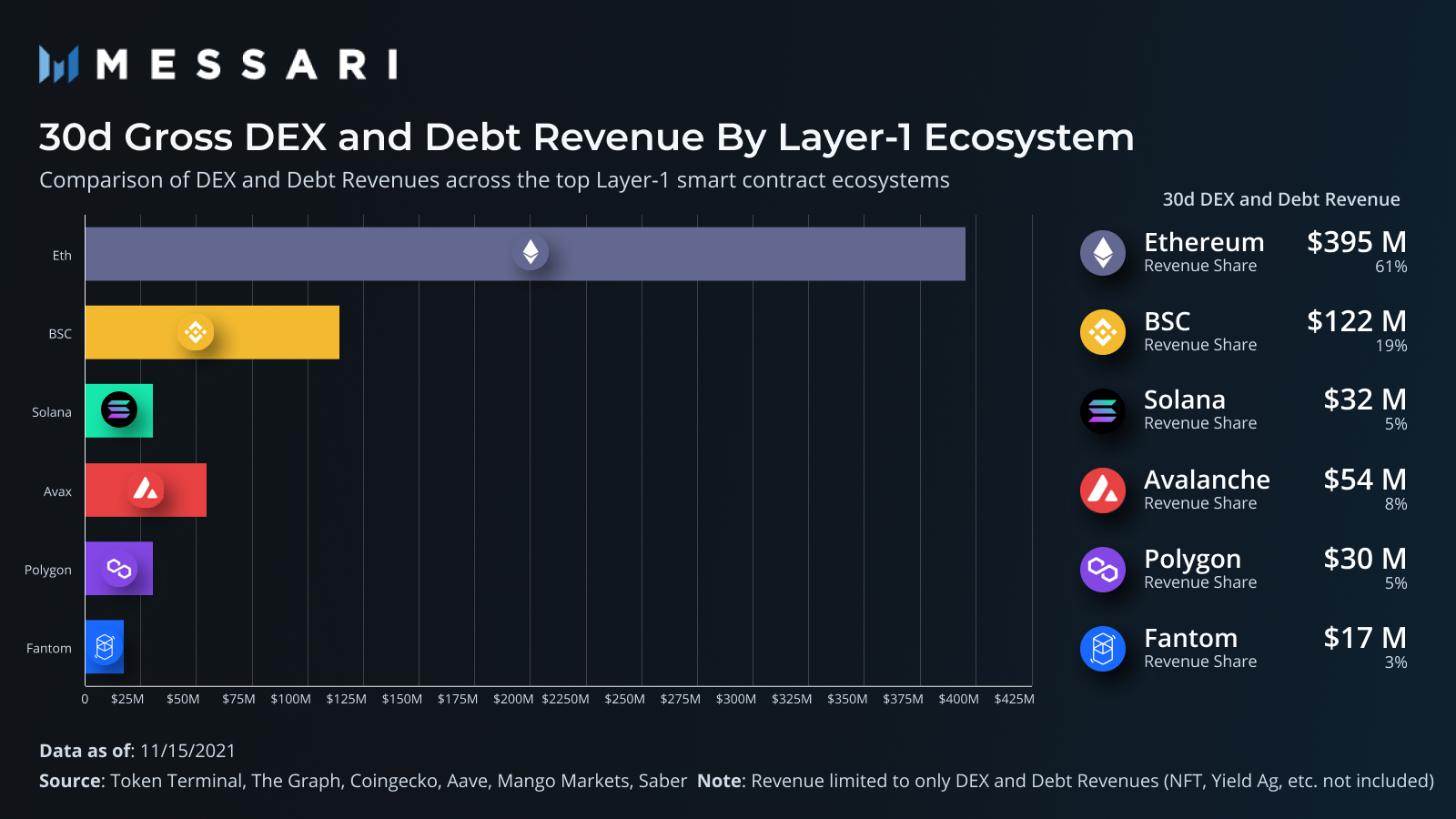
Top-line revenue generated by the collective protocols on the network is the easiest and most accessible metric to define economic activity. Included in this metric are both revenues owned by protocols as well as those paid out to liquidity providers, artists, and other participants who collect shares of protocol revenues. Functionally, this ends up looking like gross domestic product used to value nation-state economies.

Dustin was previously the Enterprise research director at Messari. He has a broad focus across crypto with a particular interest in AI x Crypto, Consumer financialization, DeFi, and general infrastructure.