DeFi Citadels: How DeFi Protocols Create and Capture Value

After a breakout summer that thrust DeFi into the spotlight, it's no longer a secret that DeFi protocols are creating real economic value. These protocols now store billions of dollars in assets and facilitate billions of dollars in financial activity daily, providing users with open, borderless, censorship-free financial services.
However what’s lesser known is that while many DeFi protocols each have their own unique cryptoeconomic designs, most share a common business model. The core of this business model is a protocol’s balance sheet, which can be defined as the total amount of assets under management (also referred to as total value locked). Understanding this can provide insight into how these protocols work and how they can defend themselves from competition and capture value.
Protocols as Coordinators of Financial Activity
DeFi protocols are coordination mechanisms that define rules and provide incentives in order to facilitate financial activity. Most DeFi protocols do this by crowdsourcing assets from their communities and putting those assets to productive use in activities such as market making (Uniswap and Curve), lending (Compound and Aave), or synthetic asset creation (MakerDAO and Synthetix). Users provide their capital to protocols in exchange for value flows, whether they be intrinsic to the system, such as liquidity-mined governance tokens, or extrinsic to the system, such as fees paid in stablecoins and other cryptoassets (ETH, BTC, etc). How much value a protocol creates for its stakeholders depends on how effectively a protocol can monetize its balance sheet.
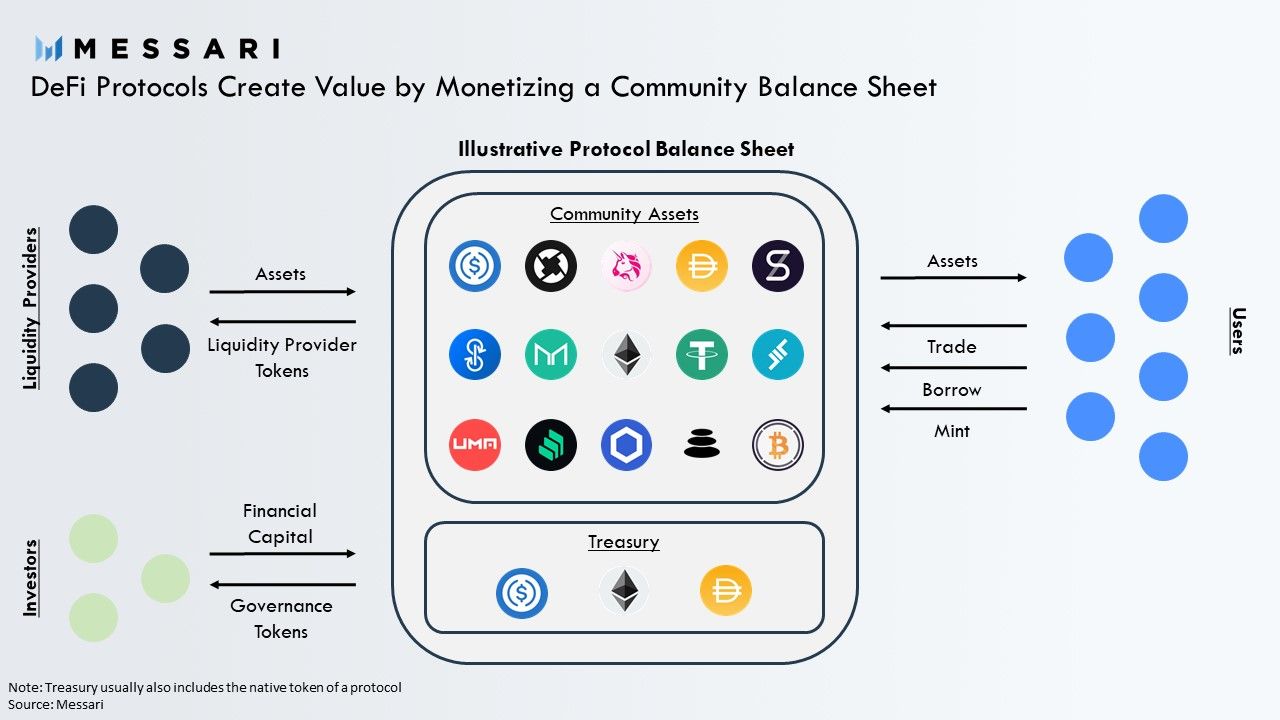
Balance sheet monetization as a business model is not new. It’s how financial institutions such as banks have generated cash flow for millennia. In the simplest model banks take in capital on one end in the form of debt (like deposits) and equity, then monetize that capital on the other end through financial services such as lending.
DeFi protocols are similar, except without the trusted third party in the middle directing the activity and a land based legal system to enforce agreements between stakeholders. DeFi protocols are just coordinators that facilitate activity between peers and their disputes are enforced using smart contracts on public blockchains.

Ryan Watkins was a Senior Research Analyst at Messari. Previously, he worked at Moelis & Company as an Investment Banking Analyst where he worked on deals in the technology, telecom, and fintech sectors. Ryan graduated Magna Cum Laude from the Gabelli School of Business at Fordham University.