DeFi Brief: Oracle-free Protocols

Key Narrative: Oracle-Free Protocols
Amidst the relatively quiet market conditions, a new set of DeFi builders is making noise by reimagining the architecture for lending and derivatives protocols. The core design change these protocols have in common is their lack of reliance on oracles. Traditionally, DeFi protocols that offer leverage via spot lending markets or derivative instruments have used oracles to determine when a position should be liquidated or what the outcome of a derivative contract should be.
For lending protocols, this means that eligible collateral is restricted to assets that have reliable oracle price feeds. Loan parameters, such as the loan-to-value ratio, are governed by the protocol and, as a result, any bad debt incurred becomes a responsibility of the protocol rather than its individual lenders. Similarly, derivatives protocols that rely on oracles for pricing lack internal price discovery mechanisms and are susceptible to lagged price updates which severely limits their scale and user experience.
Finally, oracles create another attack vector for DeFi protocols. Although protocol safety is generally assumed to be inherited from the protocol’s underlying smart contract network, it also relies on a properly functioning oracle. Should a protocol’s oracle be compromised, it can be manipulated so that attackers have an unfair advantage over the protocol and its users. This explains how Avi Eisenberg was able to conduct his infamous Mango Markets hack last October.
The New Kids on the Block
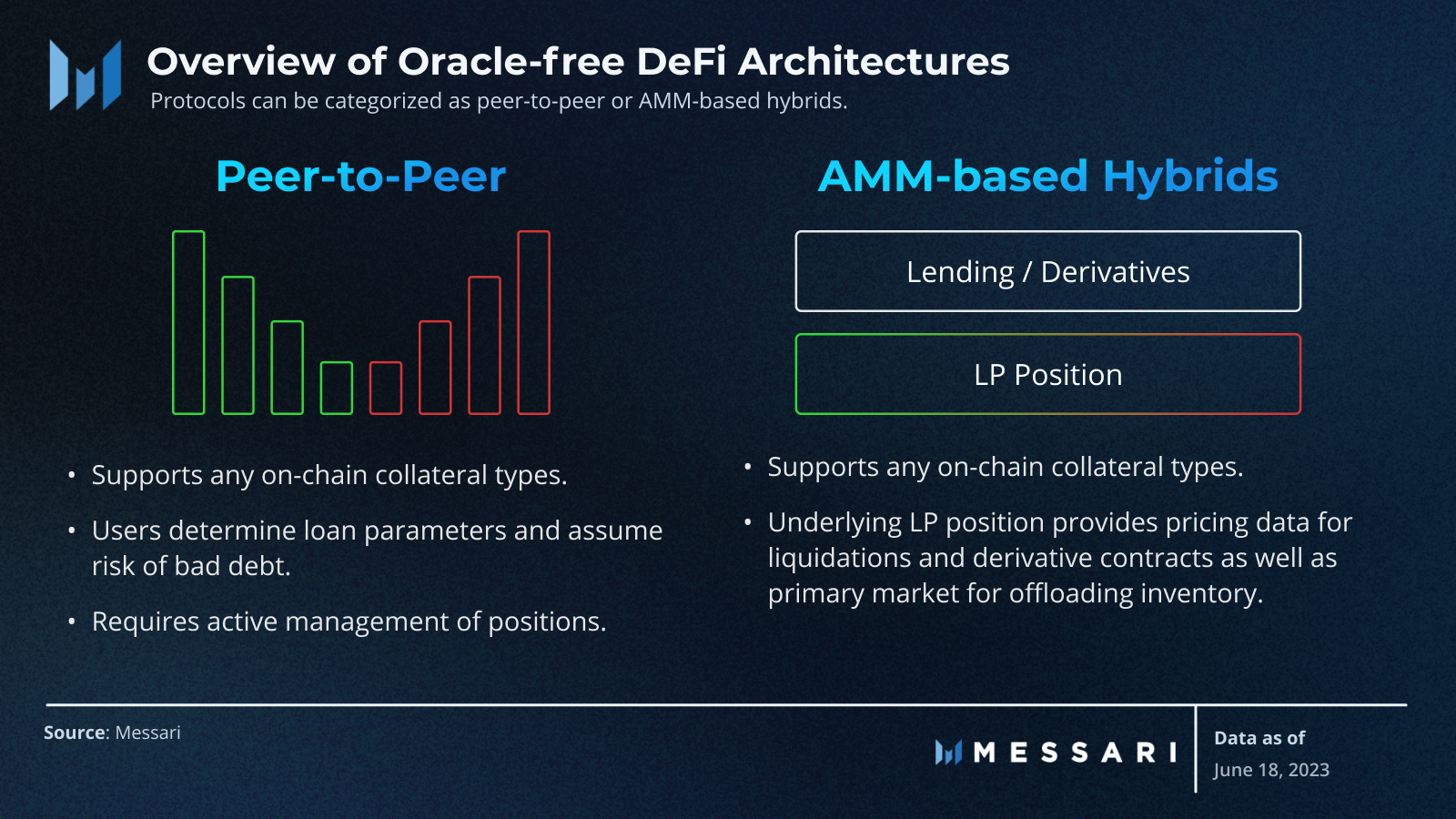
Up-and-coming “oracle-free” protocols are aiming to rebuild DeFi’s core services with novel architectures but come with their own sets of trade-offs. Their basic designs can be broken down into two general categories: peer-to-peer lending and hybrid protocols built on automated market makers (AMMs).

Chase's interest in crypto lies at the intersection of economics, psychology, and social coordination.