DeCharge reports supporting over 1,500+ electric vehicle chargers, with over 2.5 million in all-time EV charging minutes, as of December 2025.
DePIN Finance (DePINFi) pools enable site-specific financing on Solana. Contributors deposit USDC or USDT into a project-specific program and receive receipt tokens that accrue stablecoin-denominated yield tied to that site.
The APR on stablecoin deposits to DePINFi pools correlates to each site’s charging throughput and uptime, as yield is funded by site revenue, which is monitored via Switchboard oracles.
The CHARGE token is planned to launch in 2026 with a total supply of 10 billion. Token emissions will depend on verified charging sessions and kWh delivered, and will gradually decrease in predefined phases.
CHARGE will be used for network payments, staking-gated participation (higher-yield access), governance over emissions, and the treasury.
Primer
DeChargeis a decentralized physical infrastructure (DePIN) electric vehicle (EV) charging network designed to solve the scaling inefficiencies of traditional charging infrastructure. Rather than one entity covering all the costs of building out charging infrastructure, DeCharge enables individuals, landlords, or small business owners to invest in or deploy internet-connected chargers and participate in a network that incentivizes early deployment and continued utilization of chargers through points.
Key features include:
A multi-tier device lineup ranging from the 3.3 kW alternating current (AC) Mini to the 60 kW direct current (DC) Titan fast charger.
DePINFi pools are DeCharge’s capital formation layer that turns individual EV charging projects into site-specific, tokenized infrastructure financing. Instead of buying and operating chargers directly, contributors deposit USDC or USDT into project-specific pools and receive onchain receipts that track their share of capital and any associated yield. Each pool corresponds to a specific deployment, such as a particular cluster of chargers, so deposits are tied to identifiable physical sites rather than being commingled in a single capital pool.
Each DePINFi pool represents a slice of tokenized energy infrastructure where capital is aggregated into an onchain vault, deployed into hardware, and then monitored using live charger telemetry streamed through DeCharge’s coordination layer. As chargers begin operating, an oracle feedsperformance data such as utilization and uptime into the pool logic, which updates a variable APR that is paid out in the same stablecoin that was originally deposited. Contributors can periodically claim accrued yield, while their principal typically remains locked until the pool’s term ends. Eventually, users will be able to access higher-yield staking, which will be gated by the CHARGE token.
Additionally, pools follow a standardized process, so contributors know where a project sits in its lifecycle:
Funding stage: The pool accepts deposits until a predefined target or cap is reached. Deposits are recorded onchain, and contributors receive pool receipts that represent their share of the pool’s principal. Once the funding target is met, deposits close and the project transitions into execution.
Development stage: Hardware is procured, installed, and commissioned under the authority of a designated development team. Contributors cannot add new capital, but they can monitor progress through status updates and site-level disclosures. When chargers are live and transacting, the pool enters the Deployed phase.
Deployed stage: Chargers go live and begin generating yield based on usage. Contributors can claim this yield subject to pool terms, even though the principal remains locked for the duration of the pool’s term.
Closed stage: The term ends, capital is returned according to the pool's terms, and the receipts cease to earn additional yield. Asset ownership and operator rights vary by pool and are defined by that pool’s legal ownership agreement and terms.
DePINFi pools sit on top of DeCharge’s existing hardware and telemetry stack as the financial coordination layer of the network. The system already tracks energy dispensed, uptime, and device health across Mini, Beast, and Titan chargers. DePINFi reuses those signals to drive capital allocation and rewards. The pools connect global stablecoin liquidity to verified deployments of RWAs, turning chargers into programmable assets that can be financed, monitored, and settled entirely onchain.
Project Surya is the first live example of this lifecycle. For this initial project, DeCharge partnered with ReFi Hub to launch a DePINFi pool that funds 19 EV chargers across three high-traffic highway stations near Bangalore, combining Fast DC chargers and 7 kW Beast chargers to target different charging needs. The pool raised approximately $150,000 in twelve days and is progressing through development before moving into active operation, where yield will be driven by real-world charging throughput.
Solana DeFi Integration
DePINFi pools position DeCharge as a physical layer within Solana’s emerging capital markets sector. Each pool is issued and settled on Solana, denominated in stablecoins such as USDC and USDT. The pool functions as an infrastructure financing vehicle, but it is implemented as an onchain program on Solana that issues receipt tokens to depositors so that it can be accessed through standard Solana wallets and interfaces. This design enables receipt tokens to be integrated with the broader Solana DeFi ecosystem as tradable positions and, potentially, as collateral in lending protocols, provided that protocols support them and sufficient secondary liquidity develops.
For DeFi participants, DePINFi pools serve as a yield source with a different risk profile compared to lending markets or DEXs. Returns are driven by charger performance metrics like energy dispensed and uptime at specific sites, with access to higher yield potential being gated by staking CHARGE tokens. Since pool performance is tied to real-time data, integrators have a transparent performance signal to build around. Over time, this enables the development of structured financial products and strategies integrating physical infrastructure yields with standard Solana DeFi components, such as borrowing, leverage, or automated vaults.
DePINFi contributes to Solana’s stated push toward “open capital markets for real assets by 2027.” Tokenized infrastructure pools provide Solana with a concrete example of real-world, productive DeFi featuring programmable ownership, transparent capital formation, and global participation in energy infrastructure, all expressed as Solana-native positions. The result is a tighter connection between DePIN and DeFi on Solana, where physical deployments, data, and capital formation reinforce one another rather than existing in separate systems.
From DePINFi to Energy Capital Markets
The Energy Capital Markets Framework
For DeCharge, “energy capital markets” refers to a set of onchain markets where capital is raised, allocated, and priced around real energy infrastructure rather than purely onchain speculative positions that lack underlying real-world revenue. In practice, this means using Solana to represent ownership and cash flows from EV chargers as programmable assets, and then matching those assets with stablecoin liquidity through DePINFi pools. DeCharge frames this as part of a broader push toward open capital markets for real assets on Solana, with EV charging as its initial energy use case on the network.
DeCharge’s stack can be thought of in three working layers:
The Physical Layer: A distributed charger network comprising Mini, Beast, and Titan chargers, installed across various charging sites and coordinated as part of a decentralized EV charging network on Solana.
The Capital Layer: Consists of DePINFi pools and the CHARGE token. This layer uses information from the data layer to structure funding terms, route rewards, and govern how risk and return are shared between hosts, contributors, and the protocol.
This differs from traditional energy project financing, where large utilities, banks, and specialized funds often dominate access to infrastructure yields. DeCharge’s version of energy capital markets challenges this model by using tokenized project pools with low minimum deposits and standardized lifecycle stages, allowing a much broader base of contributors to finance sites. Additionally, yield is tied to real-time performance at those sites, rather than to the consolidated balance sheets of large energy companies and infrastructure funds, which most investors rarely see in detail. As a result, risk signals can be identified more frequently through oracles and dashboards.
For participants, there are several roles in the same market. EV drivers pay for energy, hosts earn a share of fees for providing location and uptime, liquidity providers earn yield by financing new deployments, and future token holders can influence how these flows are parameterized over time. In DeCharge’s framing, “energy capital markets” refers to the financing, ownership, and governance of EV charging through a unified onchain market layered over the network’s physical sites.
Why is this different from traditional energy financing?
Typically, utilities, banks, and infrastructure funds arrange multi-year debt and equity packages around long-term power purchase agreements (PPAs) or similar offtake contracts. Capital providers underwrite a small number of large projects, relying on the credit quality of the offtaker and sponsor, and receive returns through negotiated coupons and dividends over 10 to 20-year horizons. Participation is largely restricted to institutional investors, and information about project performance is monitored via periodic reporting rather than real-time data.
Instead of a few large lenders writing checks for large sums of money, DePINFi pools aggregate many smaller stablecoin deposits into project-specific vehicles that can fund a single hub or corridor. Pool terms, such as the funding goal, lock period, estimated APR range, and project description, are disclosed upfront onchain. Contributors receive programmable receipts that track their share of capital and yield, rather than holding a slice of a private project finance Special Purpose Vehicle (SPV). Yield accrues continuously and can be claimed at any time in the same stablecoin that was deposited, instead of waiting for infrequent coupon or dividend payments. With DeCharge, capital formation is open to a global base of contributors who meet the platform’s criteria, not just institutions. Minimum deposits are as low as $10, lowering the bar for participation.
Risk is also structured differently. In traditional project finance, lenders focus on counterparty risk and long-term PPA stability, and have limited visibility into day-to-day operational metrics. By contrast, DeCharge’s pools are backed by distributed EV chargers whose utilization and uptime are tracked through live telemetry and recorded onchain. Yield is tied to charging site revenue, which is monitored in real-time rather than through annual reports. This brings the information available to investors closer to real-time, making it easier for contributors and integrators to monitor whether an asset is performing as expected.
Finally, the exit profile changes. Traditional infrastructure investors are typically locked into long-dated, illiquid positions in closed-end funds or project finance vehicles, with liquidity mainly available through negotiated secondary sales to specialist buyers rather than a broad public market. DePINFi pools issue Solana-native tokens that could be integrated into the broader DeFi stack. While DeCharge still enforces lock periods at the pool level, representing claims as onchain assets enables a more flexible and composable liquidity design compared to conventional financing paths used by institutions.
The Energy Coordination Layer
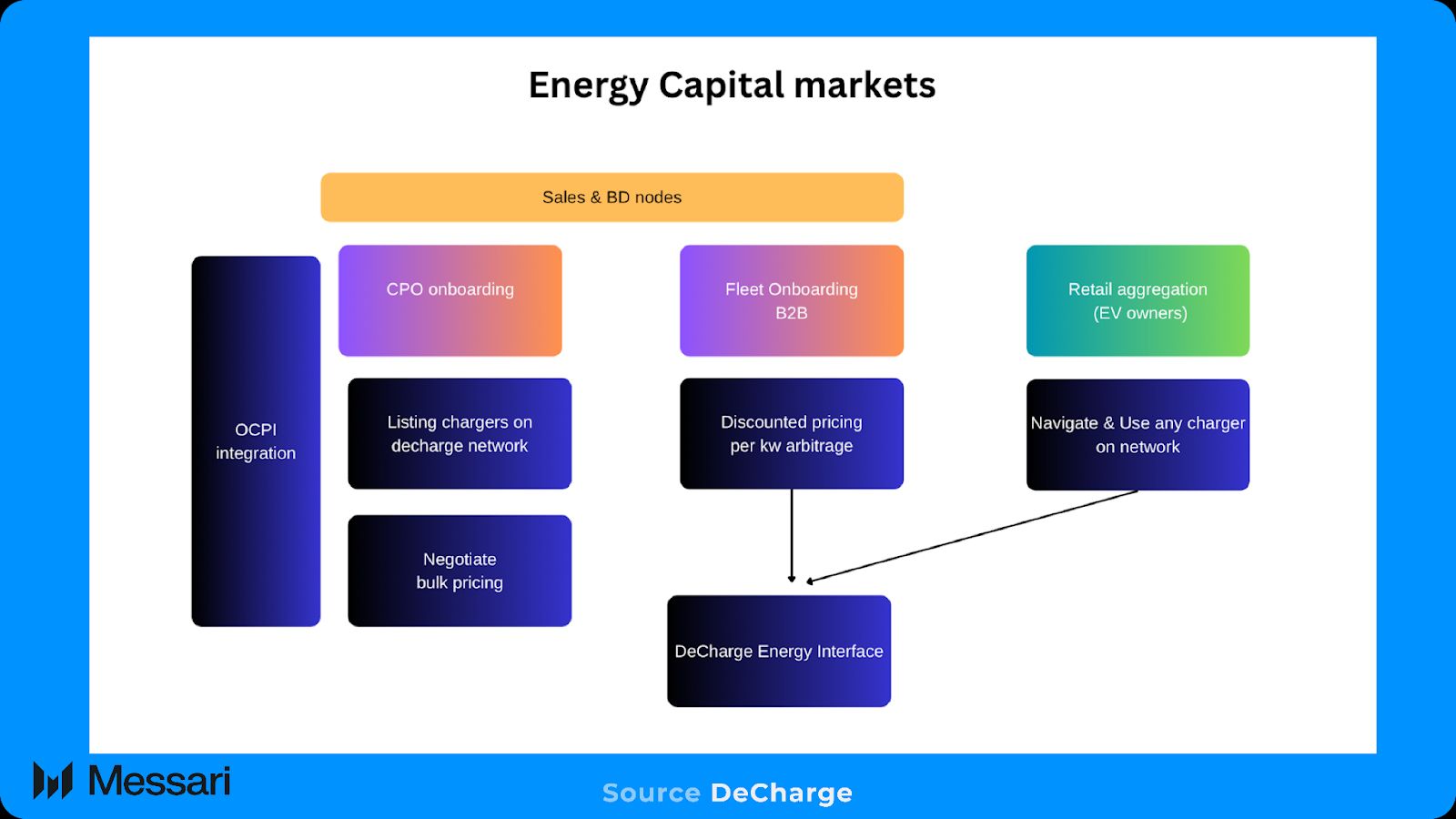
DeCharge describes an additional vertical focused on energy and capital coordination, extending beyond charger deployment. The DeCharge team believes the binding constraint in EV charging is working-capital coordination across fragmented demand (fleets, retail EVs) and underutilized charging point operator (CPO) capacity.
In this framing, DeCharge acts as an onchain coordination layer that aggregates charging demand, routes it to available capacity, and settles consumption onchain. Instead of financing chargers only as long-lived assets, DeCharge describes financing energy throughput and cycling capital as usage clears, with the goal of shortening payback cycles and improving utilization.
The closest analogy to this is cloud computing. AWS made cloud computing easier to finance and consume by standardizing it into metered, on-demand units, rather than making servers cheaper. DeCharge applies the same idea to EV charging by treating delivered energy as a throughput market that can be priced, financed, and settled programmatically, instead of underwriting each charger as a standalone asset with a long payback cycle.
DeCharge estimates the network currently routes roughly 25 MW of active charging capacity across fleets, retail locations, and underutilized CPO infrastructure. The team aims to scale this throughput layer to 100 MW, which it estimates could translate into $120 to $150 million in annual energy savings. Additionally, CHARGE utility is expected to extend to incentives and coordination for demand aggregation, including staking-gated access to higher-yield participation.
How does this fit Solana’s broader RWA thesis?
DePINFi aligns with Solana’s broader real-world asset (RWAs) thesis, which centers on using a high-throughput, low-cost blockchain to host yield-bearing, composable RWA positions. Solana’s RWA report already highlights yield-generating assets such as tokenized treasuries and credit as the dominant growth segment on the network. DeCharge extends this pattern to energy infrastructure by converting EV charging stations into Solana-native yield assets. DePINFi pools are positioned to become a “physical layer” in Solana’s emerging financial capital markets and a contributor to the vision of open capital markets for real assets.
CHARGE Token Generation Event
Although the CHARGE token is not yet live, DeCharge actively routes value and coordinates behavior through three core paths:
DeCharge Points: DeCharge Points are the network’s primary pre-token reward unit. Devices earn points for measurable contributions such as energy dispensed, uptime, reliability, deployment cohort, and geography, with higher rewards for consistently active chargers in priority locations.
Points accrue to the full set of contributors around a site, including device buyers, hosts, referrers, and selected partner projects, rather than only to hardware owners.
DeCharge frames points as convertible into future network incentives, rather than a closed, gamified metric, which positions the system as the de facto record of early contribution ahead of TGE.
Season Rewards: The network is segmented into Seasons, each with its own deployment goals, reward budget, and multipliers to gain additional points.
Seasonal point airdrops and reward boosts are allocated to specific deployment cohorts, ensuring that early or strategically important installations receive differentiated upside relative to later, lower-priority growth. This creates clear levels of contributors that can matter for future token distribution.
DePINFi Pools: DePINFi pool receipts are the capital-side primitive in the pre-token reward system. Contributors deposit stablecoins into project-specific DePINFi pools and receive tokenized claims on site cash flows.
Yield is directly tied to charger performance at funded sites, so returns reflect real utilization and uptime.
DeCharge’s infrastructure projects follow a throughput-based rule where, if no energy flows, no inflationary tokens are emitted. Tokens are only minted when a charging session occurs, kWh is dispensed through DeCharge-coordinated hardware, and the session data is verified (usage, uptime, device validity). This makes issuance a function of delivered service as compared to more traditional models based on time passing.
Emission rates fall as total network energy throughput accumulates. As the network’s total kWh power grows, the number of tokens minted per kWh decreases in predefined phases (“energy seasons”), so marginal issuance declines as usage increases. Early operators will earn more tokens per kWh to compensate for higher deployment risk and less utilization. Later operators will earn fewer tokens per kWh, but across a larger base of charging volume. In the intended end state, emissions trend toward low levels and the token’s role shifts toward coordination, governance, and staking-based access requirements.
Network Payment: A medium of exchange for protocol coordination and settlement, tied to energy throughput (kWh), including incentives and long-term governance.
Higher-Yield Participation: To access higher-yield participation in tokenized energy markets, participants must hold and stake tokens for the duration of their yield exposure.
Incentives: Emissions will be issued in response to verified real-world charging sessions and kWh dispensed, funding incentives for hosts, operators, and other network participants.
Governance: CHARGE will be used for protocol governance over emissions parameters, incentives, and treasury decisions.
Value Accrual: For each verified kWh dispensed, a nominal protocol fee is collected. A portion of these fees is used to acquire tokens from the open market or allocate them to protocol reserves, reducing effective circulating supply over time.
Together, these token utilities connect token demand to energy throughput, participation requirements such as staking, and governance.
Roadmap and Catalysts
In the near term, three catalysts are worth watching. First, the launch of native DeCharge DePINFi pools beyond Project Surya will demonstrate whether tokenized EV infrastructure raises are repeatable at the corridor and city scales. Second, execution on roadmap milestones, including Titan deployments and increasing solar retrofit kit adoption, should materially change the network’s site-level energy throughput and operating cost structure, which will shape future APR ranges and incentive budgets. Third, U.S. rollouts and the Tesla Owners SV partnership will test whether DeCharge’s DePIN model can scale beyond its initial footprint in India and attract sustained demand in more mature EV markets.
Closing Summary
DeCharge pairs a distributed EV charging network with Solana-native financing through DePINFi pools. These pools fund charger hubs with USDC or USDT, issue receipt tokens, and target stablecoin-denominated yield, funded by site charging revenue. The APR is intended to update using utilization and uptime data delivered via oracles. DeCharge frames the combined stack as “energy capital markets,” where onchain claims on charger cash flows can be funded and monitored in standard Solana wallets and DeFi dashboards, and potentially used in downstream DeFi integrations if secondary liquidity develops. The CHARGE TGE is planned for QX 2026 and will function as the network’s coordination token. Token emissions will be minted only on verified sessions and kWh delivered, and the tokens-per-kWh decrease will occur in correlation with usage growth. Additionally, CHARGE will be used for payments, staking-gated participation, governance, and routing protocol fees. DeCharge’s future traction depends on whether DePINFi pools can be launched repeatedly beyond early pilots, whether Titan deployments and solar retrofit kits change site throughput and operating costs, and whether U.S. rollouts produce sustained utilization in a more mature charging market.
This report was commissioned by DeCharge Network. All content was produced independently by the author(s) and does not necessarily reflect the opinions of Messari, Inc. or the organization that requested the report. The commissioning organization may have input on the content of the report, but Messari maintains editorial control over the final report to retain data accuracy and objectivity. Author(s) may hold cryptocurrencies named in this report. This report is meant for informational purposes only. It is not meant to serve as investment advice. You should conduct your own research and consult an independent financial, tax, or legal advisor before making any investment decisions. Past performance of any asset is not indicative of future results. Please see our Terms of Service for more information.
No part of this report may be (a) copied, photocopied, duplicated in any form by any means or (b) redistributed without the prior written consent of Messari®.