DAWN: Underwriting the Ramp

Introduction
DAWN's USD.infra Vault guides to ~12% and plans to hold 40-50% of assets in reserves. The venue does for small telecom and compute operators what USD.AI does for GPU buyers, lending them cash to build, and the loan is repaid out of the customer contracts the equipment already has signed. Structurally it is a non-yield-bearing stablecoin with full reserves, issued on M0, feeding a tokenized credit vault that holds those loans.
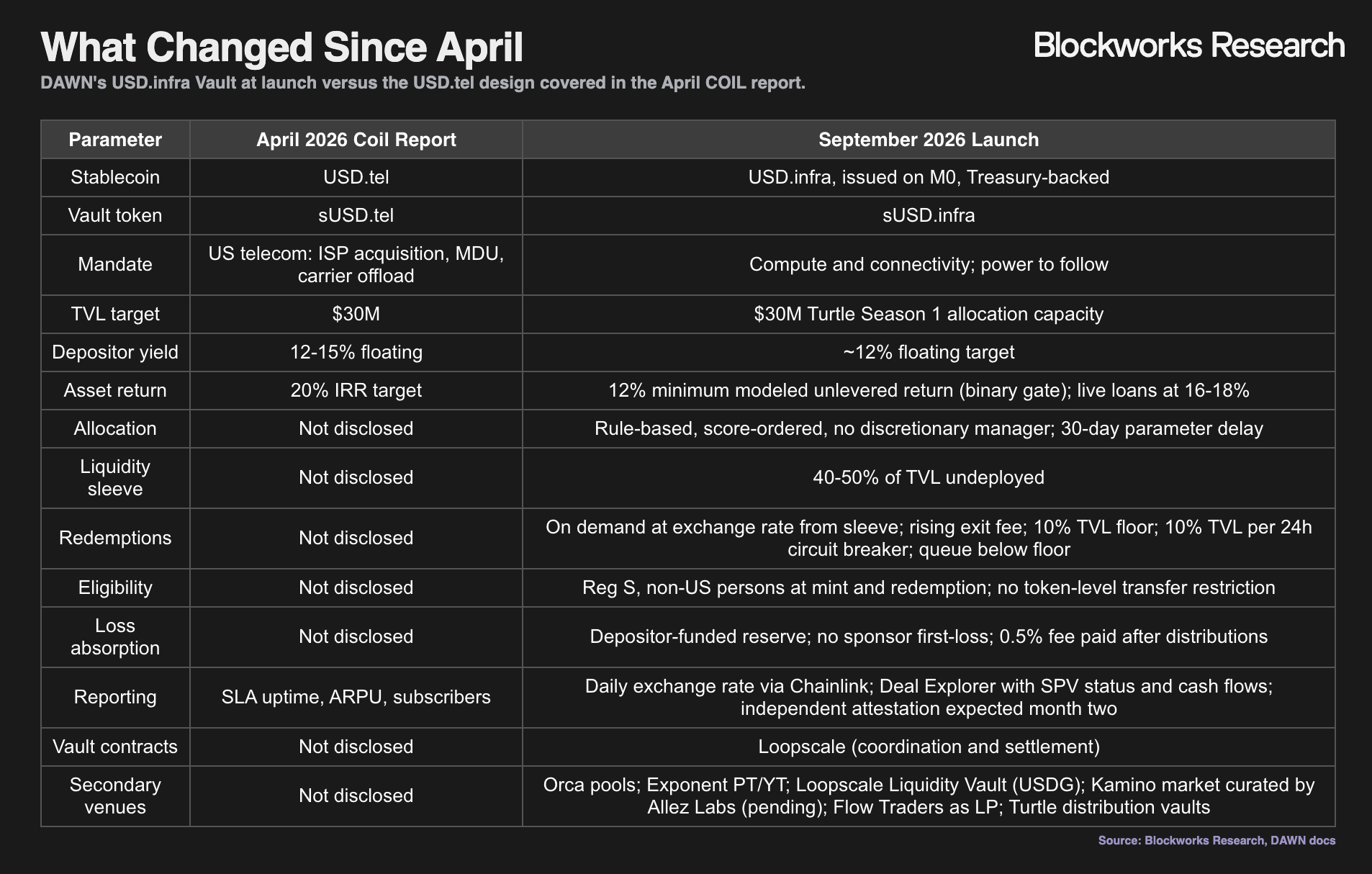
Depositors swap USDC for USD.infra, deposit it for sUSD.infra, and earn yield as operator SPVs repay amortizing loans. We covered an earlier prototype of this design in April under the name USD.tel. At the time the mandate was US broadband only; it now spans compute and connectivity, with power to follow. Primary participation and direct redemption are limited to non-US persons under Reg S, while secondary transfers stay open at the token level. The vault redeems on demand from a 40-50% reserve sleeve, behind a rising exit fee and a 10% floor, while the rest sits in four-to-seven-year amortizing paper. That structure reaches ~12% only at full deployment, and the pace of deployment sets what depositors earn in the meantime.
We have endorsed the thesis behind the vault. Traditional project finance walks away from deals below ~$50M. The operators locked out of that market hold signed contracts with paying customers, including managed Wi-Fi in apartment buildings on 10-year terms, regional ISP acquisitions, carrier offload agreements with T-Mobile and AT&T, and later GPU neoclouds and training CDNs. DAWN underwrites the contract instead of the borrower or the hardware.
What changed since April
In April we grouped DAWN with Daylight and Akash Starcluster as integrated DePIN financing. The protocol ran both the network and the financing layer, and the borrower used the infrastructure. The launch structure lends to operator SPVs against contracted revenue. Each project sits in its own bankruptcy-remote entity that holds title to the equipment and the contract behind it, with a servicer and an independent backup servicer under documented agreements for the life of the contract. That moves DAWN into the direct lending corner of COIL with USD.AI and GAIB, where we concentrated our constructive view because the credit structure is the most legible in the category. The April split between consumption-derived cash flows from end users and institutional cash flows from commercial operators no longer applies. The vault lends to an SPV, and the SPV's counterparty is a building owner, a carrier, or, on the deployment DAWN now markets, Titan Network's edge CDN business.

Nick leads coverage on the DePIN and Proof of Work sectors. Previously led research and engineering at a DePIN-focused accelerator.