Crypto’s Circadian Rhythm

An interesting anomaly in traditional markets is the difference between returns during trading hours and those accrued overnight. A buy and hold investor in the SPY ETF (which tracks the S&P 500 index) would have made over 7x on their investment since it began in 1993. However, if they had only held during market opening hours (between U.S. open and U.S. close) over the same period, they would have made no returns - all of the performance in the SPY ETF was generated overnight, between the previous day's close and the market open.
A key distinction between cryptocurrencies and traditional markets is the 24/7 nature of digital assets - unlike stocks, trading is not bound by exchange opening days and times. But even if tokens are global in nature, market participants are still beholden to differences in time zones and the need for sleep (though the average crypto trader may get less of it than most!). And when disaggregating the trading day to look like traditional market open hours (New York, London, Hong Kong), it becomes apparent that returns to holding cryptocurrencies do not accrue linearly over time.
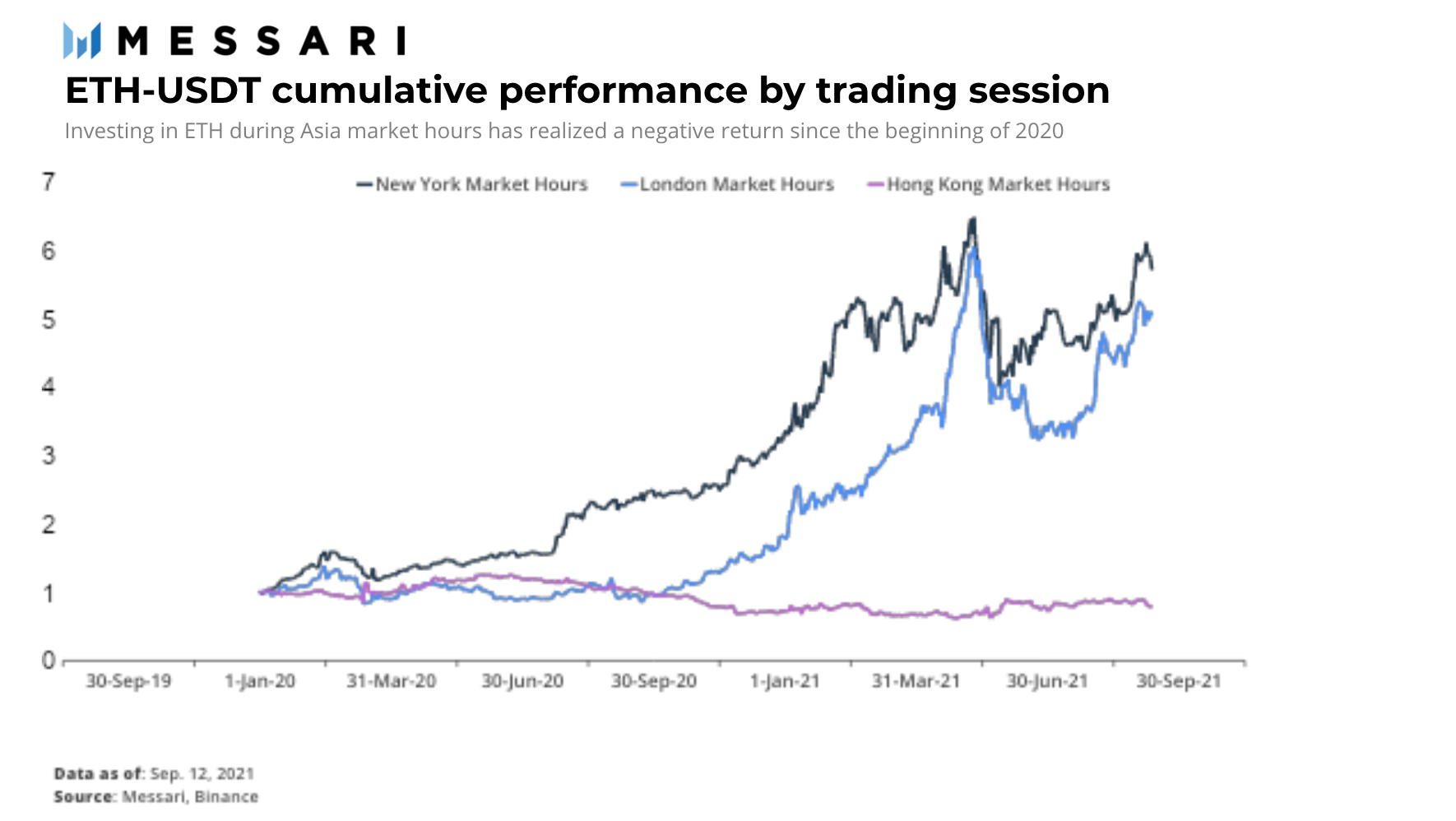
Were an investor to have held ETH since the beginning of 2020, they would have increased their initial investment over 26x (to 12 September 2021). However, if the same investor only held ETH during Hong Kong market hours, they would instead have realized a negative return. Conversely, if they had held ETH during New York or London market hours instead, they would have still captured a large proportion of the returns.
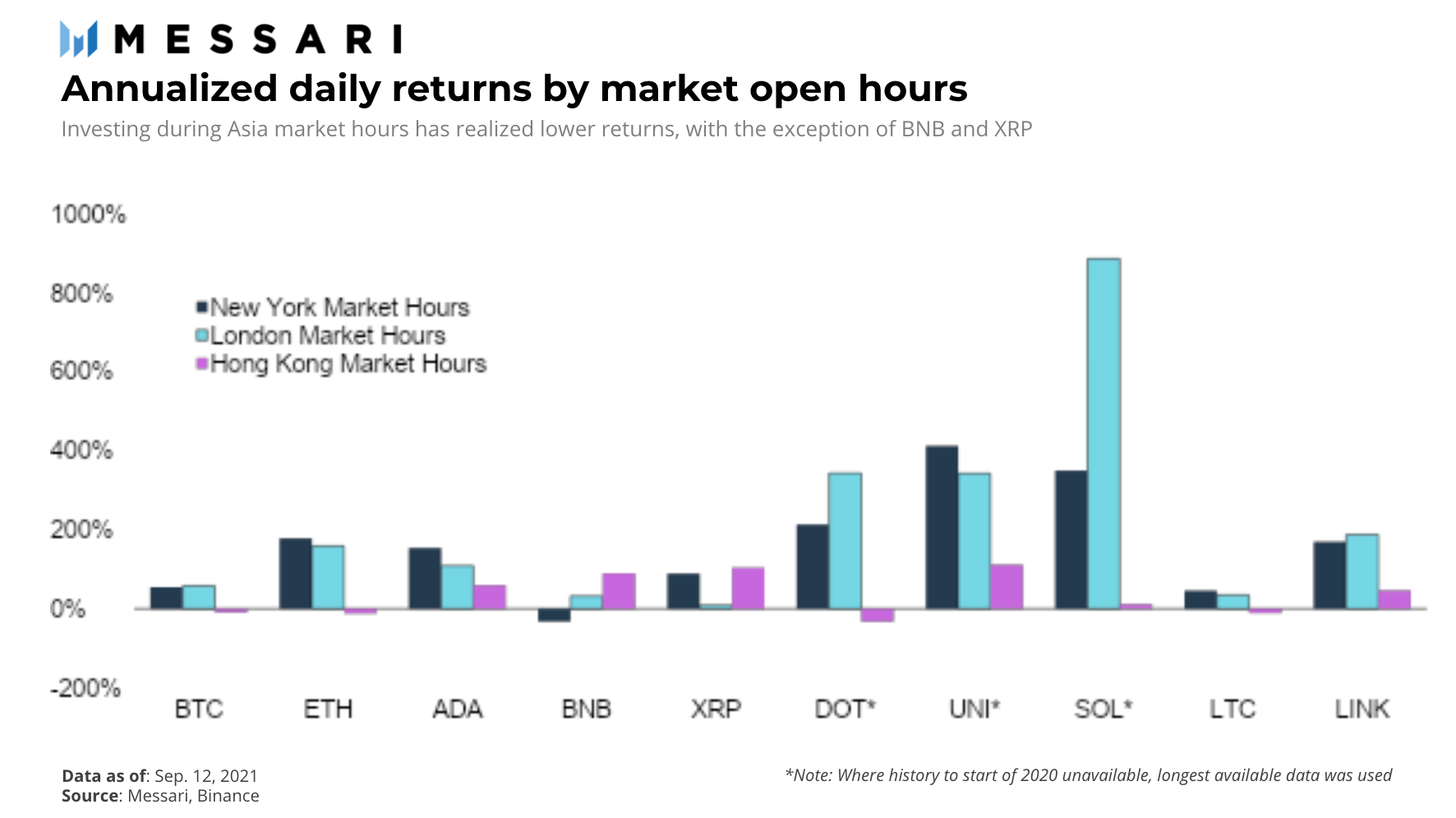
We have seen similar behavior across the majority of the largest coins during this period. With a couple of exceptions, the Asia trading session has broadly seen a significantly weaker performance, with negative cumulative returns in the cases of BTC, ETH, and LTC. In contrast, BNB appears to display the opposite pattern, experiencing extremely poor returns during U.S. market hours, whilst generating the majority of its gains when Hong Kong is open. Interestingly, XRP has seen its returns accumulate during the U.S. and Asia trading sessions but has been much weaker during London hours. In spite of the differences in the level of returns experienced by these assets during different trading sessions, correlations between the cryptocurrencies have been stable across all three trading sessions - they have co-moved around their trends in a similar way throughout the day.