Credit Protocols: DeFi's Next Step

The lending of cryptoassets is one of the key on-chain DeFi financial primitives. Three of the top ten protocols by TVL – MakerDAO, Aave and Compound – are decentralized lenders, accounting for over 30% of all DeFi TVL. As credit checking pseudonymous users is far from easy on the blockchain, early lenders scaled by restricting borrowing to those who could overcollateralize their loans with liquid tokens. For example, to borrow and mint DAI, a user must deposit ETH with a market value of at least 170% of the DAI loan. Such fully secured mark-to-market lending has provided a few successful use cases for DeFi, including margin lending, capital gains avoidance and borrowing for short sales.
TradFi, on the other hand, is largely based on trust and credit. Banks traditionally hold intraday balances owed to each other in the billions. On a smaller scale, most of our individual online transactions are only settled when we pay our credit card bill. DeFi's potential to replace elements of traditional finance will only be realized when its lending industry can expand beyond overcollateralized loans. Additionally, as cryptoasset investment use cases are limited, lending growth will depend on the degree to which real world assets can be used as a valid form of collateral. DeFi founders have recently taken up the challenge, with a plethora of approaches to credit-based lending beginning to launch.
With the ability to support credit using more than just over collateralized on-chain assets, DeFi lending can expand to undercollateralized and even fully uncollateralized use cases, threatening the TradFi monopolies. Existing fintech platforms could utilize blockchain-based lending technology without the end user even knowing they are using DeFi protocols. Though their potential is almost unlimited, credit protocols are a long way behind overcollateralized DeFi.
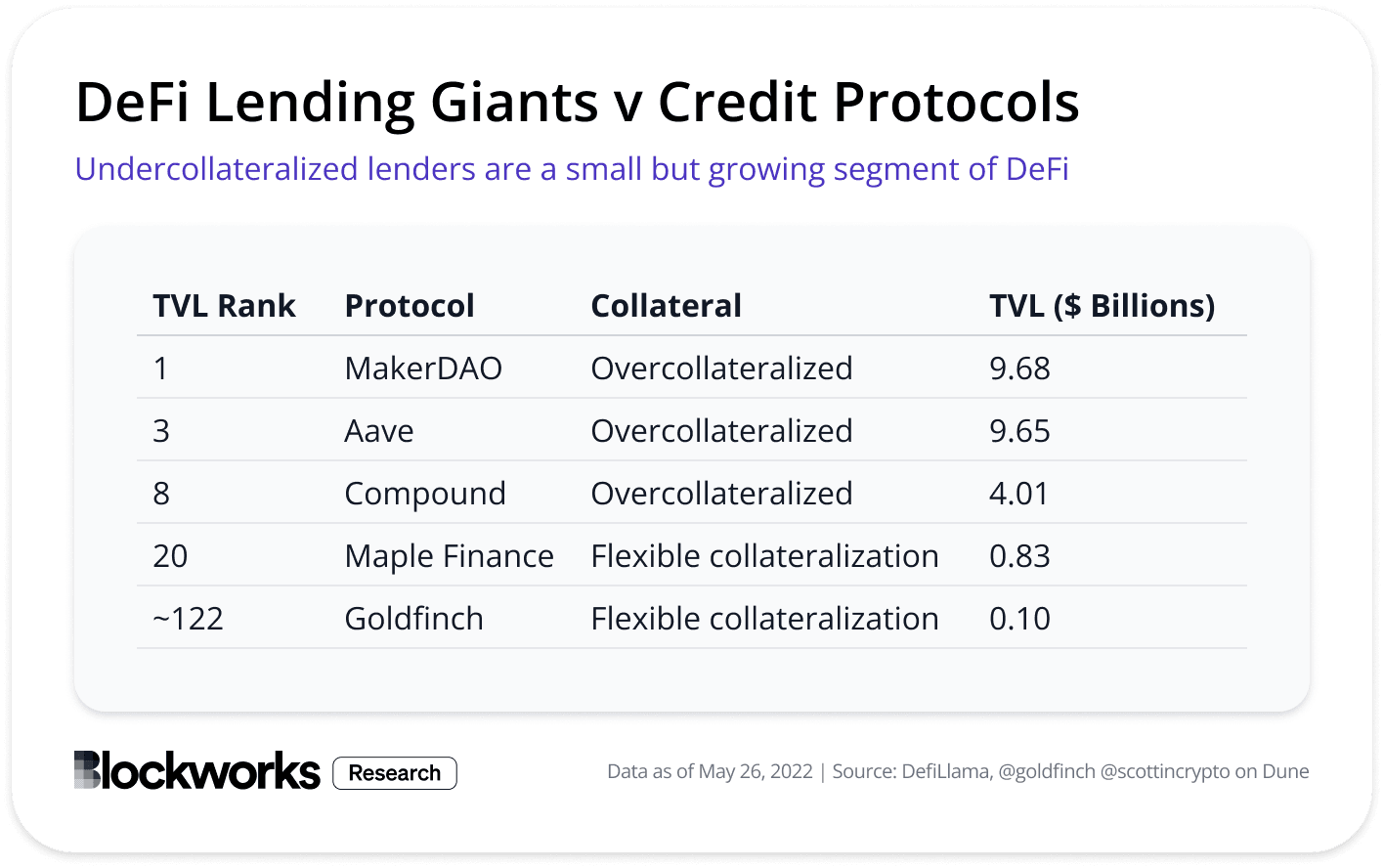
Note - Maple currently has one partially collateralized loan (1.3%).
Here we present three of the earliest credit protocols, each with a unique approach to decentralized lending.

Matt leads coverage on DEXs, derivatives, governance, and the Avalanche ecosystem. Previously he worked as an Analyst at Ikigai Asset Management and Teller Finance.