Coinbase Public Listing: Key Highlights and Valuations

Last week, Coinbase moved closer to a direct listing as its S1 filing became public, including the company’s financials. This year has seen institutional adoption and mainstream credibility in the crypto space. According to Coinbase, they promote economic freedom by building a safe, trusted, and easy-to-use platform that helps people access the crypto economy across 100 countries.
In this follow-up to our initial report on Coinbase’s history, company overview, and valuations, we look at the updated disclosures, detail more valuation methods, and highlight risks to the business.
Business Operations
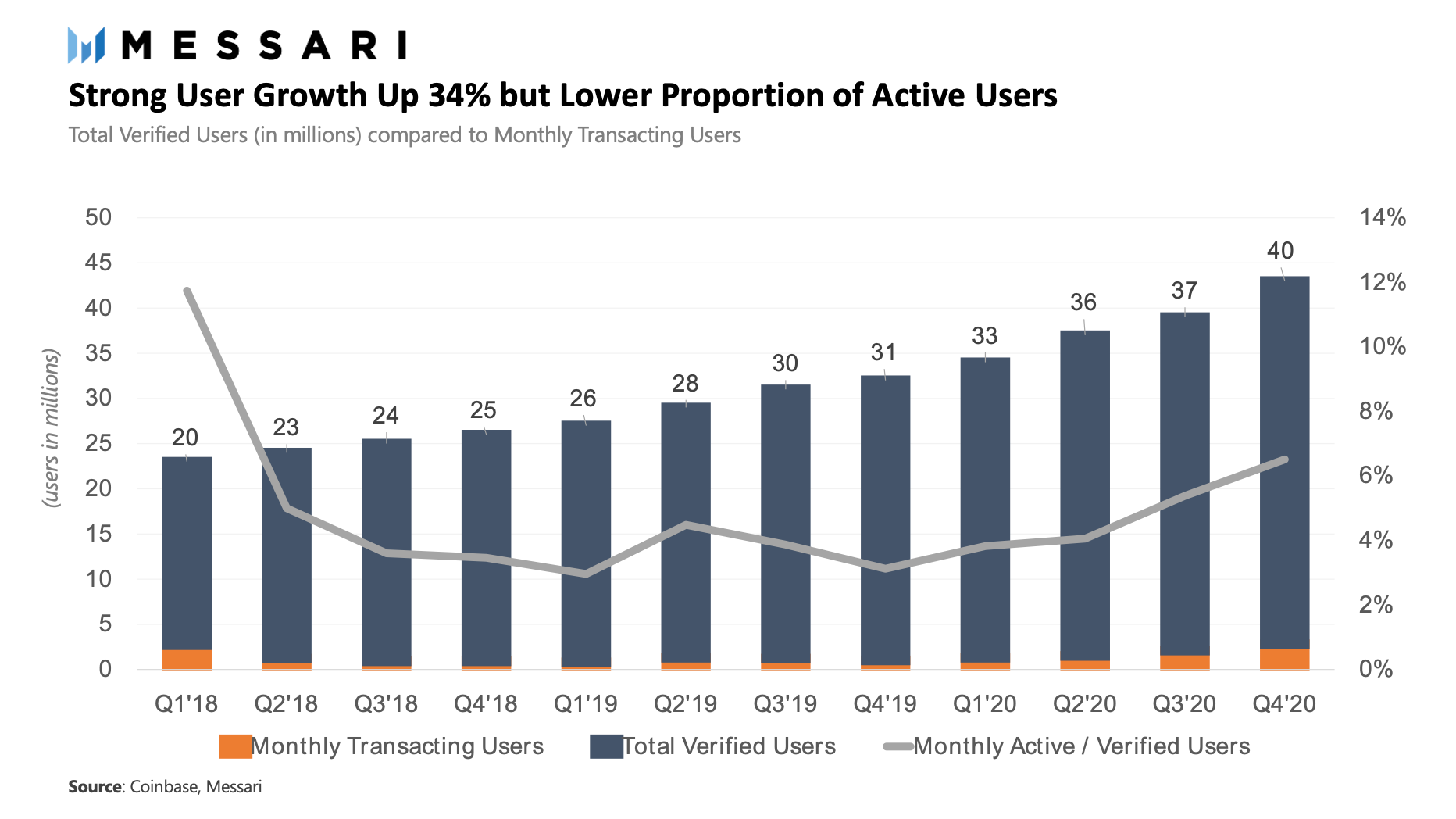
Coinbase has come a long way since its launch in 2012, with a seed investment from Y Combinator. It now has 2.8 million monthly active users and 43 million verified users, as one of the most prominent cryptocurrency exchanges in the world. While user growth is high, the number of active users has only recently surpassed Q1’2018 levels by just 3%.
Coinbase is perhaps one of the first public, or soon to be public, companies to declare that they are a remote-first company without executive offices (although they still have physical offices). This is a growing trend in the crypto sector that might be helpful for recruiting, regulatory flexibility, and company security.
While users primarily use Coinbase for buying and selling crypto, the exchange disclosed that 21% of retail users also engage in at least one non-investing product like borrowing, lending, staking, or other protocol participation. That could mean that Coinbase may increasingly participate in decentralized finance (DeFi) to capture this market.

Mira was a Senior Research Analyst at Messari. Prior to joining Messari, Mira was a Senior Portfolio Manager for a US$6 billion Asia Pacific equities fund at APG Asset Management. Mira received a BA in Economics and Mathematical Methods in the Social Sciences from Northwestern University.