CoW Protocol Update

If you are unfamiliar with the CoW Protocol, we recommend checking out our prior report which dives into CoW at a deeper level. As a brief refresher, CoW Protocol utilizes batch auctions that rely on solvers in order to give users looking to swap assets better price execution with MEV protection by efficiently matching orders from an offchain mempool. The DAO has been quietly testing fee mechanisms since the passing of CIP-34 in mid-January 2024, with the momentum picking up recently upon the passing of CIP-38 on March 1, 2024. As it stands today, the CoW protocol collects fees from users and reimburses solvers for the gas they paid settling orders, but this can result in fees not always being returned to users correctly and also introduces complexity to the protocol by forcing it to monitor solver actions.
CIP-38 alleviates these problems by removing the protocol fee charged to users that is subsequently passed onto solvers based on their respective surplus rank relative to other solvers, and replacing it with a fee charged to all block builders receiving MEV Blocker enabled transactions on a per-block won basis. The per-block won fee will be equal to 20% of the average per-block value of MEV Blocker transactions that were settled over the past month. The take rate (20%) and period measurement (1 month) are subject to change, and the balance owed will be tracked offchain, reinforced by public Dune queries for full transparency, and settled once per week to a dedicated Gnosis safe. Block builders must meet some technical requirements in order to receive flow from MEV Blocker, such as building at least 1% of blocks over the preceding period (1 month) and sending all blocks to the Agnostic MEV-Boost relay for the sake of data analysis.
The hope from the perspective of the COW DAO is that most builders will remain connected to MEV Blocker, thus lowering the bids all builders submit on Ethereum for blocks and ultimately the value of MEV that flows to validators/stakers. This appears to be the most likely outcome considering the fact that MEV Blocker enables the creation of higher value blocks, but it is unclear how the 20% fee charged to builders will affect the number of participants. Perhaps the key takeaway for investors is the caveat that the payments made to the aforementioned DAO-owned Gnosis safe will be made in COW tokens, therefore providing a new source of buy pressure on a low liquidity, low volume governance token. The deepest liquidity pool with ETH as the other side of the pair is on Balancer V2, but only has $1.3M of liquidity. Therefore, we believe that even a small amount of systemic buy pressure on the COW token occurring weekly could lead to price appreciation over time. It is worth noting that CIP-37, which passed in mid February, aims to slightly improve liquidity by selling 2.5M COW tokens from the DAO treasury for ETH and using the proceeds as well as an additional 139 ETH from the treasury to provide liquidity exclusively available to CoW Protocol Solvers. However, this isn’t a significant amount of money, so we do not expect it to have a significant impact on COW’s onchain liquidity dynamics. This proposal was enacted in order to improve COW liquidity, but also to test the Cow DAO’s new product, CoW AMM, which helps protect LPs against LVR.
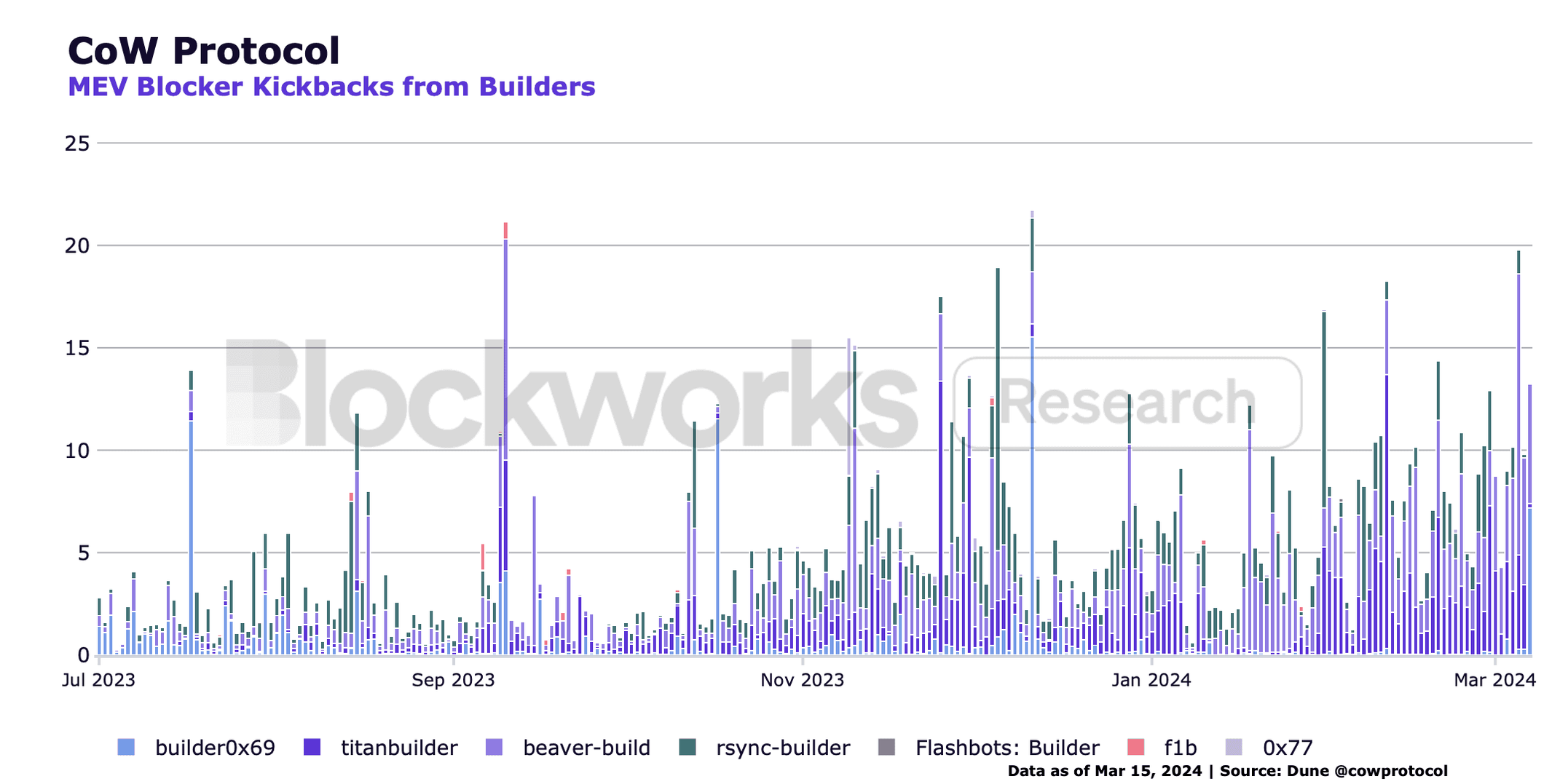
Since the beginning of 2024, MEV Blocker has generated an average of ~6.88 ETH in kickbacks per day from builders, or roughly $28k, which can be seen in the below chart. This would result in ~$2M of additional COW buy pressure over the next 12 months ($28k*365 days*0.20 DAO take rate), but we actually expect this value to grow given the increase in economic activity occurring onchain, more MEV Blocker integrations, and the rise of solver based DEX volume. On the last point, solver based-DEX volume across frontends has grown from less than 10% in 2022 to over 25% in 2024. Additionally, there is discussion on the forums for developing an L2/cross chain strategy, but these conversations have mostly stalled out. The main hesitation with additional deployments comes down to added complexity for solvers, who serve as the life blood of the entire protocol. We do not expect advancements on an L2 strategy to be fast moving.
The COW token buybacks proposed in CIP-38 will begin March 26, 2024, and market participants are widely unaware given the lack of liquidity available for COW and the small size of the protocol’s revenue. However, COW sits at just a ~$90M market cap and $420M FDV, which is substantially lower than competitors like 1INCH or UNI which have market caps of $675M and $9.5B, respectively. We view COW as a bet on MEV-aware infrastructure, a renewed focus on COW tokenomics/value accrual, the rise of intent-based architectures, and a value play relative to the protocol’s competition as onchain DEX activity continues its upward trend with solver-based solutions growing in dominance. The primary risk to COW is the rise of alternative solutions that combat MEV with a well-defined L2 strategy, especially considering a vast majority of Ethereum activity is expected to move away from the base layer and up to rollups over the long term.

Sam leads coverage on Ethereum, L2s, Aave, Compound, as well as NFTs and gaming. Previously worked on a hedge desk at UGC.