Chronology of Federal Reserve Actions (Free Version)

This article was originally published for Messari Pro subscribers but has been made freely available for all readers due to popular demand.
Start your free trial for Messari Pro today and access all of our industry leading research and data analytics tools.
-----
I’ve always jokingly said that the Chairman of the Federal Reserve is the most powerful person in the world.
There’s some truth to that. Every time Jerome Powell talks, he can create, destroy, or transfer trillions of dollars of global wealth at the snap of his fingers. He’s the Thanos of modern finance.

We should give the Federal Reserve credit where credit is due, however. Yes, some of their recent actions are morally questionable. But most of them are necessary to the smooth functioning of the economy and the market. And all of them will definitely impact your wallet and your business in one way or another.
In fact, I would argue that understanding what the Fed is doing is the most important thing you can do for your financial well-being.
So let’s begin the journey...
03/03 - Federal Funds Rate
What they did: Federal funds rate cut from 1.5-1.75% to 1-1.25%
Why it matters: The federal funds rate is the target interest rate set by the Fed at which banks lend to each other overnight. It’s arguably the most important interest rate in the world, as it propagates throughout the rest of the economy. To business loans. To mortgages. To auto loans. To credit cards. Even to the stock market. Lowering this benchmark rate means cheaper borrowing costs, and therefore potentially more willingness to spend and to invest.
Historical context: The federal funds rate has been the most important monetary policy tool. Changes in the federal funds rate are usually announced at regularly scheduled FOMC meetings. This particular one, however, was announced between meetings, as the Fed realized the urgency of the situation. This was the first emergency cut since the 2008 financial crisis.
03/09 - Repo operations
What they did: 1-month and 3-month repo offerings expanded to $500B each.
Why it matters: “Repo” is a form of short-term financing collateralized with government securities. It’s in many ways the grease for the gears of the economy, as the important actors of the economy use this market for short-term liquidity needs. By intervening in the repo market the Fed aims to support the smooth functioning of short-term fundings.
Historical context: The repo market involves many of the same banks that participate in the federal funds market, but also non-financial corporations, governments, and dealers. Because they are by definition and in practice so closely related, the two markets typically trade in line with each other. However, in September 2019, the repo rate spiked to as high as 10% while the fed fund rate remained unchanged. There are many theories as to why this occurred, but what matters ultimately is that the Fed brought the rate back down by directly providing repo to private institutions. Many criticized this Fed intervention as they claimed it was really QE in disguise. As we will see, there are some key differences between repo and QE.
03/15 - QE4
What they did: $700B liquidity injection via purchase of $500B of Treasury securities and $200B of agency MBS.
Why it matters: QE is partly designed to boost long-term borrowing by depressing long-term interest rates, as treasuries and MBSs that are eligible for the program are typically long-term securities. This is a key aspect in which QE is different from the federal funds rate and the repo operations, both of which aim at supporting short-term borrowing.
Historical context: QE is a monetary experiment that was first launched in the 2008 financial crisis. Many expected QE to lead to inflation. However, empirically, it did not. Instead it got trapped in financial markets, which helped boost asset prices. Going forward, QE will likely become less effective as long-term interest rates are already near zero.
03/15 - Federal Funds Rate
What they did: The federal funds rate cut again, from 1-1.25% to 0-0.25%.
Why it matters: The Fed quickly concluded that a 0.50% cut from two weeks ago was not enough.
Historical context: This is the largest single-day cut in the Fed's more than 100-year history.
03/15 - Discount Window
What they did: The discount window rate cut from 1.75% to 0.25%.
Why it matters: While the federal funds rate is the rate at which banks lend to each other, the discount window rate is the rate at which the Fed offers to lend to banks. The Fed typically sets the discount window rate higher than the federal funds rate. In fact, at the upper bound of the federal funds rate. This is to encourage banks to lend to each other, and only turn to the Fed when they are unwilling to lend to each other during times of stress. Essentially, the Fed acts as the lender of last resort to banks.
Historical context: Historically, banks are reluctant to use the discount window because it is a sign of weakness. This time, the Fed explicitly encouraged banks to not worry about the stigma and to take advantage of the discount window.
03/15 - Reserve Requirement
What they did: Reserve requirement cut to 0%.
Why it matters: The reserve requirement is the amount of money that a bank must have in its account at the Fed, as a percentage of deposits made by their customers. Abolishing this requirement frees more liquidity that banks can use to lend to their customers.
Historical context: The reserve requirement can be viewed as a monetary policy tool, as it influences broad monetary supply. Previously, the reserve requirement was 10%. However, reducing this to 0% does not mean that banks are allowed to create unlimited credit, as they are also constrained by capital requirements.
03/15 - FX Swap Lines
What they did: FX swap lines established with 5 foreign central banks including the ECB and the BOJ. Rates cut to OIS + 0.25%.
Why it matters: During times of stress, governments, companies, and households around the world tend to sell other assets into the USD as they view it as a safe haven. However, a knock-on effect of a stronger USD is that the trillions dollars of USD-denominated debt held by foreign entities become more expensive to service. As global trades slow down, these entities either have to sell even more assets including US treasuries and stocks or go bankrupt which indirectly hurt Americans. As such, it’s in the Fed’s best interest to provide short-term loans to foreign entities via FX swap lines to alleviate their liquidity stress.
Historical context: In the 2008 financial crisis, the Fed established FX swap lines with 14 major foreign central banks. These are standing facilities that have remained in place until today. This is why you should pay close attention to what the Fed does even if you are not American. Because the Fed is not just the central bank of the US. It truly is the central bank of the world.
03/17 - Primary Dealer Credit Facility (PDCF)
What they did: The PDCF offers 90-day loans to US primary dealers, collateralized with a wide range of securities.
Why it matters: Primary dealers are firms that buy government securities directly from the government and resell them. Primary dealers and banks aren’t the same, but are often overlapped, such as Goldman Sachs, JP Morgan, etc. By providing loans that can be collateralized with all sorts of securities, the PDCF essentially allows these large financial institutions to temporarily sell these securities to raise cash. These institutions can then use that liquidity to provide loans to businesses and households. The wide range of collateral eligible for the PDCF is what largely differentiates it from repo operations.
Historical context: The PDCF was first established in the 2008 financial crisis.
03/17 - Commercial Paper Funding Facility (CPFF)
What they did: The CPFF directly purchases 3-month commercial paper (CP) from US issuers with the highest short-term credit ratings. This is enabled by a $10B investment from the Treasury.
Why it matters: CPs are short-term unsecured debt issued by corporations, including non-financial corporations. Essentially, the Fed acts as the lender of last resort to large companies that experience 1) short-term liquidity stress due to the pandemic shutdown and 2) difficulty to raise liquidity in private markets due to a generally lower risk appetite.
Historical context: The CPFF was first established in the 2008 financial crisis.
03/18 - Money Market Mutual Fund Liquidity Facility (MMLF)
What they did: The MMLF offers short-term loans to US banks, collateralized with a wide range of securities. This is enabled by a $10B investment from the Treasury.
Why it matters: TheMMLF is similar to the PDCF, but is offered to all US banks instead of just primary dealers.
Historical context: The MMLF was arguably established in the 2008 financial crisis under a different name, the Asset-Backed Commercial Paper Money Market Mutual Fund Liquidity Facility (AMLF).
03/19 - Expanded FX swap lines
What they did: FX swap lines expanded to 9 additional central banks.
Why it matters: While the original 5 central banks are all developed economies, these 9 new central banks include some of the most important emerging markets, such as Mexico and Brazil. In fact, emerging markets tend to get hit harder in recessions, and therefore experience greater USD shortages.
Historical context: With these 9 new swap lines and the 5 announced four days ago, all 14 that were established in 2008 are now back up.
03/23 - Term Asset-Backed Securities Loan Facility (TALF)
What they did: The TALF offers $100B worth of 3-year loans to US companies, collateralized with asset-backed securities (ABS).
Why it matters: ABSsare bonds backed by auto loans, student loans, and credit cards, etc. By buying these ABSs, the Fed indirectly supports loans for auto buyers, students, and credit card users.
Historical context: The TALF was first established in the 2008 financial crisis.
03/23 - Primary Market Commercial Credit Facility (PMCCF)
What they did: The PMCCF buys up to $300B worth of Investment Grade corporate bonds at issuance.
Why it matters: Investment Grade is a rating that signifies a relatively low risk of default. The PMCCF aims to support low-risk companies that aren’t able to access the CPFF. It’s also not limited to short-term loans like the CPFF is.
Historical context: The PMCCF is a new program. In other words, this is the first time the Fed directly buys corporate bonds.
03/23 - Secondary Market Commercial Credit Facility (SMCCF)
What they did: The SMCCF buys up to $300B worth of Investment Grade corporate bonds and corporate bond ETFs in secondary markets.
Why it matters: The key difference between the SMCCF and the PMCCF, as their names suggest, is that the SMCCF buys corporate bonds in secondary markets. This is where the controversy arises, as many people argue that the Fed is really optimizing for asset prices.
The counter-argument to that is that any stress in secondary markets can easily spill over into primary markets, so the Fed’s intervention in secondary markets may be justified.
Historical context: Just like the PMCCF, the SMCCF is a new program.
03/23 - QE Unlimited
What they did: Treasury and MBS purchases “in the amounts needed to support smooth market functioning and effective transmission of monetary policy to broader financial conditions.”
Why it matters: As far as asset prices are concerned, QE unlimited is the ultimate bazooka. This marked the bottom of the SPX at 2,200.
Historical context: The US is closely following the steps of Japan...
03/31 - FIMA Repo Facility
What they did: The FIMA repo facility offers overnight repos to non-US central banks and other monetary authorities.
Why it matters: Similar to FX swap lines, the FIMA repo facility provides USD liquidity to non-US monetary authorities, in hopes that they will be able to in turn provide the much needed liquidity to their domestic businesses. In contrast to FX swap lines which are only open to 14 central banks, the FIMA repo facility is available to over 200 international monetary authorities that have accounts at the Fed.
Historical context: The FIMA repo is a new program, which highlights the unprecedented issue of global USD shortages.
04/09 - Municipal Liquidity Facility (MLF)
What they did: The MLF buys up to $500B of municipal bonds at issuance from states, cities with more than 1,000,000 residents, and counties with more than 2,000,000 residents.
Why it matters: The MLFhelps local governments manage the cash flow impact of the extension of the income tax filing deadline, tax reductions, and expense increases resulting from the pandemic. An example of state expenses is unemployment insurance. While the MLF participates in primary markets, it also indirectly boosts the price of secondary markets.
Historical context: The MLF is a new program.
04/09 - Paycheck Protection Program Lending Facility (PPPLF)
What they did: The PPPLF provides $359B of financing to banks that ultimately lend to PPP-eligible US small businesses.
Why it matters: The PPP is a loan authorized by Congress that helps small businesses keep their workforce employed during the pandemic. Small businesses account for as much as 50% of the US GDP.
Historical context: The PPPLF is a new program established specifically for the pandemic.
04/09 - Main Street New Loan Facility (MSNLF) and Main Street Expanded Loan Facility (MSELF)
What they did: The MSNLF and the MSELF offer $600B of loans to businesses with less than 10,000 employees or less than $2.5B in annual revenues.
Why it matters: While the PPP targets small businesses, the MSNLF and the MSELF primarily target medium-sized businesses that may not be eligible for the PPP.
Historical context: The MSNLF and the MSELF are new programs.
04/09 - Expanded PMCFF and SMCCF
What they did: The PMCFF and SMCFF expanded their scope from Investment Grade corporate bonds to eligible High Yield corporate bonds, also known as junk bonds. (Specifically, companies that recently got downgraded from Investment Grade to Junk are eligible.)
Why it matters: The Fed dipping its toes into junk bonds is what truly outraged many people. The PMCFF may be justified as it provides loans at issuance, but the SMCFF blatantly pushes up junk bond prices in secondary markets. Inflated junk bond markets ultimately translate into inflated stock markets due to lower perceived credit risks.
Historical context: Unprecedented. And the public outrage is understandable.
04/09 - Expanded TALF
What they did: The TALF expanded its scope from ABS to collateralized loan obligations (CLO) and commercial mortgage-backed securities (CMBS).
Why it matters: CLOs are often corporate loans made by private equity firms. CMBSs, as the name suggests, are related to commercial real estate. In other words, the Fed is trying to support private equity and real estate industries too.
Historical context: No historical precedent. Alongside corporate bonds, municipal bonds, consumer loans, repos, treasuries, the Fed is trying to seize the entire US bond and credit market.
04/27 - Expanded MLF
What they did: The MLF expanded its scope to cities with at least 250,000 residents and counties with at least 500,000 residents.
Why it matters: It’s unclear why larger cities and counties are prioritized, when smaller cities and counties tend to face greater financial difficulties.
Closing Remarks
If you managed to make it all the way here, you may have realized that the vast majority of the so-called Fed bailout programs aren’t free money. They are loans. In fact, as far as I know, the subset of these programs that were established in 2008 have been fully paid back.
Taking this into account, is there really that much of a moral hazard? Are we as a society really bailing out large corporations at the expense of individuals and small businesses? I don’t think the answer is quite black and white.
I do find junk bond purchases in the secondary market morally questionable. However, so far the Fed managed to support junk bond prices, and by extension related asset prices, by merely announcing the program and not actually spending a dime.
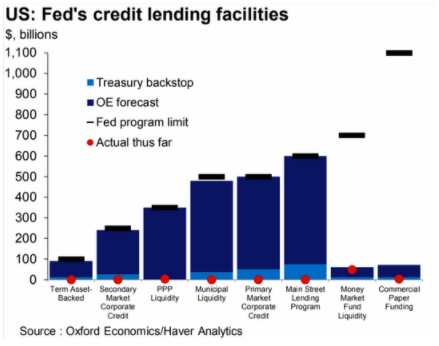
We also have no idea - and the Fed acknowledges it - how these unprecedented monetary experiments will impact the economy in the long run. How do we deal with the growing inequality resulting from asset purchases? How will future generations pay all these public liabilities? The Fed may or may not have already destroyed the future of America. But as far as dealing with this particular recession is concerned, I would give the Fed an A.
Many people in the crypto space would argue for a laissez-faire approach vs. heavy government interventions. I’m not ideologically married to either, and I think both have their shortcomings.
The laissez-faire approach assumes that the market is rational, efficient, and can take care of itself. Arguably, this is not the case in times of crisis. As you may have observed, animal spirit and herd behavior can take over the entire humanity within the span of a few weeks.
Case in point, a stock market crash causes people to feel poorer. They will tighten their belt, which may in turn lead to a deflation in the prices of consumer goods. This may in turn lead to a decrease in nominal incomes of producers of these goods. These producers may in turn feel more stress in life even if their real income hasn’t changed. And they panic-sell their stocks. A deflationary vicious circle.
And when 30% of the society loses their jobs, there will be social unrest. Especially in a country with 400M guns. Socializing some losses and helping these 30% get back on track benefits the other 70% too.
I would then argue that the role of central banks is 1) most of the time to let the market alone 2) when the market occasionally stops functioning to fight these collectively irrational behaviors.

Suggested Research Based on your Watchlists
Create a new watchlist
- 03/03 - Federal Funds Rate
- 03/09 - Repo operations
- 03/15 - QE4
- 03/15 - Federal Funds Rate
- 03/15 - Discount Window
- 03/15 - Reserve Requirement
- 03/15 - FX Swap Lines
- 03/17 - Primary Dealer Credit Facility (PDCF)
- 03/17 - Commercial Paper Funding Facility (CPFF)
- 03/18 - Money Market Mutual Fund Liquidity Facility (MMLF)
- 03/19 - Expanded FX swap lines
- 03/23 - Term Asset-Backed Securities Loan Facility (TALF)
- 03/23 - Primary Market Commercial Credit Facility (PMCCF)
- 03/23 - Secondary Market Commercial Credit Facility (SMCCF)
- 03/23 - QE Unlimited
- 03/31 - FIMA Repo Facility
- 04/09 - Municipal Liquidity Facility (MLF)
- 04/09 - Paycheck Protection Program Lending Facility (PPPLF)
- 04/09 - Main Street New Loan Facility (MSNLF) and Main Street Expanded Loan Facility (MSELF)
- 04/09 - Expanded PMCFF and SMCCF
- 04/09 - Expanded TALF
- 04/27 - Expanded MLF
- Closing Remarks