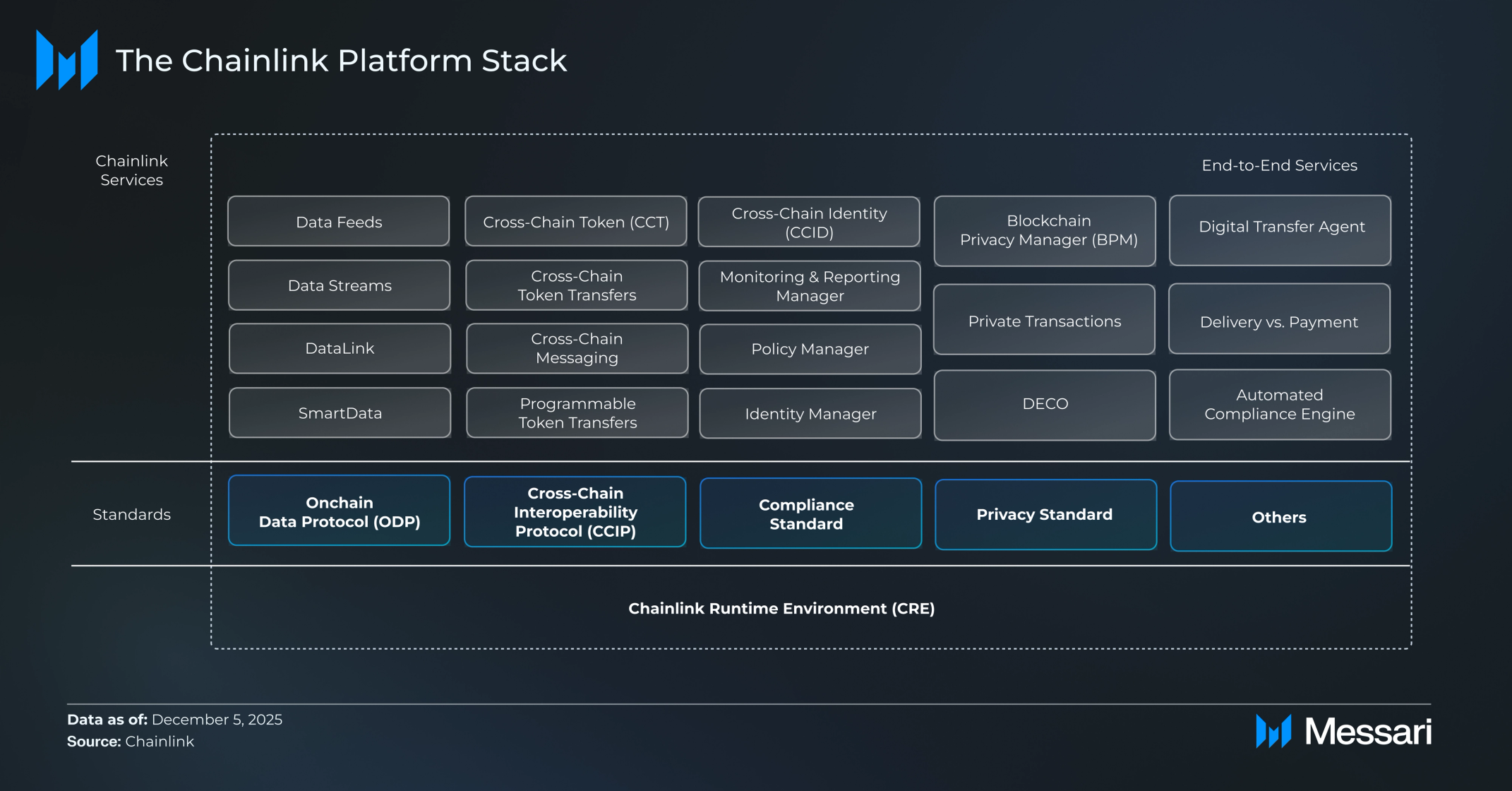
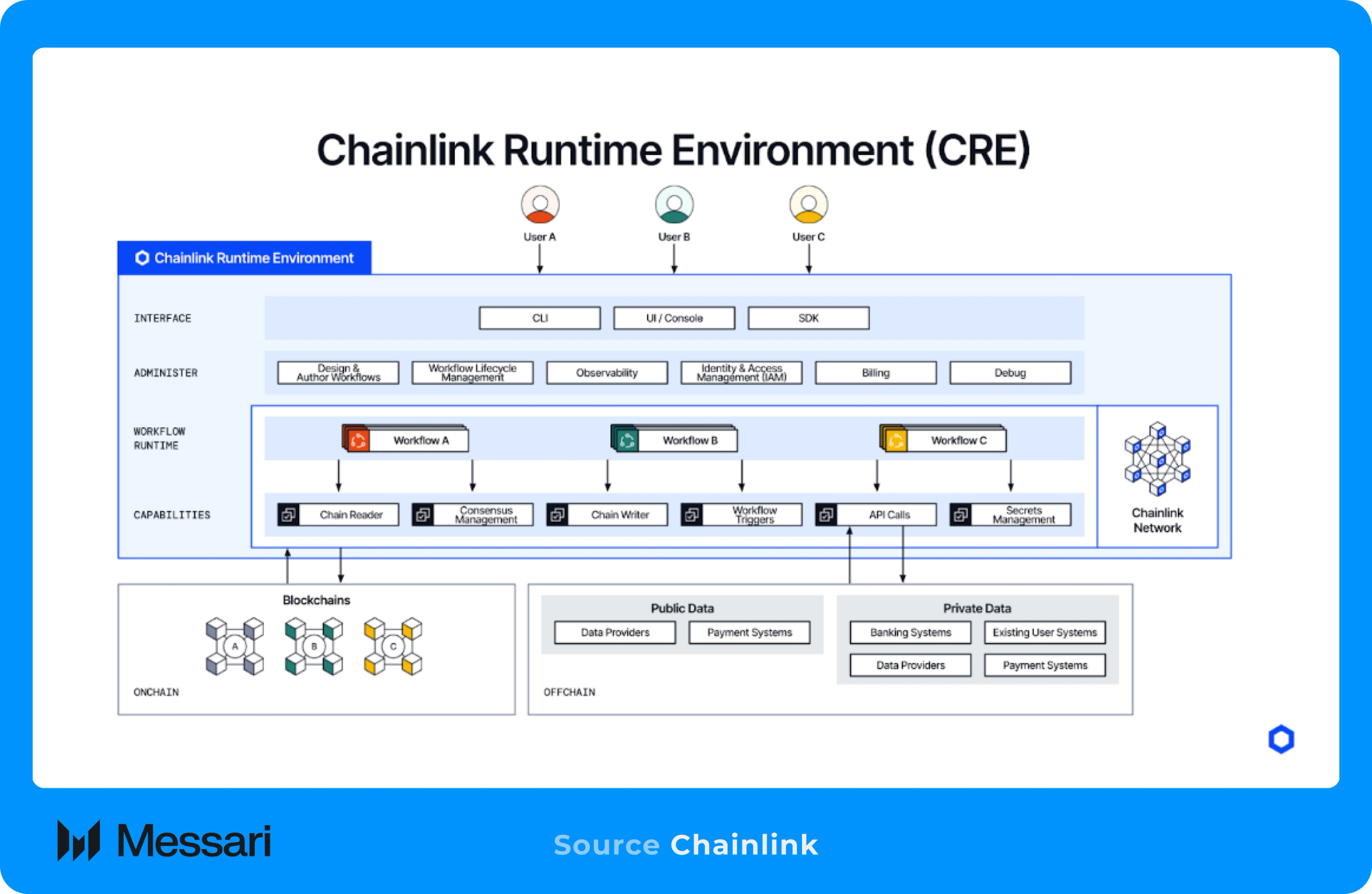
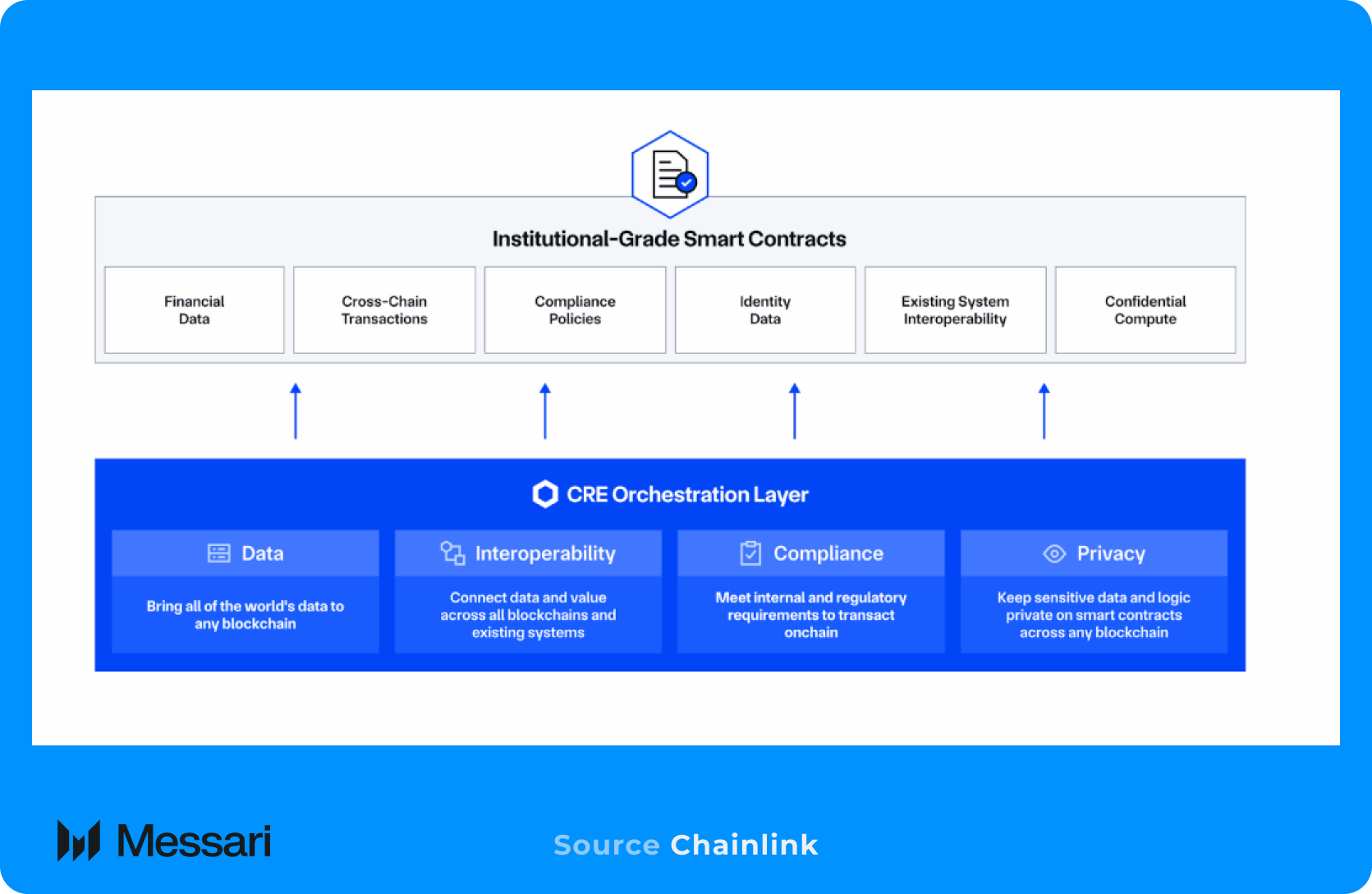
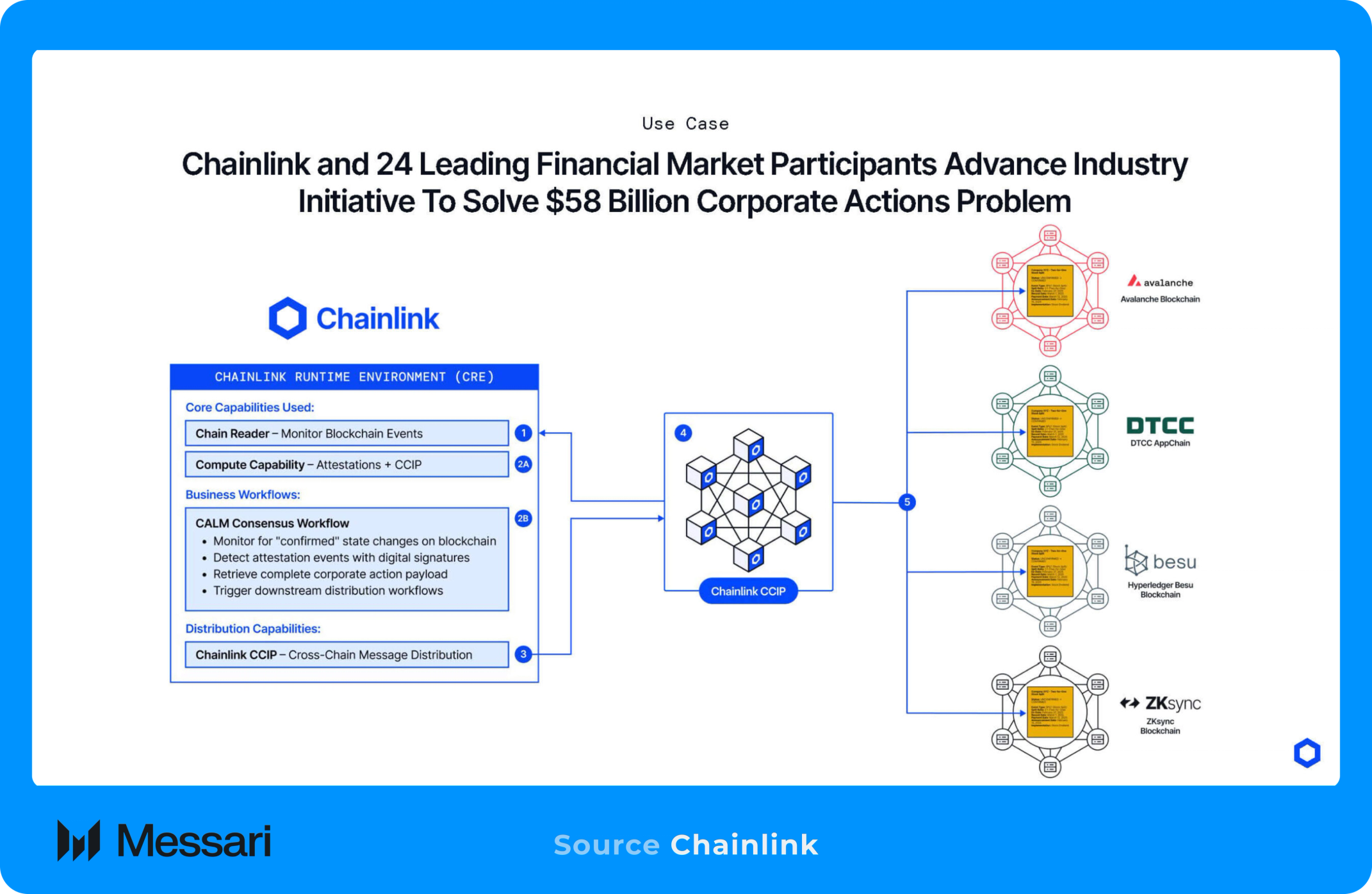
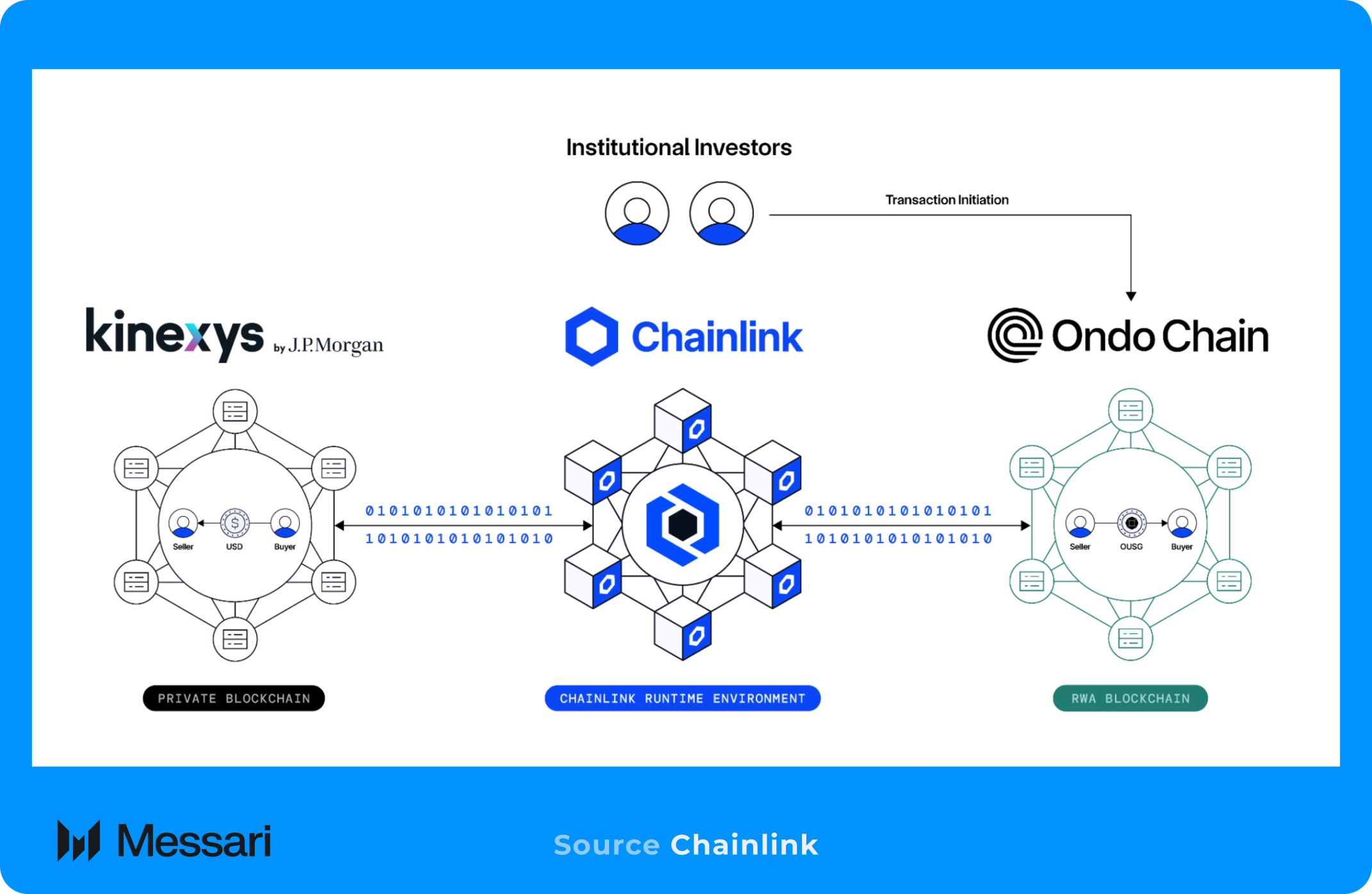
The Chainlink Runtime Environment (CRE) is the all-in-one orchestration layer that enables the easy implementation of all Chainlink standards and services, empowering developers to create institutional-grade smart contracts that are data-connected, compliance-ready, private, and interoperable across blockchains and existing systems.
For developers, CRE streamlines multiple blockchain integrationsinto a single "write once, orchestrate everywhere" model, reducing deployment time. Developers write and run CRE workflows directly on Chainlink’s oracle infrastructure rather than provisioning their own, abstracting away blockchain operations and enabling seamless, secure scaling.
For institutions, CRE provides a secure and efficient way to power institutional-grade smart contracts across chains and existing systems while enforcing policy controls, embedding privacy, and preserving an auditable trail that can be proven to counterparties and regulators.
For blockchains, CRE drives more adoption and usage by serving as a shared interoperability, services, and orchestration layer that enables support for tokenized funds, stablecoins, compliance checks, and other institutional use cases without needing to build their own bespoke bridges, privacy solutions, or native compliance stacks.
CRE is being adopted by major financial and infrastructure players (e.g., J.P. Morgan’s Kinexys, Swift, Euroclear, UBS, Apex Group, Deutsche Börse’s Crypto Finance, Aave’s Horizon, Balcony, 21X, Kiln). Developers can get started immediately with minimal ramp-up using workflow templates and building blocks for Go and Typescript SDKs, as well as a managed execution environment.
Primer
Chainlink (LINK) launched in 2017 to provide decentralized oracle infrastructure, solving the problem of blockchains being unable to interact with external data and systems without introducing centralization risks. Its initial integrations, including with ETHLend (now Aave) and Synthetix, established Chainlink as the leading provider of secure price feeds for DeFi lending, derivatives, and synthetic assets. As the market expanded, Chainlink grew into the dominant oracle network now securing more than 483 protocols, with ~70% share of the oracle market by value secured. Over time, the protocol has evolved into a full-stack platform that spans data, interoperability, compliance, and privacy standards. Innovations such as low-latency Data Streams, Proof of Reserve, and the Cross-Chain Interoperability Protocol (CCIP) have broadened its role from delivering market data to enabling cross-chain settlement, tokenized fund administration, and private institutional transactions.
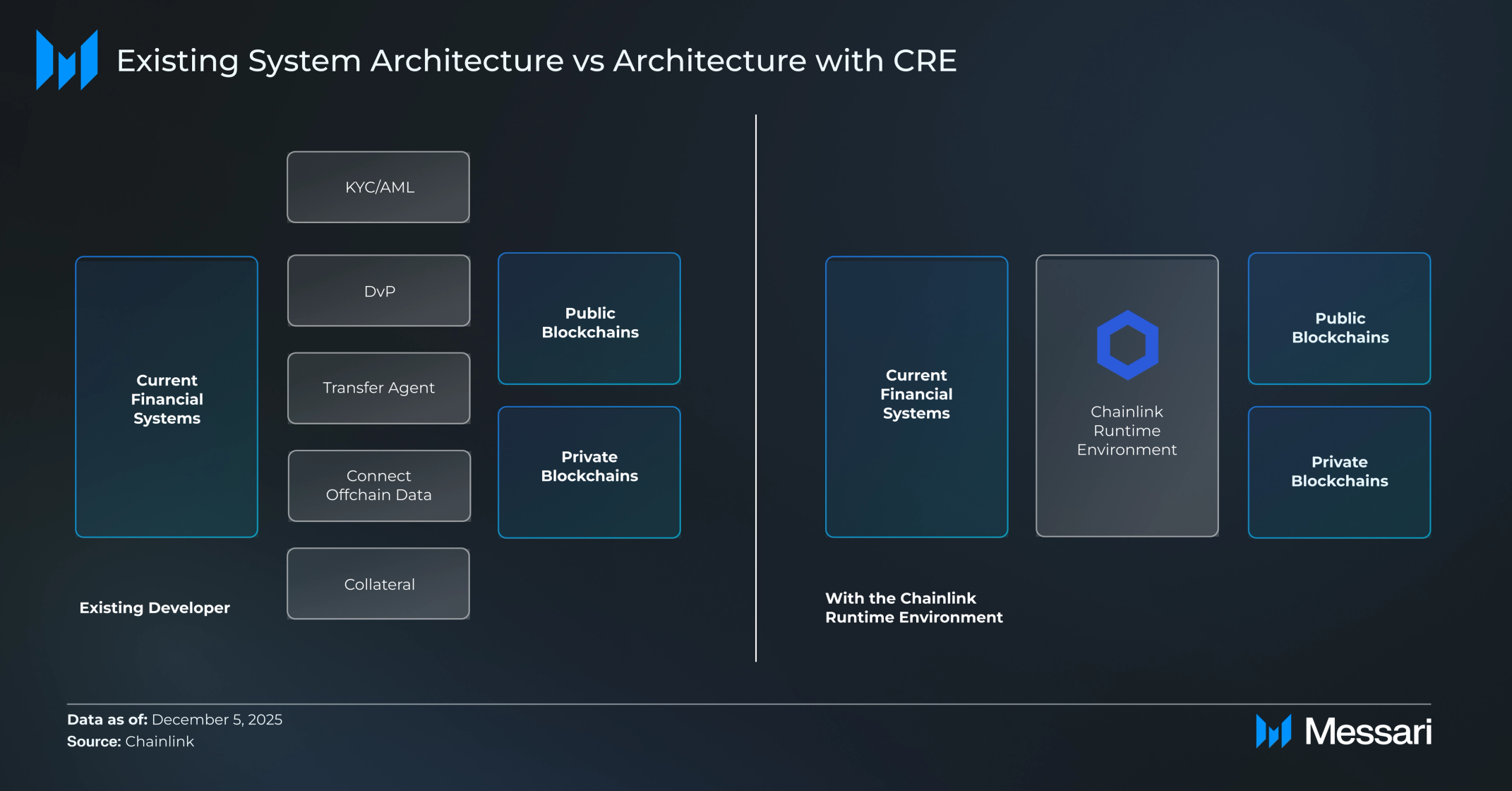
CRE is a secure orchestration layer that allows developers to create advanced, institutional-grade smart contracts and Web3 applications. Developers write workflows (i.e., programs) that combine onchain logic, offchain computation, external API calls, compliance checks, identity verification, AI, and cross-chain, cross-system actions. It consolidates what previously required multiple vendors (i.e., identity providers, data oracles, interoperability bridges, KYC checks, and custodial APIs) into a single environment. In practice, this means a tokenized fund redemption, a cross-chain DvP, or a NAV-triggered rebalance now runs as a single workflow, rather than stitched together point solutions.
Current adoption spans major financial and data infrastructure providers, including J.P. Morgan’s Kinexys, UBS, ANZ, Swift, DTCC, Euroclear, Mastercard, Fidelity, Deutsche Börse’s Crypto Finance, Apex Group, SBI Group, WisdomTree, GLEIF, and more, each leveraging CRE for tokenized assets, settlement, compliance, or other data workflows.
Why Does it Matter?
The progression of smart contract design has moved from basic single-chain transfers (2014), to conditional DeFi logic (2018), to cross-chain state updates (2022), and now to institutional workflows that span multiple chains and various offchain resources and external systems. These new institutional-grade smart contracts depend on reliable access to offchain data, coordinated execution across ledgers, embedded compliance logic, integration with existing financial messaging and settlement rails, privacy guarantees, and full traceability for auditors. Blockchain execution environments were never designed to orchestrate this level of operational complexity. It's expensive, slow, and high-risk for institutions and DeFi protocols to try and maintain dozens of bespoke adapters, bridges, and system-specific integrations without a unifying coordination layer. CRE addresses this gap by providing an environment where multichain, multi-system workflows can be defined, executed, and verified using a single, consistent model. This makes it easier to build and power the full lifecycle of “institutional-grade” smart contracts.
Developers
For developers, CRE reduces the complexity of multichain and multi-system development to a single programming model. Instead of rewriting logic for each chain, bridge, data source, or compliance module, workflows are defined once and executed consistently across environments. CRE provides prebuilt capabilities for the core primitives required in onchain finance (i.e., data posting/retrieval, CCIP messaging, identity and policy checks via ACE, and event routing), allowing developers to focus on application logic rather than integration overhead. Deterministic execution, end-to-end workflow simulations, and step-by-step debugging help eliminate the uncertainty inherent in distributed, cross-system workflows. The result is a shift from ad-hoc code to verifiable, maintainable workflows that scale as applications grow more complex.
Institutions
For institutions, CRE provides the connective tissue needed to execute real operational systems onchain. It integrates with existing standards (e.g., SWIFT and ISO-20022), interfaces with custodial and settlement systems, and incorporates offchain data sources used in fund administration, payments, and reconciliation. Compliance requirements (i.e., eligibility rules, jurisdiction constraints, and KYC/AML checks) can be encoded directly into workflows rather than managed through manual processes, while privacy can be incorporated into any part of the transaction lifecycle, from data inputs, API requests, and identity verification to transaction processing, cross-chain transfers, and final settlement. Because CRE produces an auditable trail across public chains, private ledgers, and offchain systems, institutions gain operational assurance and regulatory visibility while experimenting with tokenized assets and automated settlement flows. CRE effectively bridges institutional infrastructure with blockchain environments in a way that is verifiable, programmable, and scalable.
Blockchains
For blockchains, CRE acts as a shared interoperability, offchain services, and orchestration layer that expands the features a chain can support without native engineering lift. Tokenized funds, institutional stablecoins, cross-chain collateral, policy-gated asset transfers, and regulated market workflows become available to any chain connected to CRE. Instead of building custom bridges, compliance frameworks, privacy solutions, and data connectivity, chains inherit these capabilities from CRE’s shared environment. Each additional workflow increases the usefulness of all integrated networks, creating a network effect where liquidity, assets, and institutional activity flow more freely into different chain ecosystems without bespoke infrastructure.
Protocols Enabled by CRE-Level Orchestration
Kiln
Kiln provides institutional-grade onchain asset and yield management, allowing asset managers to deploy and blend strategies across DeFi and real-world assets. A key challenge was accounting for asynchronous yield sources (i.e., RWAs with varying redemption windows and cooling periods), especially when combined with leveraged DeFi strategies where state changes are not atomic. Relying on Kiln or asset managers to compute and publish net asset value (NAV) updates introduced trust assumptions and operational fragility.
How CRE unlocked a new strategy design
CRE addressed this by serving as a neutral execution layer where asset managers define accounting methodologies, and workflows compute, validate, and post state transitions onchain in a deterministic and auditable manner. In parallel, CRE allows Kiln to satisfy institutional compliance requirements by integrating offchain risk intelligence from providers such as Chainalysis and TRM Labs via Chainlink’s Automated Compliance Engine (ACE) powered by CRE, enforcing address-level risk thresholds dynamically at deposit and withdrawal time.
This combination allows Kiln to bridge offchain compliance systems and onchain execution without embedding those responsibilities into its own infrastructure. The team emphasized that without CRE, many of these strategies would not be pursued at all due to opportunity cost and architectural complexity, underscoring CRE’s role as an enabling layer rather than a convenience.
LlamaRisk
LlamaRisk is a risk management provider for DeFi protocols, including Aave and Aave Horizon, where it evaluates collateral types, determines loan-to-value parameters and liquidation thresholds, and monitors risk conditions for both crypto-native and real-world assets. The fundamental problem LlamaRisk faced was that many RWAs used as collateral on Aave Horizon lack reliable secondary market liquidity, making traditional price discovery infeasible. Instead, protocols must rely on issuer-reported NAV data delivered via APIs, which introduces centralization risk, data integrity concerns, and operational fragility if processed through a proprietary backend.
How CRE altered their risk model
Before CRE, LlamaRisk would have been forced to process NAV data and risk logic in its own infrastructure (e.g., AWS), creating a scenario where downtime or errors could cascade into incorrect pricing, forced liquidations, or halted markets. CRE allowed LlamaRisk to move its core risk computation and validation logic onto CRE, combining issuer-reported NAVs, onchain registry parameters, and bounded validation logic into a verifiable workflow. If NAV values deviate beyond predefined bounds, CRE workflows can automatically adjust reported prices or trigger protocol-level responses such as freezing markets while allowing withdrawals. This architecture allows Aave Horizon to delegate narrowly scoped, automated risk authority to LlamaRisk without introducing a centralized black box. According to the team, there was no viable alternative that offered equivalent transparency, fault tolerance, and onchain enforceability, making CRE a structural dependency rather than an optimization.
Swapper Finance
Swapper Finance builds infrastructure that allows users to move from fiat or custodial crypto balances into DeFi positions through a single, abstracted flow, handling asset detection, routing, conversion, and cross-chain execution behind the scenes. The core challenge Swapper faced was orchestration: detecting when funds arrive in a wallet or custodian account, aggregating liquidity and execution paths across offchain APIs (e.g., 1inch, Uniswap, custodial systems), and then executing the final onchain and cross-chain transactions deterministically.
How CRE changed their architecture
Prior to CRE, Swapper had built this infrastructure in-house using centralized servers to coordinate offchain aggregation and onchain execution; however, this approach introduced a single point of failure and unacceptable operational risk for a system intended to handle user funds at scale. CRE replaced this architecture by acting as a distributed execution layer where offchain aggregation, wallet state detection, and CCIP-based cross-chain execution are coordinated through verifiable workflows executed across decentralized oracle networks. This allowed Swapper to offload uptime, execution, and coordination risk from a centralized backend to a fault-tolerant, multi-node system, while still retaining flexibility in how routing and aggregation logic is defined. In practice, Swapper’s team noted that the product they are building would not be viable without CRE, as replicating equivalent reliability and execution guarantees in-house would be operationally prohibitive.
How Developers Build, Test, and Deploy CRE
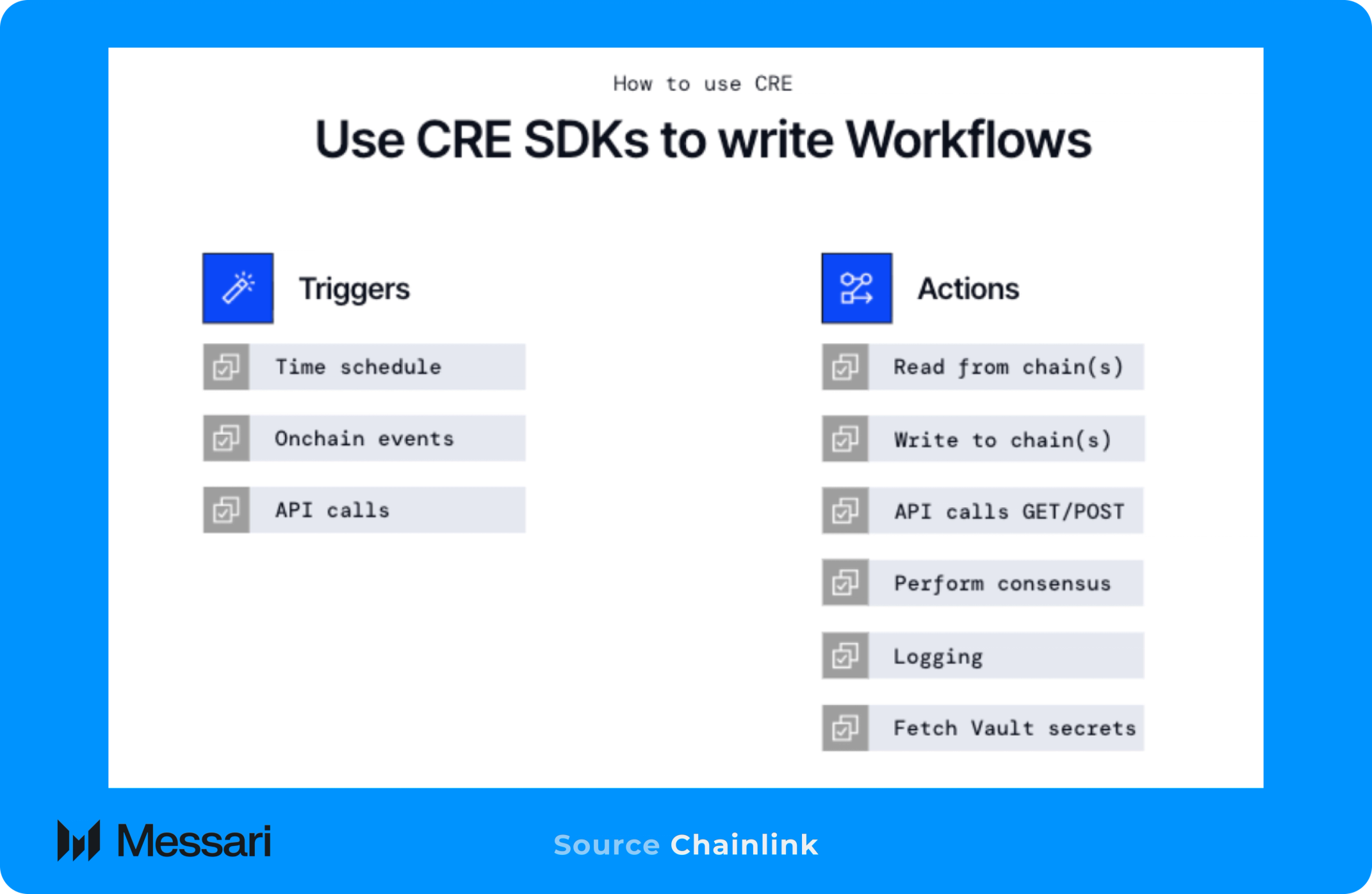
CRE exposes Go and TypeScript SDKs, as well as a command-line interface for workflow building, simulation, and deployment. It also ships with quick-starter workflow templates and a web app for monitoring and debugging. Developers begin by installing the CLI, authenticating with the CRE platform, and initializing a project, with access to templated workflows. Workflows define triggers (such as scheduled events or onchain/offchain actions) and business logic that orchestrates actions across systems.
A typical workflow might begin by listening for an onchain event (e.g., a deposit or subscription instruction), fetching external state such as Proof of Reserve data, checking and enforcing compliance policies, and issuing a cross-chain instruction before finalizing with a verifiable log or callback to an issuer or offchain system.
Before deployment, workflows can be simulated to provide deterministic previews of each step and highlight failure modes (e.g., policy violations, missing data dependencies, and/or unreachable targets). This gives developers confidence in their output and helps ensure that workflows behave predictably across chains and systems. Developers then deploy the workflow to CRE’s execution environment (powered by Chainlink decentralized oracle network infrastructure), which assumes responsibility for orchestrating all onchain, offchain, and cross-chain-related operations with verifiable execution guarantees. Once active, developers can track execution history, inspect logs and traces, and iterate on workflow logic without rebuilding bespoke infrastructure. CRE allows developers to build production-grade applications that would otherwise require substantial custom infrastructure. Two examples illustrate the range of capabilities:
Stablecoin Issuance: Developers can orchestrate an end-to-end minting and issuance pipeline for fully collateralized stablecoins. A workflow can begin with a deposit notification from a bank or custodian, which then triggers the retrieval of offchain reserve data via an external API, a Proof of Reserve verification, invocation of Chainlink ACE to enforce blacklist or volume policies, minting of the token onchain, and transfer ot the token cross-chain using Chainlink’s Cross-Chain Interoperability Protocol (CCIP). Each stage is executed within a single workflow that spans offchain systems, compliance logic, and multiple blockchains. This pattern generalizes to institutional issuers who want deterministic, auditable minting without building their own bridging, policy enforcement, or offchain data ingestion layers.
AI-Powered Prediction Market Settlement: Prediction markets that rely on subjective or multi-source information can delegate settlement to a CRE workflow that integrates with an LLM, such as Google Vertex AI. After detecting a settlement request event, CRE can structure a query containing the market question, invoke the LLM with grounded search enabled, retrieve a structured verdict with confidence and citations, and generate a verifiable report that the smart contract uses to finalize settlement. CRE can also log the inference output to an offchain system such as Firestore, producing a provable audit trail.
CRE extends Chainlink from a set of oracle services into a general-purpose orchestration layer for onchain finance, providing a single environment in which data ingestion, cross-chain messaging, compliance logic, and offchain integration can be expressed as unified workflows. For developers, it shifts complexity from bespoke infrastructure and ad hoc code into a unified programming model with deterministic, verifiable execution guarantees. For institutions, it provides a means to translate existing operational processes into cryptographically enforced logic, while maintaining full auditability across chains and enterprise systems. For blockchains, CRE acts as shared interoperability, privacy, and compliance rails, enabling institutional flows and tokenized assets to move across networks without each chain having to rebuild bridges, policy engines, or data connectivity. As integrations accumulate, CRE exhibits increasing network effects, as each new workflow or chain expands the utility of all others. Looking ahead, the introduction of Chainlink Confidential Compute into CRE’s execution model signals the next phase where privacy-preserving workflows become first-class capabilities, enabling regulated financial operations that require confidentiality alongside verifiable computation.
This report was commissioned by Chainlink Labs. All content was produced independently by the author(s) and does not necessarily reflect the opinions of Messari, Inc. or the organization that requested the report. The commissioning organization may have input on the content of the report, but Messari maintains editorial control over the final report to retain data accuracy and objectivity. Author(s) may hold cryptocurrencies named in this report. This report is meant for informational purposes only. It is not meant to serve as investment advice. You should conduct your own research and consult an independent financial, tax, or legal advisor before making any investment decisions. Past performance of any asset is not indicative of future results. Please see our Terms of Service for more information.
No part of this report may be (a) copied, photocopied, duplicated in any form by any means or (b) redistributed without the prior written consent of Messari®.