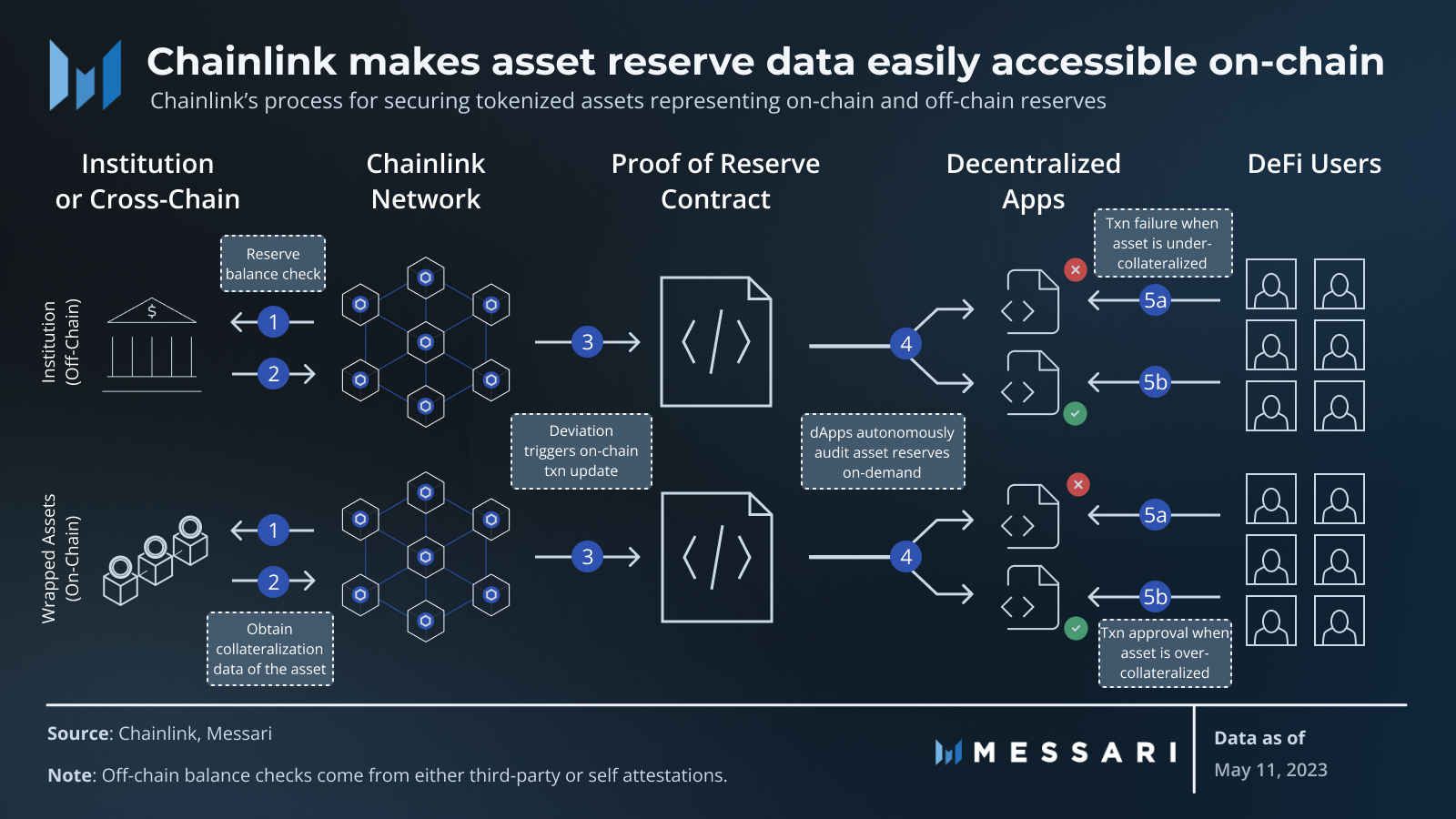
Chainlink Proof of Reserve (PoR) is blockchain-agnostic. It relies on a decentralized oracle network that creates automated on-chain data feeds for collateralized assets represented on-chain that update in near real-time.
Chainlink Proof of Reserve currently reports on assets worth ~$8.5 billion in value, where ~$3.5 billion includes off-chain reserves and ~$5 billion includes on-chain reserves.
Within one month after Chainlink added TUSD PoR data feeds, the TUSD market cap increased by 121%.
With bridge exploits accounting for ~$1.9 billion in losses, Chainlink PoR can be used to help secure DeFi protocols that use off-chain assets or wrapped assets as collateral by automatically triggering circuit breaker-like mechanisms to mitigate under-collateralization risk.
To ensure updates remain cost-efficient, Chainlink’s oracle network checks reserves off-chain regularly and performs on-chain updates when the balances change over a certain threshold. Hence, it makes updates when reserves are volatile and saves on gas costs when reserves are stable.
Introduction
In response to the Mt. Gox debacle in 2014, the crypto community has consistently tried to set standards around centralized exchanges (CEXs). Vitalik added to the conversation by publishing a blog roughly one week after FTX filed for Chapter 11 bankruptcy. In his post, he shared a vision of how CEXs may approach non-custodial values. It detailed the technical approaches for designing a “safe CEX” that proves it has enough assets to cover its liabilities. Although Vitalik focused on howproof of solvency, or proof of reserves, would work for CEXs, he glossed over the potential of proof of reserves if applied to stablecoins and DeFi.
As the industry matures, stablecoin reserves grow, and on-chain bridge hacks begin to account for billions of dollars worth of losses, the focus placed on proving reserves needs to be applied to more than just CEXs. Chainlink is attempting to meet this need by offering proof of reserves for various asset types through oracle-driven data feeds that are easily accessible on-chain.
Chainlink Proof of Reserve (PoR) is blockchain-agnostic. It relies on a decentralized oracle network that creates automated on-chain data feeds for various assets that update in near real-time. Depending on the use case, Chainlink provides feeds from on-chain data or third-party off-chain attestations. Its PoR product adds a new layer of transparency to crypto and can be used in development to help secure DeFi protocols and collateralized assets represented on-chain.
Background: Why Proof of Reserves?
Traditional finance has a fair amount of drawbacks. It’s opaque, inefficient, permissioned, centralized, socially trust-based, and largely operates on fractional reserves. As a response to this faulty system, the crypto community launched new systems that address these shortcomings, with the first major development being Bitcoin in 2009.
Bitcoin was created to solve electronic payment settlement, eliminating the double-spend problem without requiring a centralized authority. It performs this function while maintaining key tenets like permissionless access, decentralization, and cryptographic validity. Its success has sparked an increasing demand for more complex systems with Bitcoin-like properties. As a result, Chainlink was launched to connect blockchains — which cannot pull data from outside their own networks — to external data sources, through decentralized oracle networks.
Many blockchain projects operate by issuing assets based on deposited or accumulated collateral. This collateral can originate on-chain, such as native assets wrapped to another network (e.g., Wrapped Bitcoin, Wormhole-wrapped assets), or off-chain through cash and treasury-backed stablecoins (e.g., Tether, USD Coin).
FTX’s collapse revealed that it had only a fraction of the assets needed to cover its liabilities, and frequent scrutiny of Tether’s holdings has highlighted the lack of transparency and the active social trust that many projects require. Chainlink PoR was created to meet the demand for a decentralized network that can cryptographically and verifiably prove sufficient reserves on-chain.
Chainlink PoR provides on-chain data feeds of various reserve backings, from off-chain collateral like currencies and precious metals to on-chain wrapped assets of any type (e.g., bridged, liquid staked, etc.). These feeds are publicly viewable, adding transparency to projects for current and potential users. Chainlink’s PoR data feeds can also be accessed through smart contracts to add various safety functionalities that can mitigate the risks of interacting with wrapped assets.
Key PoR Beneficiaries
Time and time again, crypto projects make choices that may limit transparency and put protocol safety at risk. For example, a bridge application may not publicize all the collateral-holding addresses that it owns, leaving users to trust that all wrapped assets are backed. Or a DeFi application may not add fail-safes to halt activity if wrapped assets become unbacked, putting users at risk of interacting with partially-backed assets.
Chainlink’s PoR product can alleviate these issues for various applications and, in turn, improve the experiences for users and protocols.
Application Users
At its core, proof of reserves provides transparency. Though the crypto ethos leads many to believe that transparency is built into all things crypto, it is often only an accessory.
Off-chain collateral-backed stablecoin issuers and tokenized real-world asset (RWA) issuers are not contractually obliged to provide proof of reserves. Some projects, such as Tether (USDT) and Circle (USDC), provide quarterly and monthly reserve attestations, respectively, to strengthen trust with their users. However, the opaque periods between attestation updates still leave room for additional transparency.
In contrast, TrueUSD’s (TUSD) off-chain reserves are attested to continuously by a third party with Chainlink Proof of Reserve publishing on-chain updates of this data every 24 hours — or when there is at least a 5% balance change. This process can be implemented for any collateral-backed asset. Chainlink PoR currently provides reserve data on RWAs like PAX Gold (PAXG), bridged assets like Wrapped Bitcoin (WBTC), and has the ability to cover liquid-staked assets like Liquid Staked ETH (stETH).
Frequently updating PoR data feeds adds more transparency for application users, given balances can experience large changes within a month, let alone a quarter.
Within a month after adding Chainlink’s PoR data feeds to TrueUSD on Feb. 15, 2023, the TUSD market cap more than doubled, growing 121% to more than $2 billion by March 12. This also means its reserves more than doubled. Chainlink’s robust infrastructure did not falter in processing this increase of greater than $1 billion in magnitude.
In addition to providing a frequent and immutable record of reserve holdings, Chainlink PoR publishes data on-chain. This allows developers to include various functionalities in their projects that can react to inconsistencies, further increasing protocol safety.
Projects
Asset Issuers
By bringing reserve data on-chain, Chainlink allows protocols to add programmatic guarantees requiring the reserve value to be greater than or equal to the stablecoin or RWA supply being minted.
In Solidity, guaranteeing an adequate reserve is as simple as creating one require statement within the smart contract’s mint function. (For example, see line 1,404 in TUSD’s smart contract code.) By enabling mints with near real-time on-chain verification of off-chain reserves, Chainlink PoR sets a new standard for the reliability and transparency of stablecoin and RWA minting.
Tokenized assets that previously operated with more opacity can utilize Chainlink Proof of Reserve to improve the transparency of their collateralization. In addition to TUSD, CACHE Gold uses Chainlink PoR to enable users to verify that their tokenized gold products are fully backed by gold reserves held in off-chain vaults. In addition, tokenized RWA project Backed Finance is integrating PoR to increase transparency around its bTokens.
Bridges & Wrapped Assets
Bridges are a large source of DeFi hacks and exploits. Of the top 10 exploits, four are bridges that account for ~$1.7 billion in losses (49% of the total losses for the top 10 exploits). Typically, bridges are attacked in two ways:
Collateral is stolen from the source chain (making wrapped tokens worthless).
Wrapped tokens on the destination chain are minted without the equivalent collateral being deposited on the source chain (also known as an “infinite mint” attack).
Chainlink PoR can help prevent infinite mint attacks when incorporated into a bridge’s minting smart contract. Though it can’t prevent collateral from being stolen on the source chain, PoR can identify this issue and give developers the tools to mitigate the impact of such an attack. By verifying cross-chain collateral via its decentralized oracle network, Chainlink enables smart contracts to read its data feeds for wrapped tokens. Based on this information, an automatic fail-safe can be implemented to pause the minting, redeeming, and burning of wrapped tokens when there are inconsistencies in the number of reserves or tokens minted.
To ensure updates remain cost-efficient, Chainlink’s oracle network checks reserves off-chain regularly and performs on-chain updates when the balances change over a certain threshold. Hence, it makes updates when reserves are volatile and saves on gas costs when reserves are stable.
Chainlink’s data layer for bridges provides extra transparency for users that want to ensure they are not using a bridge with fractional reserves on the source chain, and it can be a powerful tool for any protocol, particularly DeFi protocols interacting with wrapped or bridged assets.
DeFi
Compromised bridges affect the bridge users and any protocol that has adopted the wrapped asset. Large exploits could lead to a DeFi protocol’s insolvency and loss of funds for users and the protocol.
The verification services that Chainlink PoR enables for bridges and wrapped assets can be extended to DeFi. These services would allow developers to implement decentralized circuit breakers into DeFi smart contracts that can protect against potential security issues. A circuit breaker in a DeFi app is an automated function that constantly checks Chainlink PoR data feeds and halts all application activity related to a particular wrapped asset if it becomes unbacked.
As a real-world example, BGD Labs has implemented circuit breaker functionality into Aave’s Avalanche-based markets for wrapped assets. The new conditional functionality checks Chainlink’s PoR data feeds to see whether wrapped assets are sufficiently collateralized. As such, the circuit breaker can pause all lending activity involving wrapped assets in emergency situations, mitigating or reducing potential losses.
Liquid Staking
With the successful implementation of the Shapella upgrade and the growing popularity of staking as a relatively lower-risk way of earning sustainable yield in DeFi, the liquid staking token market has been experiencing increased interest and growing competition between a few key players.
Liquid staking token issuers can also use Chainlink PoR for reliable and timely updates to determine if liquid staking token reserves are fully backed at all times by an equivalent amount of staked tokens.
Bridge Exploits
Chainlink PoR provides more than just consumer comfort; developers can integrate it within their applications to potentially mitigate the risk of excessive losses from hacks and exploits.
With the top 100 exploits totaling ~$6.1 billion in lost funds, the top six bridge exploits alone account for ~$1.9 billion of lost funds (31% of the top 100). All of these exploits affected wrapped assets within their respective bridge ecosystems.
While some of the exploits elicited immediate responses, others took days to be recognized. If Chainlink PoR had been included as an extra, third-party examination of bridge collateral and assets, it’s possible that the protocols could have been alerted earlier of the inconsistencies brought on by the attacks.
In multiple instances, the attacker either sold wrapped assets or used them as collateral to essentially steal lenders’ assets. Any DeFi protocols interacting with wrapped assets from the hacked bridges could have implemented circuit breaker functionality to pause activity associated with the affected wrapped assets.
Crypto’s Largest Exploit
The Ronin Network is an EVM-compatible blockchain launched by Sky Mavis (the Axie Infinity creators) to serve gaming applications. To date, the hack on the Ronin Network bridge was the largest, accounting for ~$624 million in losses (173,600 ETH and 25.5 million USDC). It took the Ronin team six days to discover the amount drained from its bridge thanks to a report from a user that was unable to withdraw 5,000 ETH from the bridge.
In other words, Ronin users were interacting with unbacked wrapped ETH and USDC on the network for six days, conducting various forms of economic activity. Had Ronin or any applications on Ronin implemented Chainlink PoR, this exploit could have been discovered automatically within the day, instantly pausing all activity on Ronin involving wrapped ETH and USDC.
Other Bridge Exploits
Chainlink PoR’s automation abilities could have also potentially mitigated losses from other exploits. The bridge projects could have implemented Chainlink PoR for wrapped assets and built automatic notifiers to speed up the time-to-discovery of each exploit. While the amount exploited from each bridge would not have changed, a quicker reaction from certain teams could have mitigated the impact of the attacks.
In the Wormhole exploit from February 2022, an attacker was able to mint 120,000 Wrapped Ethereum (WETH) on Solana without posting the required equivalent amount of collateral on Ethereum. Across a series of transactions, the attacker seized tokens worth about ~$326 million at the time. Had Wormhole implemented Chainlink PoR, the extent of this exploit may have been mitigated.
The latency between the time-to-discovery and the time-to-respond could be drastically shortened for applications that implement circuit breaker functionality for wrapped assets based on Chainlink PoR. DeFi applications interacting with wrapped assets from Ronin, Wormhole, Harmony, and Qubit could have paused the activity with anything that became unbacked. However, it is inconclusive if Chainlink PoR could have helped against the BNB Bridge and Nomad exploits.
PoR Activity
In securing information for billions of dollars in on-chain assets, proof of reserve data should be delivered by a reliable entity. Chainlink is the largest oracle network in the crypto space and arguably the most robust, with a track record that spans a multitude of oracle services. It has also been delivering on-chain Proof of Reserve data feeds since October 2020.
Since its first Proof of Reserve datapoint, Chainlink has made ~1.4 million PoR updates and grown to cover 20 different assets (some assets are repeats on a different chain or with a different issuer). The number of oracles per data feed ranges between 10 and 16, and Chainlink requires roughly 70% participation to publish updates.
In July 2022, daily updates started to ramp up by ~200–350%. And in August 2022, Chainlink doubled the data feeds it supports. Chainlink’s ability to manage these sharp increases in daily PoR updates processed and data feeds onboarded in July and August 2022, respectively, showcased the network’s robustness as it maintained uptime.
Chainlink PoR covers ~$8.5 billion in value, where ~$3.5 billion includes off-chain reserves and ~$5 billion includes on-chain reserves. Though most off-chain reserves consist of U.S. dollars, Chainlink has also proven its ability to cover international currencies like the Euro and Great British Pound, which it has maintained data feeds for since March 2021 and October 2022, respectively.
Of the on-chain reserves, Chainlink currently covers wrapped assets on Ethereum, Avalanche, and Polygon, though its blockchain-agnostic infrastructure enables it to cover assets on nearly any blockchain. Thus far, Wrapped Bitcoin (four different versions) accounts for ~93% of the total value of Chainlink’s on-chain PoR coverage.
Challenges
Chainlink PoR is a powerful data layer that adds transparency by putting data on-chain in an accessible way for users and developers. However, there are still aspects of the process that introduce varying levels of risks if used incorrectly.
Trust in Off-Chain Data Sources
Trusting the data source is a problem that any oracle network faces when retrieving off-chain data. When interacting with off-chain assets like gold or fiat currencies, oracles fetch reserve data from either third-party attestations or self-attestations. More trust is required in self-reporting, given the reporting entity is also the issuer and holder of collateral. However, the reporting entity/issuer is incentivized to act truthfully if they implement Chainlink PoR in their own contracts/minting functions. Additionally, third-party and self-reporting entities are motivated to report truthfully to maintain a good reputation. This setup assumes the providers consider their reputation to be more valuable than any potential gains from committing fraud.
Oracles per Data Feed
Each PoR data feed currently has either 10 or 16 oracle nodes fetching the respective feed’s reserve data. PoR oracle nodes do not have additional requirements outside of typical Chainlink oracles. While some users may be satisfied with the number of nodes fetching PoR data, others may consider the number of nodes not to be sufficiently distributed or decentralized. Of note, more nodes can be added to individual PoR data feeds as value increases.
Stolen Collateral
Chainlink PoR data feeds cannot directly prevent collateral from being stolen. That said, they can be used to prevent infinite mint attacks and can be referenced by DeFi developers to build tools that mitigate the potential impacts after a bridge or asset-wrapping smart contract has been exploited. Chainlink PoR does not promise to act as a preventative security layer for asset issuance protocols; rather, it was built as a data layer that makes reserve data accessible on-chain. The extent of use for Chainlink PoR is less of a shortcoming and more of a design feature of oracle data feeds.
Final Thoughts
Chainlink Proof of Reserves provides a step in the right direction to improve the transparency in many of the core products used in crypto. Chainlink PoR can update reserve data on-chain on at least a daily basis and can then enable smart contract security with this data.
With bridges and wrapped assets, Chainlink optimizes costs when reserves are stable and automatically publishes movements over a certain threshold. It also offers smart contract developers tools for making their protocols more secure, giving them the ability to read from Chainlink’s constantly updating data feeds. Additionally, applications that interact with wrapped assets can also utilize Chainlink’s developer tools to help mitigate losses from potential exploits.
Although obtaining off-chain reserve data is not fully trustless, Chainlink PoR has the potential to be the most robust mechanism for verifying on-chain reserves and delivering off-chain data on-chain in a decentralized, secure, and cryptographically verifiable way.
This report was commissioned by Chainlink Labs. All content was produced independently by the author(s) and does not necessarily reflect the opinions of Messari, Inc. or the organization that requested the report. The commissioning organization may have input on the content of the report, but Messari maintains editorial control over the final report to retain data accuracy and objectivity. Author(s) may hold cryptocurrencies named in this report. This report is meant for informational purposes only. It is not meant to serve as investment advice. You should conduct your own research and consult an independent financial, tax, or legal advisor before making any investment decisions. Past performance of any asset is not indicative of future results. Please see our Terms of Service for more information.
No part of this report may be (a) copied, photocopied, duplicated in any form by any means or (b) redistributed without the prior written consent of Messari®.
Looking to dive deeper? Subscribe to Messari Pro. Messari Pro memberships provide access to daily crypto news and insights, exclusive long-form daily research, advanced screener, charting & watchlist features, and access to curated sets of charts and metrics. Learn more at messari.io/pro.