Chainlink: Does Demand Meet Supply?

When crypto-natives hear the name Chainlink, they often associate the project with importing price data from external sources onchain: in other words, a traditional oracle service provider. One can’t blame them, though, as the project’s early days revolved around this vertical, and Price Feeds are still Chainlink’s main and most important product.
However, throughout the years, Chainlink has evolved its product lineup to include much more than that, most notably adding more data types, decentralized offchain computing capabilities, and a cross-chain messaging offering. The project has steadily spread out across adjoining crypto verticals, introducing middleware infrastructure that has been widely adopted, generally achieving a market-leading position within the new expansion areas—sometimes because no other entity offers a similar service—with the exception being general message transfers, at least for now. Chainlink has firmly taken over a vast share of the supply chain, but value capture has been lackluster, inherent to the market structure of oracle providers and seemingly low demand outside of the core offering.
Chainlink’s key long-term goal—one the project has recently pushed heavily through its public communications—is to become a secure middleware layer for TradFi enterprises to connect legacy systems to blockchains, abstracting away general crypto complexities such as fees and reorganizations in addition to specific blockchain features, while offloading computations traditionally performed onchain to its own ecosystem. Many bullish analysts envision the project becoming a crypto data indexing monopoly enabled by its wide-ranging product suite of data transfer and compute solutions, similar to what Google has done with today’s internet. Through its robust partnerships, dominant market position, and product architecture that is horizontally scalable and tailorable to institutional needs, Chainlink is arguably well-positioned to achieve this goal. However, it won’t happen overnight, given that TradFi institutions are infamous for integrating new technologies slowly for a multitude of reasons, including but not limited to system compatibility and overall resistance to change.
In addition to execution risk, the most notable hurdle for the long-term bull thesis is TradFi institutions forming an onchain-focused alliance similar to how SWIFT was originally created or governments forcing their way into the vertical through regulation, creating proprietary solutions and pushing Chainlink out of its greatest potential target market. Another risk for long-term investors worth mentioning is EigenLayer’s entry into the vertical as a facilitator. The core market for restaking is infrastructure, with EigenLayer lowering the entry barriers for new oracle providers, weakening one of Chainlink’s competitive advantages.
As mentioned above, the project’s value capture hasn’t been anything to brag about. With the exception of Chainlink’s main product, Price Feeds, and a fee-sharing deal with GMX, the project’s other products aren’t creating relatively meaningful revenue. Price Feeds has yielded ~$2.6M in revenue MTD, while the total value secured (“TVS”) by Chainlink is ~$11.4B as of October 31, 2023. Furthermore, value accrual to the native token, LINK, is unclear. LINK staking is slowly being introduced across products, but oracle node operators are still accruing most of the value, which they are able to do without having to hold native tokens. In other words, node operators aren’t incentivized to accumulate LINK, instead selling native tokens to cover expenses, which likely accounts for a majority of the downside pressure on LINK.
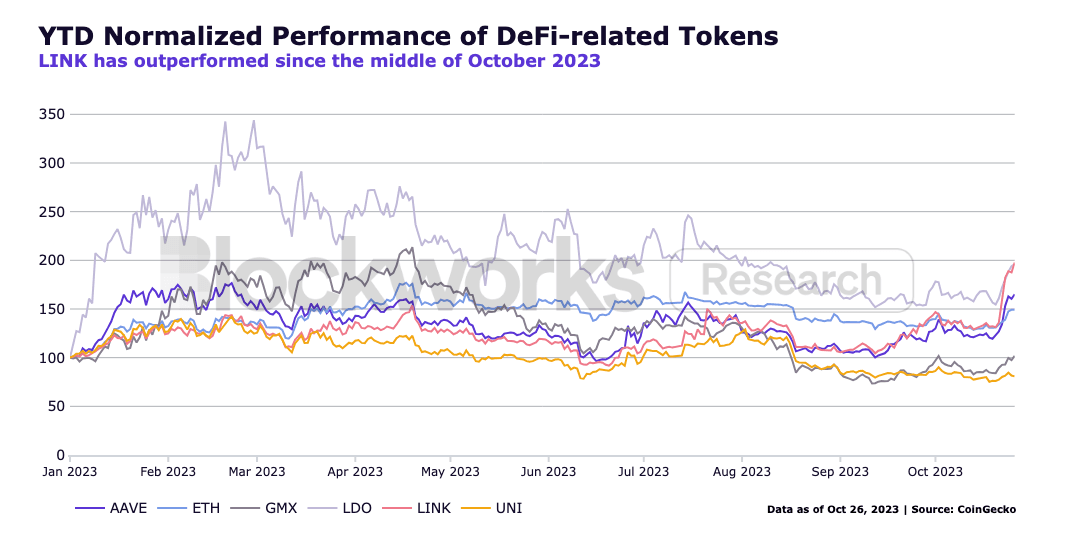
Despite these hurdles, Chainlink has an extremely robust community and is one of the best projects in the space with respect to guiding market expectations in its favor in a timely manner by creating forward-looking, highly optimistic narratives. This might explain why the native token has traded within a range of ~$6–9 for the past year, with sell pressure being offset by narrative traders, despite the fact that KPIs haven’t improved and most of the token supply can’t gain exposure to the project’s potential upside due to a capped staking pool yielding a fixed return. As of October 31, 2023, LINK’s trailing 14-day price has increased ~55% and has been on an upward trend since the beginning of September, possibly as the market starts positioning itself for the launch of Staking v0.2 later this year.

Brick leads coverage on Aevo, Chainlink, and MakerDAO. Previously he worked in investment banking as a sector-agnostic M&A and ECM advisor.