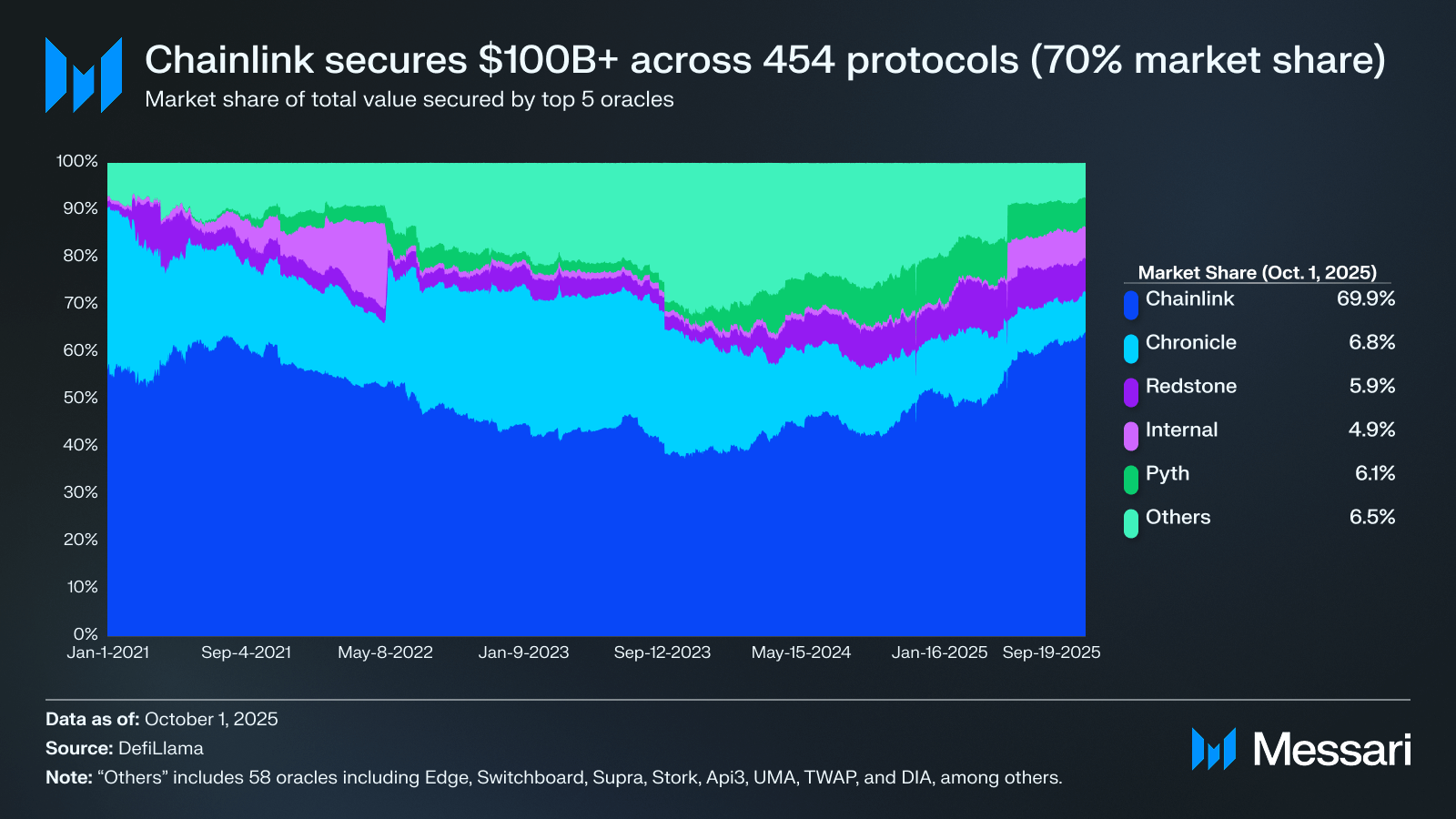
As of October 2025, Chainlink secures $100+ billion, features 2,400+ integrations, holds a ~69.9% share of the oracle market, and has enabled over $26 trillion in cumulative transaction volume.
LINK launched in 2017 via a $32 million ICO, with allocations to the public, protocol team, and node operators. In 2025, Chainlink introduced the Chainlink Reserve, an onchain reserve of LINK funded by service fees and enterprise revenue.
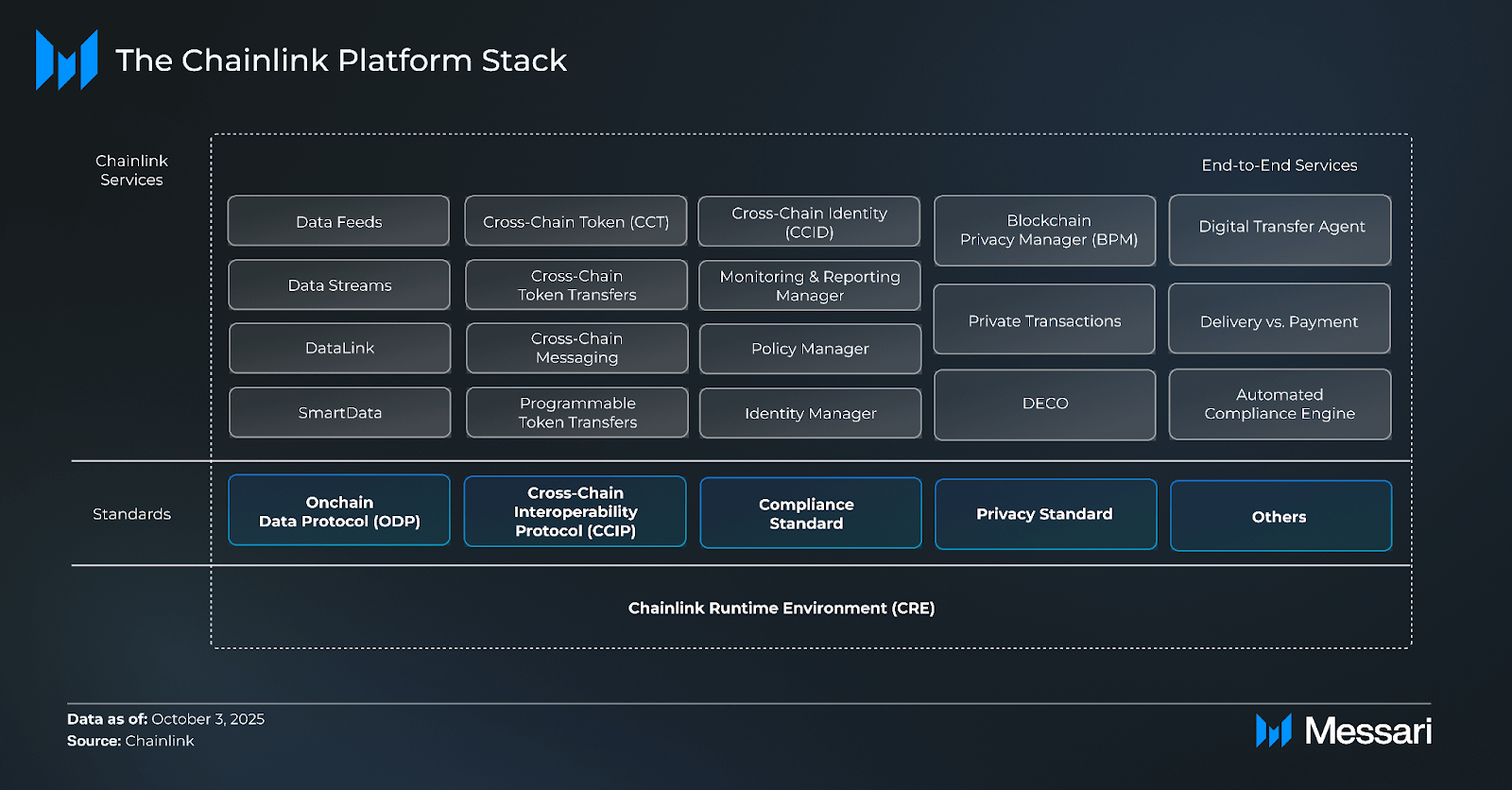
Chainlink has expanded into a full-stack oracle platform and global set of standards for onchain finance spanning data (Feeds, Streams, Proof of Reserve, DataLink), interoperability (CCIP, Cross-Chain Token standard), compliance (ACE, Cross-Chain ID, Policy Manager, Monitoring and Reporting), privacy (Confidential Compute, Blockchain Privacy Manager, DECO), and orchestration (Chainlink Runtime Environment), positioning itself for the adoption of stablecoins, tokenized funds, and other onchain financial applications.
In DeFi, Chainlink is powering leading protocols, including Aave, Lido, Kamino, ether.fi, and Maple Finance, securing lending, perps, synthetic assets, and cross-chain stablecoin strategies.
In TradFi, Chainlink is partnered with some of the world’s largest financial institutions and market infrastructure, including J.P. Morgan, UBS, ANZ, Swift, DTCC, Euroclear, Mastercard, Fidelity International, Apex Group, and SBI Group, to enable digital asset settlement, onchain data distribution, automated compliance, and cross-chain fund management.
Primer
Chainlink (LINK) launched in 2017 to provide decentralized oracle infrastructure, solving the problem of blockchains being unable to access external data and systems without introducing centralization risks. Chainlink became established as the leading provider of secure data feeds for DeFi lending, derivatives, and tokenized assets by enabling the live production launch of DeFi pioneers like Aave and providing superior security and reliability. As the market expanded, Chainlink grew into the dominant oracle network, now securing more than $100+ billion, integrated by 2,400+ projects, with an approximate 69.9% share of the oracle market by value secured. Over time, Chainlink has evolved into a full-stack oracle platform and global set of standards spanning data, interoperability, compliance, and privacy, along with an all-in-one orchestration layer for building and powering institutional-grade smart contracts across blockchains and offchain systems. Innovations such as low-latency Data Streams, Proof of Reserve, Confidential Compute, and the Cross-Chain Interoperability Protocol (CCIP) have broadened its role from delivering market data to enabling any tokenized asset use case, such as cross-chain settlement, tokenized fund administration, and private institutional transactions. Chainlink is now increasingly being adopted by the largest financial institutions and market infrastructures in the world across various tokenized asset use cases through the same set of standards that power DeFi.
Chainlink was founded in 2017 by Sergey Nazarov and Steve Ellis to solve a pressing issue in early smart contract development: secure and reliable access to offchain data. At the time, blockchains were closed systems unable to communicate with external systems without introducing centralization risks. Chainlink’s initial solution was to create decentralized oracle networks for fetching, aggregating, and delivering market data onchain, with its first integration powering ETHLend (now Aave). From these early beginnings, Chainlink quickly became the dominant oracle provider. As of Oct. 2, 2025, Chainlink secures more than $100 billion in value across DeFi markets and commands approximately 69.9% of the total oracle market by value secured, maintaining the top position among all oracle providers.
But simply delivering data to blockchains was never Chainlink’s end goal. As the industry evolved from single-chain applications, such as early DeFi lending, to a fragmented multichain landscape with tokenized RWAs and institutional solutions, the requirements for unlocking value onchain expanded from simple price feeds to advanced orchestration encompassing other forms of data, compliance, privacy, cross-chain execution, and integration with existing financial systems. Chainlink’s response was to evolve into a full-stack platform for onchain finance.
The core premise is that it is impractical for institutions to build every component themselves or rely on a patchwork of separate vendors with different standards and risk assumptions. Instead, they require an all-in-one orchestration layer capable of handling the full lifecycle of onchain applications. Today, Chainlink’s technology stack spans (i) core data services such as Data Feeds, Data Streams, and SmartData; (ii) interoperability via the Cross-Chain Interoperability Protocol (CCIP) for token transfers, messaging, and programmable settlement; (iii) compliance tooling including the Automated Compliance Engine (ACE); (iv) privacy infrastructure through Confidential Compute, the Blockchain Privacy Manager and DECO Sandbox, and (v) the Chainlink Runtime Environment (CRE) for orchestrating onchain and offchain activity by allowing developers to write and execute end-to-end workflows on a secure, verifiable execution layer.
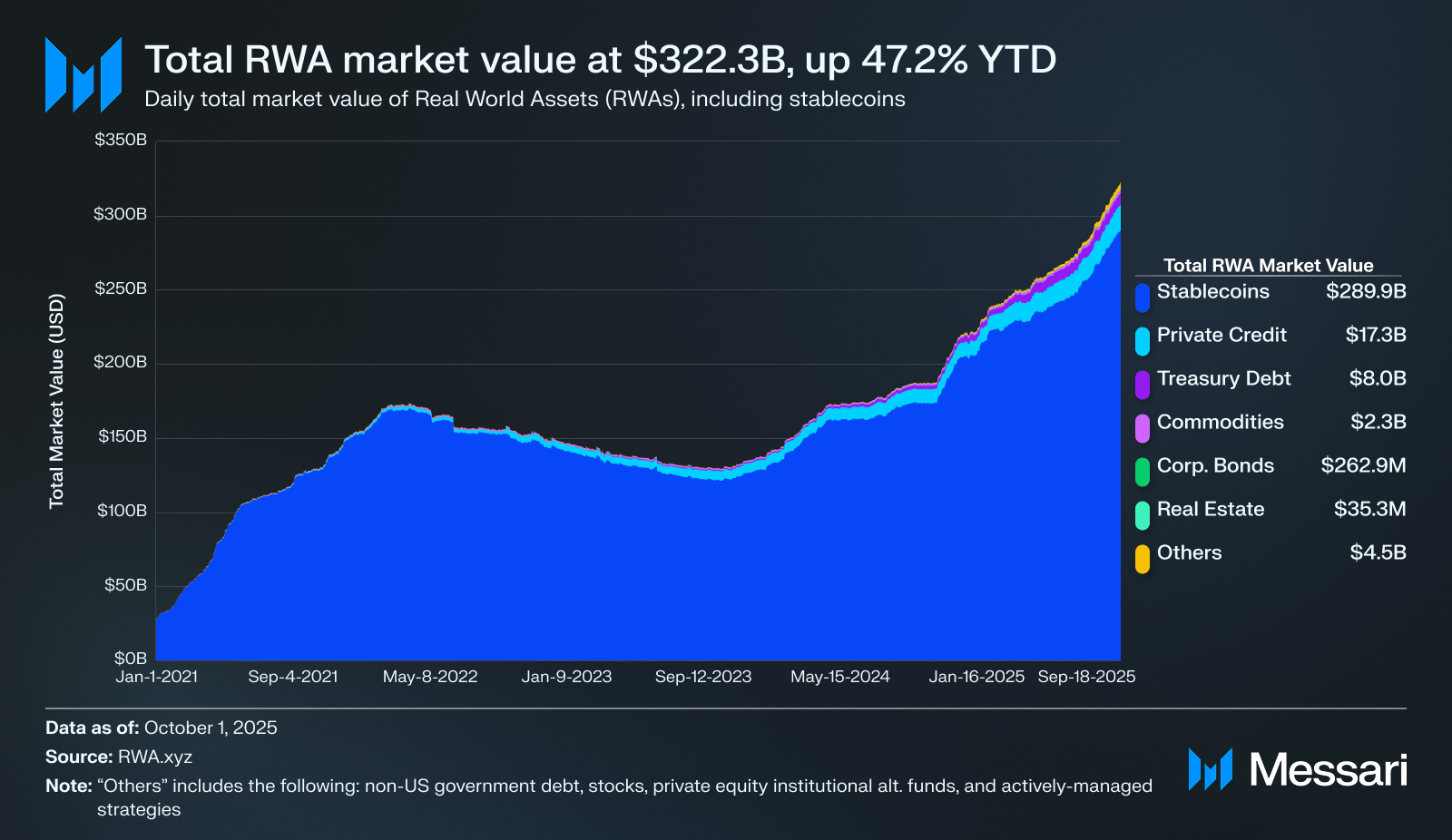
Similar to how the introduction of Chainlink Price Feeds powered the growth of the DeFi economy and apps like Aave, tokenized RWAs require standards for data, interoperability, compliance, and privacy, all of which are provided by Chainlink. Many of the largest RWA initiatives, including Ondo and xStocks, already rely on Chainlink’s infrastructure to anchor data and asset integrity. As institutional participation in tokenized markets expands, the adoption of standardized, proven infrastructure, such as Chainlink’s, is likely to deepen. Chainlink is the first data and interoperability oracle platform to achieve ISO 27001 certification and SOC 2 Type 1 attestation, further aligning it with established enterprise security requirements, positioning the protocol as an early enterprise-grade infrastructure suitable for real-world use cases.
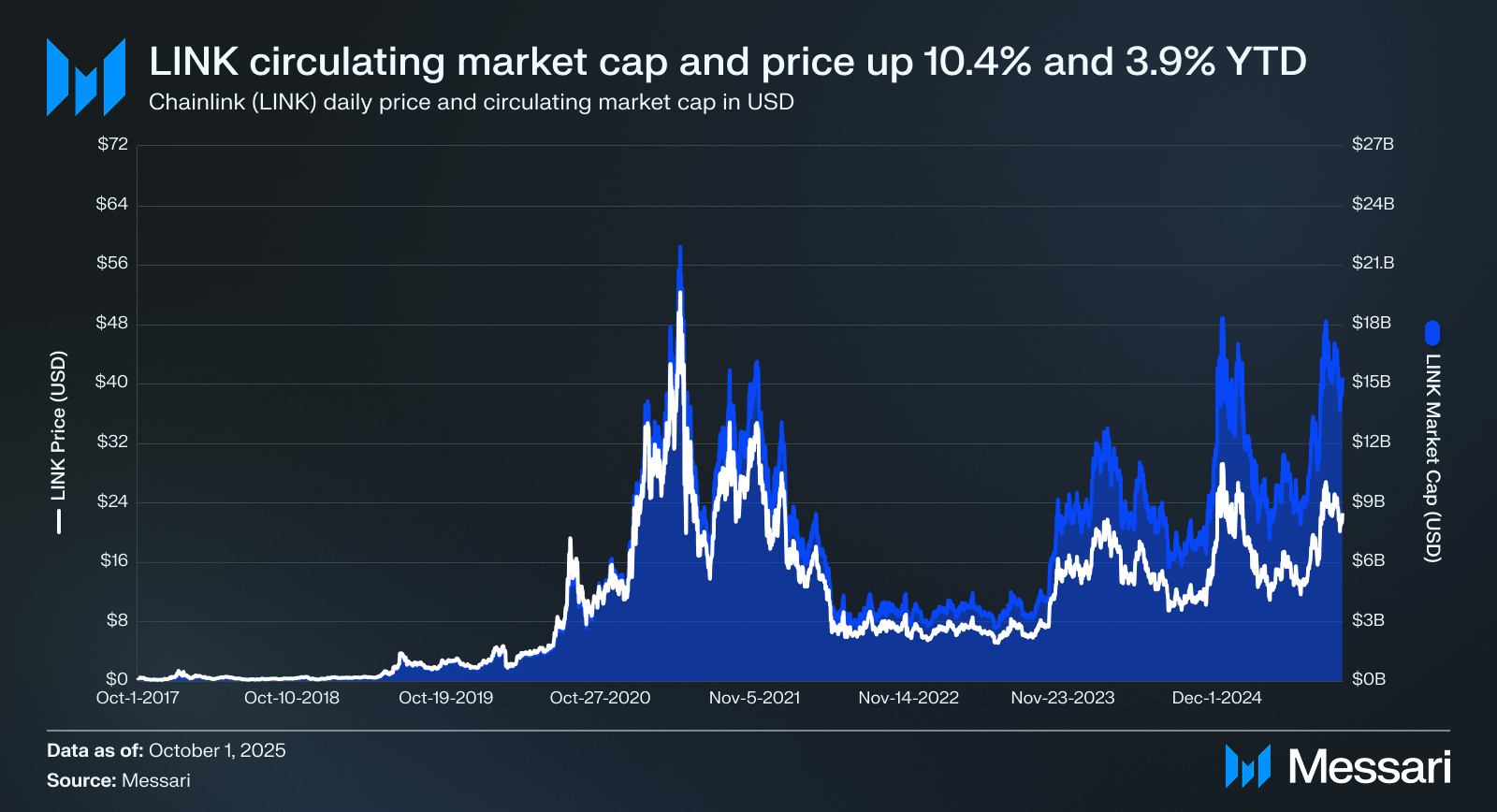
This broader scope also reframes the role of LINK, the network’s token. Originally launched in 2017 through a $32 million ICO, LINK currently serves as the unit of payment for oracle services, staking, and node incentives, anchoring Chainlink’s security model while evolving alongside new monetization and value capture mechanisms. Specifically, on Aug. 7, 2025, Chainlink announced the creation of the Chainlink Reserve, an onchain reserve of LINK tokens funded by both onchain service fees and offchain enterprise revenue. Using its new Payment Abstraction infrastructure, revenue can be programmatically converted into LINK and enter the Reserve. Notably, this includes a commitment that 50% of fees from staking-secured Smart Value Recapture (SVR) services, such as liquidation MEV collected from Aave markets, are now redirected into the Reserve. Since launch, the Reserve has accumulated over $9 million worth of LINK, with expectations to grow as adoption expands across capital markets and enterprise integrations.
In addition to the Reserve, Chainlink launched the Chainlink Rewards program, which lets Chainlink Build projects make their native tokens claimable by Chainlink ecosystem participants, including eligible LINK stakers. The Build program supports early-stage and established projects within the ecosystem by providing enhanced access to Chainlink services and technical support. In return, projects commit a percentage of their total token supply to the Chainlink ecosystem.
The first phase, Season Genesis, saw Space and Time distribute 100M SXT tokens to eligible LINK stakers, followed by Season 1, which features nine Build projects and a more advanced engagement and claiming mechanism.
Alongside this, the Chainlink Scale program helps blockchain ecosystems kickstart developer adoption by providing resources that cover the integration, maintenance, and operational costs of deploying Chainlink on their chains. These various initiatives, combined with usage-based payments (e.g., subscription contracts and per-call models) and revenue-sharing agreements (e.g., percentage of app revenue), highlight some of the different ways that users can pay for Chainlink services in their preferred form of payment, both in onchain and offchain methods, supporting the long term sustainability of the ecosystem.
The Evolution Into a Full-Stack Platform
Chainlink started with price feeds but has since broadened into a multi-standard infrastructure stack. Over time, five categories have emerged: (i) data, (ii) interoperability, (iii) compliance, (iv) privacy, and (v) orchestration. Each captures a different layer of market demand, ranging from high-frequency price delivery to institutionally compliant fund administration.
Chainlink Runtime Environment (CRE)
Underpinning the above categories is the Chainlink Runtime Environment (CRE), which was first introduced in 2024 and is now live in production. It acts as a modular upgrade that breaks core oracle functions into reusable capabilities (e.g., fetching data, performing consensus, and writing onchain) that can be combined into custom workflows.
Rather than relying on multiple fragmented solutions with different interfaces and trust models, developers can use CRE to coordinate all the Chainlink services their applications need within a single, unified orchestration layer. Specifically, developers and institutions can easily leverage the combination of onchain/offchain logic, onchain/offchain data, cross-chain connectivity, compliance rules, and privacy requirements into a single, reusable, and auditable workflow, unlocking institutional-grade smart contracts that interact across chains and offchain systems. CRE orchestrates the full lifecycle of these applications using a secure, verifiable execution layer. Developers looking to build with CRE can get started here.
Data Standard
All of Chainlink’s data oracle solutions are unified under the Onchain Data Protocol (ODP) standard. Data Feeds remain the backbone that secures lending and stablecoins with decentralized price oracles, while Data Streams take this further by providing low-latency data delivery aimed at use cases such as derivatives, perpetuals, and other high-speed DeFi markets, where sub-second-level precision is crucial. DataLink extends this layer to enterprises, offering a turnkey solution for publishing institutional-grade market data onchain without requiring new infrastructure. Most notably, it has been adopted by the Deutsche Börse Group to bring Eurex, Xetra, 360T, and Tradegate data to blockchain networks. Lastly, SmartData provides a suite of onchain data offerings designed to unlock the utility, accessibility, and reliability of tokenized RWAs, such as Proof of Reserves, Net Asset Value (NAV), and Assets Under Management (AUM) data. Together, these services turn offchain information (e.g., FX prices and fund NAVs) into reliable and cryptographically verifiable inputs usable by smart contracts across any blockchain.
Interoperability Standard
The next layer is interoperability. At the core of this sits CCIP (Cross-Chain Interoperability Protocol), the standard that enables digital assets and messages to move across 70+ public and private blockchains. Building on top of this, the Chainlink Cross-Chain Token (CCT) standard establishes rules for minting, burning, and redeeming assets as they flow between networks. Interoperability extends beyond tokens, allowing arbitrary data to move between chains, from settlement instructions to compliance checks, powered by the CCT Compliance Extension.
Diving deeper, CCIP also supports programmable token transfers that allow assets to carry embedded logic, unlocking advanced use cases, such as cross-chain swaps. It also enables gasless transactions in permissioned environments, an important feature for institutions, as it abstracts away the need for them to hold and manage native tokens.
Compliance Standard
Chainlink’s compliance framework is built around four key components:
The Cross-Chain Identity (CCID) system creates reusable digital identities by storing verified credentials (e.g., KYC/AML, jurisdiction, accreditation) onchain, without exposing sensitive personal information.
The Policy Manager provides a customizable rules engine that defines and enforces compliance requirements (i.e., transaction limits, sanctions checks, or eligibility criteria) at the asset or protocol level.
The Identity Manager acts as middleware that links offchain identity sources (e.g., KYC providers, legal entity identifiers) to onchain formats (e.g., CCID), ensuring credentials remain synchronized and verifiable across chains.
The Reporting Manager collects an auditable transaction log that combines onchain and offchain compliance data, documenting the reasoning behind why each transaction was approved or denied.
These services are built to manage compliance across complex multichain, multi-jurisdictional environments. They allow institutions to integrate compliance logic directly into digital assets and blockchain applications, allowing asset issuers to maintain control over their assets in public markets and providing DeFi protocols with a means to attract institutional liquidity by demonstrating compliance readiness. The components come together as an end-to-end solution for solving onchain compliance requirements through the Automated Compliance Engine (ACE).
Privacy Standard
Lastly, privacy represents another key requirement for institutional adoption. The Blockchain Privacy Manager allows private blockchain networks to connect to the public Chainlink platform and existing institutions, while only revealing the data necessary to process transactions. This underpins CCIP Private Transactions, a cross-chain solution that enables private blockchain networks to exchange encrypted amounts, counterparties, and terms onchain, while still meeting compliance requirements for authorized reviewers. Work like DECO, a zkTLS oracle, allows attestations of sensitive offchain data without revealing the raw input, complementing this privacy framework.
Building on these, Chainlink Confidential Compute unlocks fully private smart contracts on any blockchain, preserving the confidentiality of data, logic, external connectivity, and computation. Built on CRE, Confidential Compute across the full transaction lifecycle, from data inputs and identity checks to processing, cross-chain transfers, and settlement, without requiring applications to move to new blockchains. It combines trusted execution environments with cryptographic verification and Chainlink’s oracle infrastructure to enable secure, verifiable, and interoperable private computation. Collectively, this addresses one of the core institutional barriers to adoption: the need for confidential yet verifiable transactions across chains.
End-to-End Solutions
Outside the core standards, Chainlink has developed several end-to-end solutions on top of CRE that utilize Chainlink’s standards to orchestrate the full lifecycle of traditional market operations in a blockchain-native format. Chainlink ACE embeds automated regulatory checks and internal business rules into onchain workflows, enabling workflows such as KYC/AML screening before settlement. The newly launched ACE partner ecosystem initially comprises over 20 leading identity, risk, and compliance providers, including GLEIF, Chainalysis, TRM Labs, and Apex Group, whose services integrate directly with ACE to standardize onchain compliance. Notably, the Chainalysis partnership allows institutions to enforce Know Your Transaction (KYT) risk intelligence within ACE policies, automating cross-chain compliance decisions and audit reporting
Delivery versus Payment (DvP) ensures the asset and cash legs of a transaction settle atomically across chains or offchain through traditional payment rails while also supporting data, compliance, and external system integration requirements. Similarly, the Digital Transfer Agent (DTA) technical standard enables fund administrators and transfer agents to expand their operations onchain, while combining Data Feeds, Proof of Reserve, CCIP, and ACE to automate registrar functions and fund administration processes, such as subscriptions and redemptions. Chainlink also provides auxiliary infrastructure critical for day-to-day operations. Proof of Reserve verifies collateral backing for stablecoins, wrapped tokens, and RWAs, while VRF generates tamper-proof randomness for gaming, lotteries, and NFTs.
Chainlink Use Cases
Chainlink’s infrastructure and footprint span the entire stack of onchain finance. To date, the network has enabled over $26 trillion in transaction value, integrated by 2,400+ projects, and operates 2,000+ decentralized oracle networks (DONs).
The question now is how these building blocks come together in practice. A way to illustrate this is with a hypothetical stablecoin launched in a regulated environment. Its pricing and collateralization logic is secured by Chainlink Data Feeds and Proof of Reserve; compliance requirements are managed through the Automated Compliance Engine (ACE); programmability across blockchains is handled by CCIP; when transactions require confidentiality, the Blockchain Privacy Manager and Confidential Compute enables privacy-preserving data, logic, and transfers; and the whole stack comes together as a single workflow that is powered end-to-end through the CRE. While this example is illustrative, many of these workflows are already live in production.
Institutional Finance
In TradFi, Chainlink provides the connective tissue for financial market infrastructure, fund administrators, banks, and asset managers looking to bring regulated products onchain and enable financial institutions to connect to any blockchain using their existing infrastructure and messaging standards to power onchain finance. Chainlink’s standards and services enable compliance, reporting, and cross-chain operations without compromising on regulatory requirements. Key strategic partnerships include:
J.P. Morgan’s Kinexys: Partnered with Chainlink for cross-chain and orchestration capabilities to successfully complete a cross-chain Delivery versus Payment (DvP) transaction that combined a permissioned interbank payment network (Kinexys), a public blockchain (Ondo Chain), and a tokenized U.S. Treasuries Fund (OUSG).
UBS: Partnered with Chainlink under the Monetary Authority of Singapore’s Project Guardian and, through its UBS Tokenize initiative, completed the first live tokenized fund transaction using the Chainlink Digital Transfer Agent (DTA) standard with DigiFT; automating onchain fund subscriptions and redemptions for its USD Money Market Investment Fund.
ANZ: Partnered with Chainlink and ADDX in Project Guardian on a tokenized RWA use case for commercial paper, leveraging interoperability between private blockchains alongside its A$DC stablecoin.
Swift:Partnered with Chainlink to enable financial institutions to connect to any existing public/private chain using Chainlink and their existing Swift infrastructure and messaging standards.
DTCC: Partnered with Chainlink and 10 of the world’s largest financial institutions on a Smart NAV industry initiative to deliver key mutual fund data onchain, as well as on a corporate actions industry initiative that leveraged AI and oracles to solve the $58 billion corporate actions problem.
Euroclear: Partnered with Chainlink and 23 other financial organizations to launch AI-powered corporate action oracles to address the unstructured data challenge for the financial industry.
Mastercard: Partnered with Chainlink to allow over 3 billion payment cardholders to purchase crypto assets directly onchain via the new Chainlink-powered Swapper app, creating a unified, compliant, and intuitive user experience that brings crypto access to mainstream payment cardholders.
Fidelity International:Partnered with Chainlink on a landmark live production use case for tokenized assets where NAV data for Fidelity’s $6.9 billion Institutional Liquidity Fund is onchain via Chainlink, enabling real-time transparency for tokenized fund shares on zkSync.
Deutsche Börse Group: Deutsche Börse Market Data + Services, a business unit of Deutsche Börse Group, partnered with Chainlink to publish its market data onchain for the first time via DataLink, including real-time data from the largest exchanges in Europe, Deutsche Börse Group’s Eurex, Xetra, 360T, and Tradegate.
Apex Group: Partnered with Chainlink and the Bermuda Monetary Authority to build an institutional-grade stablecoin framework powered by CCIP, ACE, and Proof of Reserve, and continues to adopt Chainlink services to enable compliant tokenization and liquidity solutions across its $3.5 trillion AUM client base
SBI Group: Partnered up with Chainlink to expand institutional tokenization in Asia for fund tokenization, NAV reporting, and PvP settlements under Project Guardian, with plans for yen-backed stablecoins and real estate tokenization. In addition, SBI Group’s digital asset arm, SBI Digital Markets (SBIDM), is adopting Chainlink as its exclusive infrastructure solution to power its digital assets platform.
WisdomTree: Partnered with Chainlink to use DataLink Services for bringing NAV data onchain for its $130 billion AUM Private Credit and Alternative Income Fund (CRDT), marking the first tokenized private credit fund with verifiable onchain NAV transparency and expanding Chainlink integration across its broader tokenized fund suite.
GLEIF: Partnered with Chainlink to establish a new institutional-grade identity solution that combines GLEIF’s verifiable Legal Identity Identifier (vLEI) with Chainlink’s ACE and infrastructure for Cross-Chain Identity (CCID) to enable digital asset transactions that are verifiable, compliant, and trusted across jurisdictions while preserving user privacy.
S&P Dow Jones Indices and Dinari: Partnered with Chainlink to power the upcoming S&P Digital Markets 50 Index, the first tokenized benchmark combining leading U.S. equities and major digital assets, using Chainlink’s oracle infrastructure to deliver verified, real-time index data for transparent, onchain pricing and performance.
FTSE Russell: Partnered with Chainlink to bring global index data for the Russell 1000, Russell 2000, Russell 3000, and FTSE 100 Indexes; WMR FX benchmarks; FTSE DAR Digital Asset Prices; and FTSE Digital Asset Indices across blockchains via DataLink.
Tradeweb: Partnered with Chainlink to publish its U.S. Treasury data onchain for the first time via DataLink, making its FTSE U.S. Treasury Benchmark Closing Prices available to 2,000+ onchain applications across 60+ public and private blockchains in the Chainlink ecosystem.
DeFi
In DeFi, Chainlink is embedded across lending, derivatives, and tokenized asset platforms. In-production adoption of Chainlink includes:
Aave: Launched into production in 2020 with Chainlink and now secures $70+ billion in TVL across all lending market deployments through Price Feeds since inception; uses NAVLink feeds for pricing RWAs on the Horizon market (with additional risk protections via LlamaGuard NAV); recaptures non-toxic liquidation MEV through SVR feeds; validates bridged asset collateralization through Proof of Reserve; enables cross-chain transferability of Aave’s native stablecoin GHO through CCIP; and leverages custom oracle solutions like L2 sequencer flag feeds for enhanced risk management on L2 networks.
Kamino: Partnered with Chainlinked to leverage low-latency market data through Data Streams to secure the largest DeFi lending protocol on Solana, with $2+ billion in TVL.
Lido: Partnered with Chainlink to make CCIP the official cross-chain infrastructure for Wrapped Staked Ether (wstETH). Lido also utilizes CCIP to support cross-chain liquid staking of ETH on Ethereum L2s and Data Feeds to price and secure its liquid staking tokens across chains and DeFi protocols, such as on Aave.
Securitize: Adopted the Chainlink data standard to price Securitize tokenized funds used as collateral on Aave's Horizon, starting with VanEck's first tokenized fund, VBILL.
xStocks: Partnered with Chainlink to adopt CCIP for cross-chain transferability of tokenized U.S. equities, Proof of Reserve for collateralization verification, and Data Streams for pricing RWAs across DeFi and integrating with corporate actions data.
ether.fi:Partnered with Chainlink to integrate Proof of Reserve to provide verifiable proof of the reserves backing its staked assets, assuring users that their funds are secure.
Pendle: Partnered with Chainlink to adopt the Chainlink data standard to access funding rates onchain to power its newly launched futures platform, Boros.
Maple Finance: Partnered with Chainlink to power syrupUSDC with Price Feeds and CCIP, surpassing $2 billion in AUM and $130 million in cross-chain volume.
Spiko Finance: Partnered with Chainlink to integrate CCIP to let money market fund shares transfer seamlessly across chains, eliminating the need for manual redemption and resubscription.
Closing Summary
Chainlink has evolved from a price feed oracle into an all-in-one oracle platform and a global set of standards for onchain finance, encompassing data, interoperability, compliance, privacy, and orchestration. Its services now support decentralized protocols and traditional institutions, securing tens of billions in value and providing the common framework for tokenization, settlement, onchain data distribution, private smart contracts, and automated fund administration. In DeFi, Chainlink anchors lending platforms like Aave and Kamino with secure data, powers cross-chain liquid staking with Lido, enables broad distribution of tokenized U.S. equities with xStocks, and powers tokenized money market funds via Spiko. In traditional finance, Chainlink facilitates cross-chain settlement of tokenized assets with J.P. Morgan, enables fiat settlement of tokenized funds with UBS, collaborates with Swift to enable institutions to connect to any public/private blockchain, and addresses corporate actions reporting using AI oracles and Euroclear. These integrations highlight its function as connective tissue between fragmented systems. Looking ahead, the trajectory points toward Chainlink as the full-stack platform for onchain finance. By combining data, compliance, programmability, interoperability, and privacy into a single orchestration layer, Chainlink positions itself as the infrastructure underpinning stablecoins, tokenized funds, and other financial applications that require verifiable, compliant, and interoperable infrastructure.
This report was commissioned by Chainlink Labs. All content was produced independently by the author(s) and does not necessarily reflect the opinions of Messari, Inc. or the organization that requested the report. The commissioning organization may have input on the content of the report, but Messari maintains editorial control over the final report to retain data accuracy and objectivity. Author(s) may hold cryptocurrencies named in this report. This report is meant for informational purposes only. It is not meant to serve as investment advice. You should conduct your own research and consult an independent financial, tax, or legal advisor before making any investment decisions. Past performance of any asset is not indicative of future results. Please see our Terms of Service for more information.
No part of this report may be (a) copied, photocopied, duplicated in any form by any means or (b) redistributed without the prior written consent of Messari®.