Celestia's Modular Stack: Abstracting Data Availability from Consensus

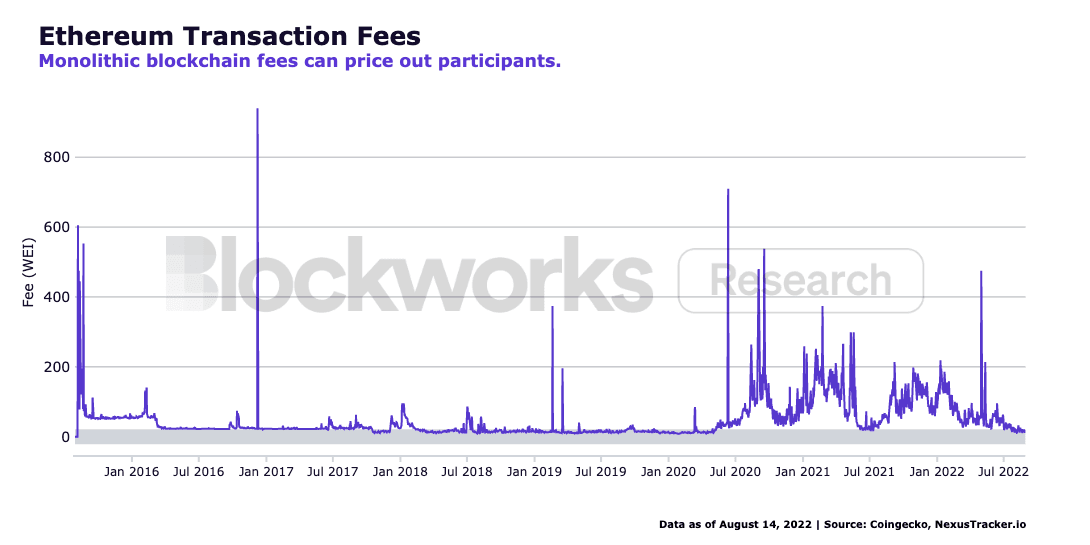
While monolithic blockchains, such as AVAX, ETH, or SOL, have scaled the industry to what it is today, they do not come without flaws. At the market’s peak, a simple Ethereum transaction could cost upwards of $150. On a given event, such as the Otherside land sale, Ethereum transaction fees momentarily spiked to nearly $600-$800. Further, a transaction on Ethereum can take anywhere from 30 seconds to five minutes to confirm, which isn’t necessarily a prime experience when you consider that a transaction on Venmo appears nearly instant to the user.
Modular blockchains pose a paradigm shift to the status quo of monolithic Layer 1 networks (ETH, AVAX, SOL) seen today. By separating four core parts of a blockchain - consensus, data availability, settlement, and execution - into separate layers, modular blockchains theoretically scale far easier with significantly less hardware requirements. Through cheaper transaction fees, faster throughput, and a clear path to decentralization, modular blockchains will shake up the state of the industry. This report dives into Celestia, which is leading the way in creating a composable and sovereign blockchain that is interoperable with most architecture today.

Through the introduction of a data availability layer, modular blockchains theoretically address the issue of expensive and unpredictable base layer fees, leading transaction fees to be associated primarily with the usage of a specific rollup. A modular blockchain is a type of blockchain that is part of a modular stack, which consists of layers of specialized blockchains that rely on each other to create an entire system. To better understand modular blockchains, we should first break down four proposed major layers of a modular stack:
- Consensus - A crucial piece of security that allows network participants to agree and verify that a transaction or event on a blockchain actually has taken place via a single source of truth. Consensus concerns the actual ordering of transactions. Examples include proof-of-work (Bitcoin, Litecoin) and proof-of-stake (Ethereum 2.0, ATOM). Network validators are often incentivized to reach consensus with token rewards.
- Data Availability - The guarantee that a block proposer published all transaction data for a block and this data is available to other network participants. When a block producer proposes a new block, nodes participating in consensus should be able to download the block’s data and re-execute the transaction to confirm validity. Data availability provides the option for nodes to download transaction data for a block before it reaches consensus.

Pibblez leads coverage on emerging L1s, infrastructure, and stablecoins. Previously worked as a Research Analyst at Kraken.