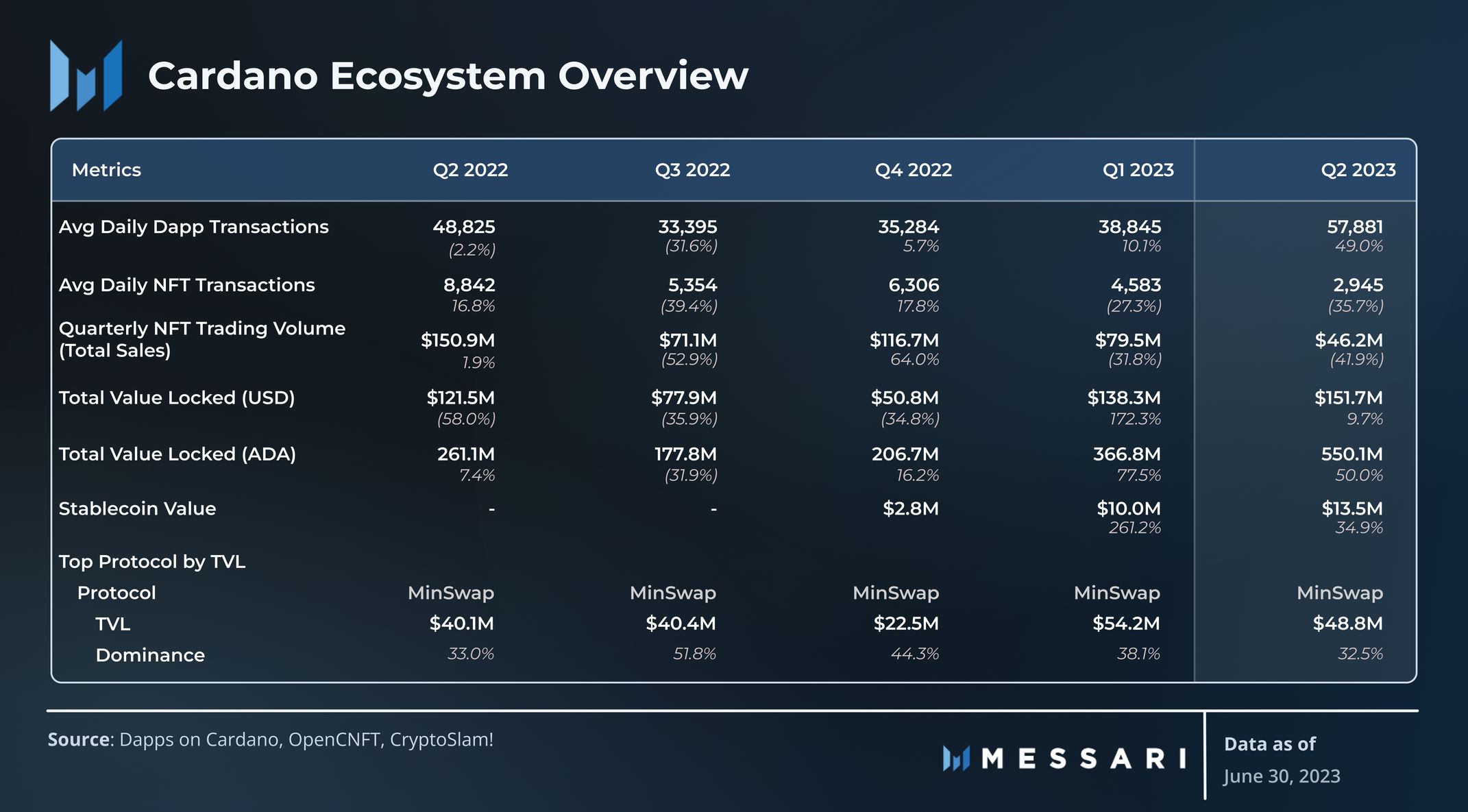
Stablecoin value was up 34.9% QoQ and 382.1% YTD. Indigo Protocol led stablecoin and synthetic asset issuance.
TVL dominance continued to shift toward new projects. Protocols created in the last ~6 months accounted for 47.4% TVL dominance in Q2.
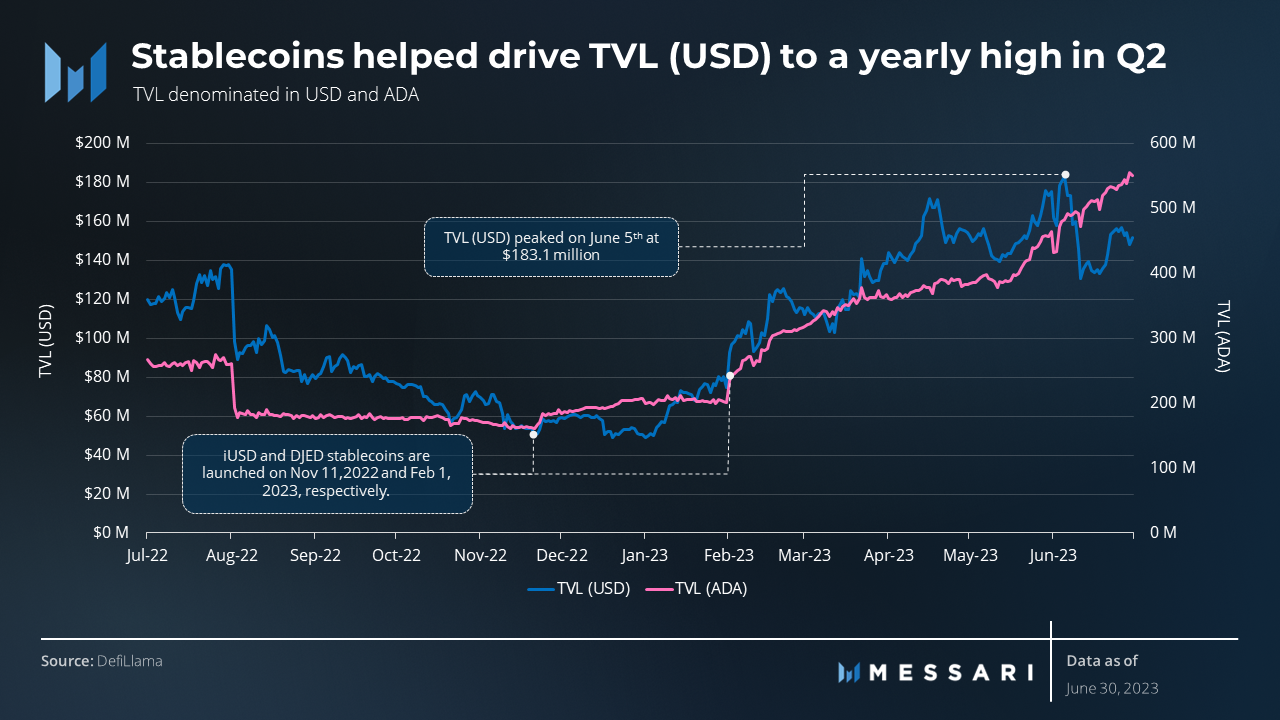
TVL (USD) was up 9.7% QoQ and 198.6% YTD. Through 2023, Cardano moved up from 34th to 21st in TVL ranking across all chains.
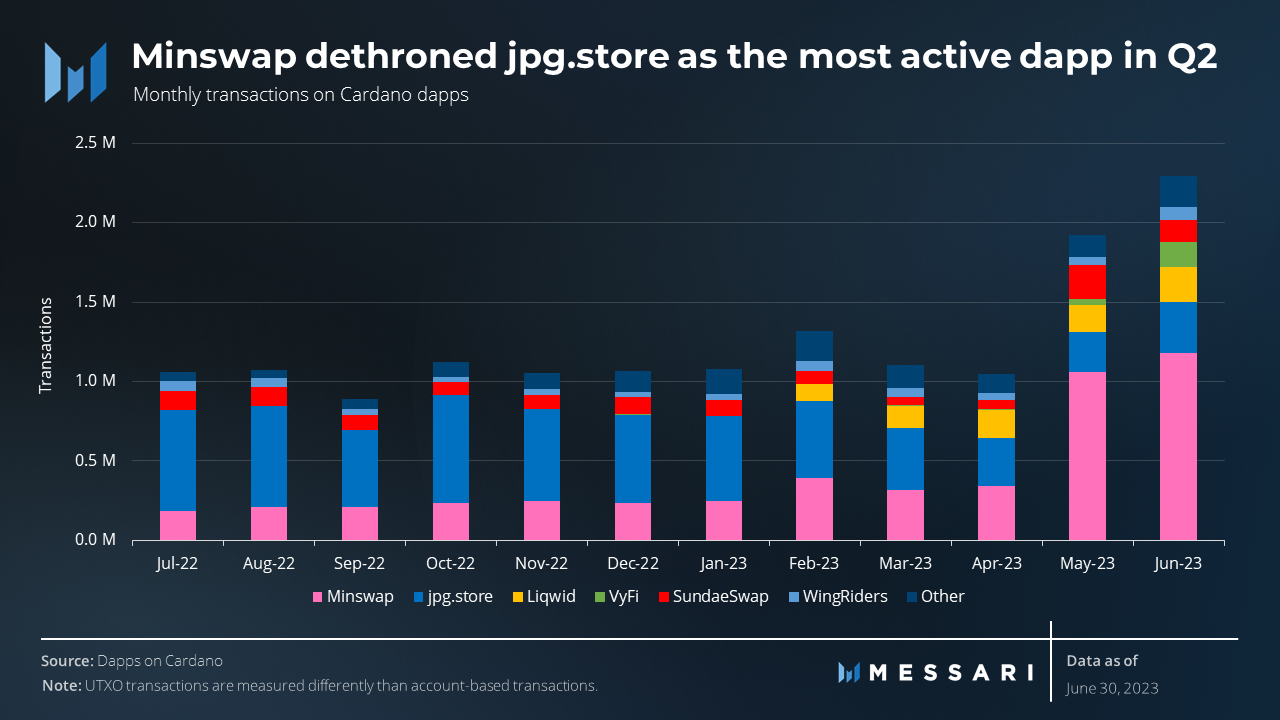
Average daily dapp transactions were up 49% QoQ. Minswap had the largest absolute growth, but several new dapps contributed to the overall increase.
Note: This Ecosystem Analysis explores Cardano’s ecosystem in depth within the scope of Q2 2023. The ‘Network’, ‘Financial’, and ‘Staking and Decentralization’ overviews are explored in the State of Cardano Q2 2023 report. In addition, Cardano uses a variant of the unspent transaction output (UTXO) accounting model, like Bitcoin. Activity metrics such as those involving address and transfers are fundamentally different from those on networks with account-based accounting models (e.g., Ethereum, Solana).
Ecosystem Performance Analysis
Average daily dapp transactions increased for the third consecutive quarter. Dapp activity accelerated to a 49.0% QoQ increase in Q2, averaging 57,900 daily transactions.
Minswap, an automated market maker (AMM), was the most popular Cardano dapp by transactions in Q2, clearing 1 million monthly transactions in May and June. Increasing 167.5% QoQ, Minswap surpassed the leading NFT marketplace jpg.store in dapp transactions. This aligned with an overall sectoral shift, as DeFi activity rose and NFT activity declined.
TVL (USD) also increased in Q2, up 9.7% QoQ to $151.7 million. This TVL increase is impressive in light of ADA’s 26.9% price decline in Q2. Cardano’s 198.6% YTD increase in TVL (USD) boosted its TVL ranking among all networks from 34th to 21st in 2023.
Stablecoins, arguably the most important piece of infrastructure behind this TVL run, also grew in both absolute and relative terms. The total stablecoin market cap grew 34.9% QoQ from $10.0 million to $13.5 million. Relative to other networks, Cardano’s stablecoin market cap moved up from 54th to 37th in 2023. Stable assets are ideal for pairing in liquidity pools, borrowing and lending, creating leverage, and quickly escaping volatility, which is quite common in the crypto market.
DeFi
Minswap remains the liquidity king of Cardano DeFi, ending Q2 with a TVL of $48.8 million and 32.2% dominance. AGIX/ADA was the most popular LP on Minswap, accounting for 37% of TVL as of the beginning of Q2, according to Minswap DAO (AGIX is a token for SingularityNet). Synthetic asset issuer Indigo Protocol, which was open-sourced in April, ended Q2 with a TVL of $31.5 million, increasing its dominance from 17.4% to 20.8%. Via Indigo’s Proposal #18 for an ADA/INDY incentivized liquidity pool was launched on Minswap.
The ADA deposited into Minswap’s liquidity pools (LPs) was previously all delegated to one stake pool. With the increase in TVL, that stake pool has become oversaturated. In June, a working group was recently formed to decide how to delegate additional LP ADA.
Newer protocols grew in absolute terms as well as relative terms, i.e., TVL dominance. Notable protocols launched in 2023 include:
VyFinance, a multi-headed platform with a DEX, redistributive mechanism (BAR), vaults, and more.
Indigo and Djed are the two main stablecoin issuers on Cardano. They issue the overcollateralized tokens iUSD and DJED, respectively. Indigo and Djed offer other tokens as well, such as Indigo’s synthetic asset iETH and Djed’s reserve token SHEN, which also contribute to TVL. Between the overcollateralization of the stablecoins themselves and the other assets created, protocol TVL is several times higher than the stablecoin market cap in the case of both issuers.
Users lock up ADA on Indigo as collateral in order to generate iUSD or other synthetic assets, known as a collateralized debt position (CDP). Liquidations occur in CDPs when the value of the locked-up collateral falls below a predefined threshold, triggering a margin call. If the CDP holder fails to address the margin call, the platform initiates a liquidation process, where a portion of the collateral is auctioned off to repay the borrowed stablecoins and fees. Liquidations help maintain the stability and solvency of the lending platform, ensuring that undercollateralized positions are resolved and reducing the platform's exposure to risk.
Following the SEC-induced ADA flash crash on June 6, hundreds of users were liquidated on Indigo Protocol, the largest stablecoin and synthetic asset issuer. Indigo performed well during its first true test of volatility. The protocol avoided any significant depegging when it liquidated millions of dollars worth of iUSD, iETH, and iBTC, even if the liquidations were slow.
In Q2, Indigo saw a total liquidation volume of $3.6 million from 870 liquidations. The June 10 spike included two of the top three liquidations by volume: one iETH liquidation worth $354,000 and one iBTC liquidation worth $262,000. These greatly exceeded the average volume of $39,000.
MELD, a borrowing and lending protocol, had concerns over the liquidation process with Cardano’s architecture in April that prevented them from launching. The absence of a fee market on Cardano makes the liquidation process different from that of established lending protocols and stablecoin issuers on other chains, such as Ethereum’s MakerDAO. IOG is working with the MELD team to address this risk of bad debt.
During the ADA flash crash, Indigo’s liquidation queue extended to nearly two hours for ~200 liquidations. This long queue was primarily a result of having a single liquidation bot processing liquidations serially. Other contributing factors were throughput limitations and concurrency limitations typical of DeFi architectures on Cardano. Given that batching transactions does not alleviate all concurrency limitations, Indigo chooses not to operate its own batchers over centralization concerns. The long queue gave more time for users to deposit more collateral to avoid being frozen/liquidated. It also left more time for collateral value to dip below the loan value, potentially creating bad debt, which was part of MELD’s concern. Indigo’s stability pool successfully worked as a preventative measure against bad debt, preventing any from occurring in Q2.
Indigo has witnessed 21 governance polls since December 2022, and its development roadmap items include:
Transaction chaining for the liquidation bot to further address queue times. This will increase throughput to process liquidations faster.
Updating the liquidation bot to process liquidations in parallel.
Oracle integrations, which will enable for support of new assets such as iEUR.
Automating rewards in collaboration with the Sundae Labs team.
DJED has its own hurdles to overcome, mainly with liquidity, as the token spent much of June priced around the $1.05 range. DJED requires a minimum reserve ratio of 400% with its reserve token SHEN. When the reserve ratio falls below that threshold, additional DJED cannot be minted, which can cause the existing DJED to trade at a premium. While it can depeg upwards (>$1.00), its redemption mechanism prevents a prolonged downward depeg (<$1.00). When DJED depegs upwards, which it did in Q2, it disincentivizes the burning of the stablecoin, as users would have to pay >$1.00 to redeem for $1.00. As a result, an upwards depeg can further delay repegging.
NFTs
NFT metrics were down QoQ nearly across the board. Average daily NFT transactions were down 35.7% QoQ to 2,900, and total quarterly trading volume fell 41.9% QoQ to $46.2 million. This is in line with the broader market, as even blue-chip collection floor prices have been dropping in 2023.
Overall, NFT activity is still driven by unique buyers rather than unique sellers, i.e., a relatively small number of sellers continues to sell to a larger number of buyers. NFT sales volume is largely concentrated in jpg.store with its 98% dominance. The next largest marketplace is the collection-specific market for SpaceBudz.
13 projects have crossed 10 million ADA in trading volume.
131 projects have crossed 1 million ADA.
501 projects have crossed 100,000 ADA.
Many developments in the NFT sector are not related to traditional PFP projects, but rather, they are related to real-world use cases and gaming. Notable NFT initiatives in Q2 include:
The UN Refugee Agency uses proceeds from NFT projects to assist refugees and fund their WRFGS stake pool to support long-term charity initiatives.
Empowa, a grant recipient from Fund 5 of Project Catalyst, used NFTs to fund a housing project pilot. The program aims to provide affordable, environmentally responsible housing as well as accessible housing loans.
Paima’s Stateful NFTs carry dynamic data such as game stats and achievements.
Milkomeda C1
Milkomeda C1 launched in early 2022 as Cardano’s first sidechain. It brought EVM compatibility to Cardano. While Milkomeda C1 does use a different virtual machine from Cardano, it still uses wrapped ADA as the base asset for fees and gas. Milkomeda C1 is primarily maintained by dcSpark.
The more promising metrics that represent new developments on Milkomeda are daily unique contract callers and daily total contract calls, which surged 279.9% and 273.2% QoQ, respectively. These increases can be attributed to the gaming sector. The Paima Engine is a framework for rollups focused on creating on-chain games and autonomous worlds. Paima-built rollups are true rollups with decentralized sequencing/proving, like Fuel V1, and unlike all other current rollups (including Ethereum rollups which are still centralized).
Since the Q1 release of Paima’s first game, Jungle Wars, many more games have launched. One such game, Tower Defense, had over 1,500 games played and 10,000 transactions in the first few days following its launch. This game crossed 500 unique players in the first week, which was a driving force for the surge in unique contract callers. More games are under development on Paima, including Tarochi, an on-chain, Pokemon-like MMORPG.
Milkomeda C1’s activity metrics and TVL have declined since Q2 2022, with the exception of average daily transactions increasing 8.2% QoQ from 6,200 to 6,700. Its TVL was led by native DEX Blueshift with nearly 50% dominance, and it did not experience the same YTD surge as Cardano mainnet. However, TVL could improve with future developments to make EVM contracts directly accessible to Cardano users from Cardano wallets.
Qualitative Analysis
Project Catalyst
Project Catalyst is a decentralized fund for innovative projects in the Cardano ecosystem, which utilizes the Cardano Treasury. In each funding round, ADA tokenholders vote on different proposals, with 1 ADA being equal to 1 vote. So far, Catalyst has funded 1,163 proposals in nine rounds, with the most recent fund ending in Q4 2022. Submissions for Fund 10 of the program opened in June and will run through Q3. There will be 50 million ADA (~$14 million) allocated to proposals in this fund among 13 Challenges (project categories). Anyone can submit proposals, whether it be new project teams, such as privacy protocol ENCOINS, or existing project teams, such as Minswap with its Stableswap initiative.
Participation and vote-selling (i.e., paying another user for their vote) are two points of focus in decentralized governance that affect nearly all groups and initiatives. Governance always has room for improvement, and the community is exploring different ways not only to assess proposals and distribute funds but also to increase participation and formalize vote-selling. Fund 9 had 354,000 votes cast, which represents a maximum of 6.8% of wallets, provided no wallet voted more than once.
As far as vote-selling goes, Fund 10 may become an enlightening case study on the topic. Vote-selling is possible either on or off chain and cannot be completely avoided. However, Optim Finance may drive this practice to the surface with its liquidity bonds (a vehicle to borrow and lend ADA delegation and, by extension, voting power). This service is unique to Cardano with its native liquid staking.
Cardano addresses have separate keys for payment and staking. This enables native liquid staking, meaning users can deposit ADA on protocols (i.e., the protocol contract owns the payment key) without having to also relinquish control of the stake key. This is handled differently by various protocols:
Indigo keeps the lender’s stake key attached to their own deposits, retaining voting rights for the lender.
Minswap attaches its own stake key to the lender’s deposits, transferring voting rights to the protocol.
Optim attaches the borrower’s stake key to the lender’s deposits, transferring voting rights to the borrower.
Optim’s model enables borrowers to pay a premium to gain additional voting power from lenders. Thus, a user can pay a relatively small premium to borrow many votes for a single epoch to vote on Catalyst proposals. Rather than fighting the existing vote-selling, the Optim team has chosen to make it transparent in order to strengthen governance in the long term.
Certain voting schemes, such as quadratic, conviction, and reputation-based voting, may be worth exploring, while other schemes, such as holographic, are likely counterproductive in addressing vote-selling. This latter scheme would depend on whether the community deems it to be an issue and not an opportunity for both yield and added transparency.
Development
Notable development events and efforts in Q2 include
Continued development on Marlowe, Aiken, and other programming languages.
A shared security model for sidechains was introduced, and development on several sidechains continued.
Hydra, a family of scaling protocols, continued development. Protocol teams, including Sundae Labs, are already exploring ways to leverage Hydra for an improved DeFi UX.
Mithril, a solution for light clients, continued development.
Lace V1.0went live. Lace is a light wallet platform compatible with browsers that aims to simplify UX. Development continues on a monthly release cadence.
The UTXO Selection Benchmarking tool was released by dcSpark. This tool helps developers create more efficient coin selection algorithms.
Programming Languages
Cardano developers are building developer tooling to support many languages.
Marlowe is a domain-specific language (DSL) and a set of tools developed to build and run smart contracts.
Aiken is a Cardano smart contract language and toolchain, which launched its alpha phase.
Plu-ts is a Typescript-based smart contract language.
Helios is a DSL that compiles to Plutus Core (i.e., Cardano on-chain validator scripts). Helios is a non-Haskell alternative to Plutus.
OpShin is a Python-based smart contract language and toolkit. It compiles Python 3 code into Cardano Smart Contract Assembly.
Marlowe, which launched in Q2, aims to simplify the process of creating, testing, and deploying smart contracts, enabling users to focus on the logic of the contract without needing to understand programming or DSL technicalities. The Marlowe deployment features tools and services, including the Marlowe programming language, Playground, Runtime, Runtime APIs, Command Line Interface (CLI), a starter kit repository with tutorials, and integration with Demeter Run.
Sidechains
IOG launched a toolkit for building custom sidechains for Cardano. The toolkit currently includes a technical specification for developing sidechains on Cardano and a chain follower. It was showcased alongside the announced proof-of-concept EVM testnet. In the future, the toolkit will entail templates for mainnet smart contracts and a sidechain module to interpret mainnet data.
Sidechains built with this toolkit will be validated by any participating Cardano SPOs. Their participation will be incentivized by additional rewards offered by the sidechain’s tokenomic model. The shared security model for Cardano mainnet and its sidechains bears some similarities to EigenLayer’s restaking model with Ethereum validators.
Milkomeda C1 is working towards increasing the adoption and utility of Cardano. The network already hosts an array of projects and is being further fueled by incubators and hackathons. New developments with Paima may position it to see increased adoption. Milkomeda and Paima plan to allow Cardano wallets to directly access EVM contracts.
Midnight is Cardano’s upcoming data-protection-focused sidechain. By leveraging zero-knowledge cryptography, Midnight aims to bridge the principles of DeFi with the requirements of TradFi. It will enable users to have selective data disclosure while meeting regulatory needs. They will also be able to choose which data they wish to keep private. Unlike Milkomeda, Midnight will have its own token called DUST.
World Mobile has plans to partner with IOG to build out its own sidechain. This proposed sidechain will use the Cosmos SDK; however, it is unclear what security model it will use.
Wanchain is an L1 PoS EVM blockchain and a decentralized blockchain interoperability solution. Since Q3 2022, it has been working to connect Cardano to fully heterogeneous blockchains, such as Ethereum, Polkadot, and Bitcoin. With these capabilities, Wanchain will serve as another EVM-compatible sidechain to Cardano. The Wanchain Foundation also recently announced that its bridge is now live on the Cardano preview testnet environment.
Hydra
Hydra is a family of scaling protocols, mostly L2s based on state channels. Hydra Head, the first solution from the set, is an off-chain mini ledger working between a small group of participants, similar to popular state channels such as Lightning. Hydra leverages the eUTXO model for a more efficient and flexible transfer from L1 to L2 and back, allowing for the isomorphic transfer of data. Hydra for Payments is an open-source toolkit for implementing payment solutions that will leverage Hydra Head.
The first Head on the Cardano mainnet, also known as a channel, was opened in a limited form in March 2023. Right now, the protocol can be considered to be in a “public beta.” Until the protocol is more thoroughly tested, the quantity of ADA committed is limited for user safety.
Heads can be used for a variety of use cases, from making P2P payments to moving dapp activity off chain onto cheaper Head channels. In Q4 2022, Sundae Labs demoed an instance of the SundaeSwap DEX on Hydra on testnet. Sundae Labs has submitted a proposal to Project Catalyst Fund 10 to secure funding for continued development. MLabs and IOG plan to leverage Hydra Head channels to execute auctions that will have higher throughput and be faster, and cheaper than if they were on L1.
Several topologies, or architectures, have been proposed for Hydra. Testing and development continued in Q2, with a mobile demo being shared.
Closing Summary
Cardano’s ecosystem is expanding in multiple directions, specifically with DeFi. New protocols are popping up for swaps, stablecoins, synthetics, and even services unique to Cardano, such as lending staking power. However, incumbent protocols are still building and maintaining a presence, as seen in Minswap’s dominant dapp activity in Q2. Despite its lead, Minswap faced more competition as newer protocols Indigo, Djed, Liqwid, and VyFi began to carve out pieces of TVL market share. With Project Catalyst Fund 10 in progress, the next generation of protocols and protocol features are on their way to establishing their own niches.
While DeFi certainly owned the spotlight in Q2, teams continued building in other sectors, such as NFTs, gaming, and L2s. NFT marketplace jpg.store was dethroned as the most active app, but it still processed over 1 million transactions in Q2. Paima Engine, a Layer-2 framework, has enabled games and autonomous worlds to reach production at much faster rates, as well as supported early use cases for token bound accounts. Similarly, scaling solutions like Hydra are in their infancy and may soon see certain dapp functionalities migrate off of the base network.
This report was commissioned by Input Output Global. All content was produced independently by the author(s) and does not necessarily reflect the opinions of Messari, Inc. or the organization that requested the report. The commissioning organization may have input on the content of the report, but Messari maintains editorial control over the final report to retain data accuracy and objectivity. Author(s) may hold cryptocurrencies named in this report. This report is meant for informational purposes only. It is not meant to serve as investment advice. You should conduct your own research and consult an independent financial, tax, or legal advisor before making any investment decisions. Past performance of any asset is not indicative of future results. Please see our Terms of Service for more information.
No part of this report may be (a) copied, photocopied, duplicated in any form by any means or (b) redistributed without the prior written consent of Messari®.
Red is a researcher, educator, and developer in the web3 space. Red's background is in electrical and software engineering. His main interest is privacy technology, through zero-knowledge proofs and general cryptography.
Red is a researcher, educator, and developer in the web3 space. Red's background is in electrical and software engineering. His main interest is privacy technology, through zero-knowledge proofs and general cryptography.