The Caldera Foundation's ERA Strategic Reserve launched with 3.9 million ERA accumulated from open-market purchases. The reserve is designed to help sustain validator participation and strengthen long-term security alignment across the network.
Caldera introduced the Metatoken Standard, enabling long-tail assets like governance tokens and memecoins to exist across multiple networks with a unified supply and identical contract address.
The Stablecoin Module, developed with M0, also launched and allows rollups to issue branded, yield-bearing stablecoins that return a portion of yield back to the rollup and integrate natively with the Metalayer for cross-chain connectivity.
Studio Chain, Intuition, and SANDchain all joined the Caldera ecosystem. Studio Chain introduced a dedicated gaming and entertainment rollup for the KARRAT Protocol, Intuition launched a knowledge-graph appchain using Arbitrum Orbit, and SANDchain deployed a ZK rollup to power its creator economy network.
With over 100 deployed chains, $326 million in TVL, and more than 1 billion transactions processed as of October 2025, Caldera is evolving into a modular operating system for Ethereum scaling.
Primer
Caldera functions as the central deployment hub for a diverse and interoperable ecosystem of rollups. With Caldera’s Rollup Engine, developers can launch rollups using popular tech stacks like OP Stack, Arbitrum Orbit, or ZK Stack. As of writing, October 17, 2025, Caldera reports that it powers more than 100 customizable L2 and L3 chains. Its networks have processed over 1 billion transactions and hold about $326 million in TVL. Across 30 tracked mainnet rollups, the ecosystem has generated more than 2,700 ETH (approximately $12 million) in onchain transaction fees. More than 40 million unique addresses interact with Caldera chains. Caldera was used to deploy some of the industry’s most active rollups, including Manta Pacific, ApeChain, K2, and Sanko, which host applications like DeFi, AI, and Gaming.
With this foundation, Caldera enables powerful appchains (or application-specific rollups) built with custom environments tailored to each project’s needs. For example, gaming-focused rollups could implement gasless transactions, so users can join and play without funding a wallet. Rollups that require more throughput can choose between a variety of alternative data availability layers like Celestia, Near, EigenDA, and Arbitrum Anytrust.
After helping teams launch the deployment of over 100 rollups since April 2023, Caldera is addressing the next major challenge in scaling: blockchain fragmentation.
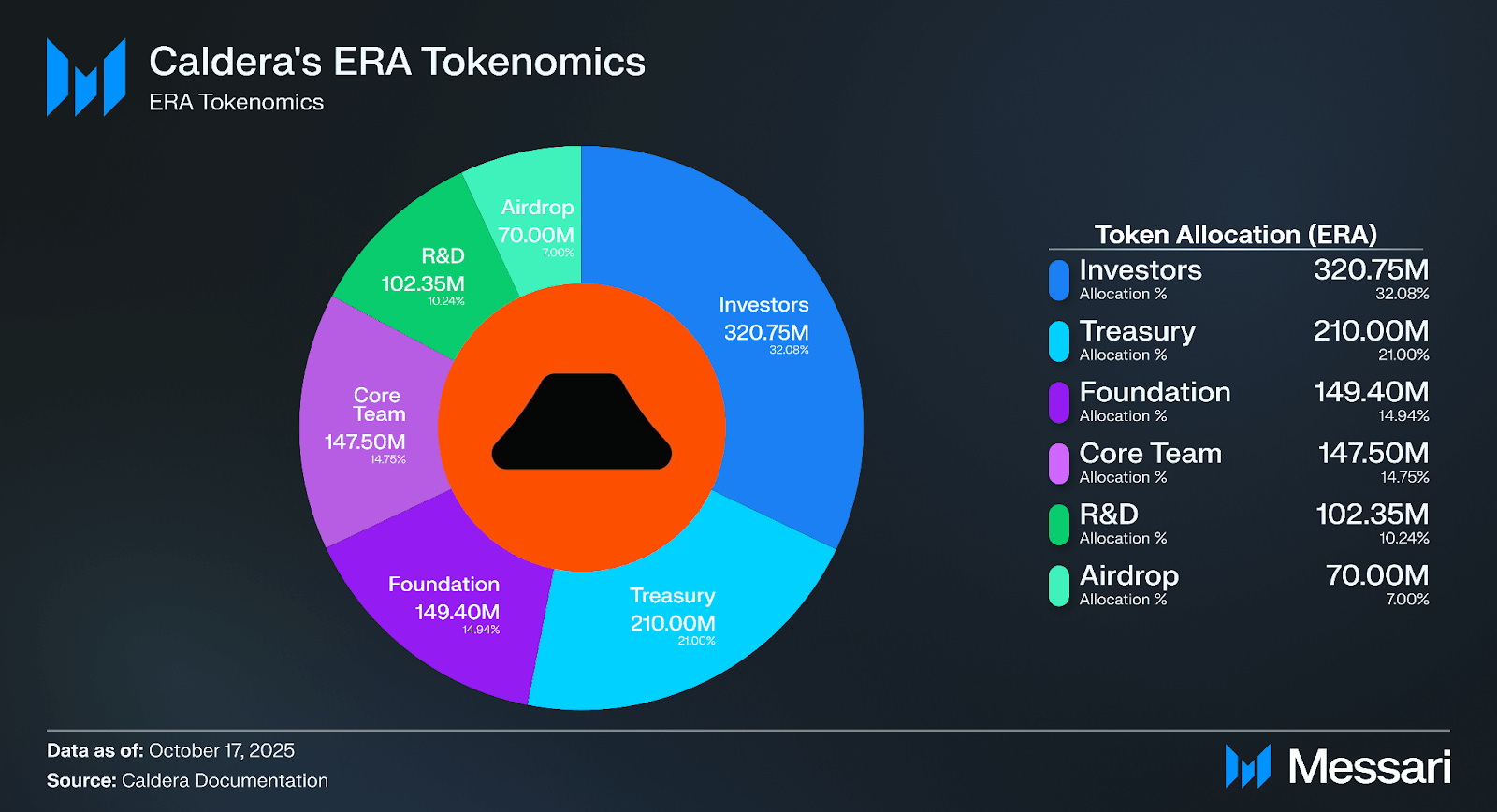
The Caldera Foundation introduced ERA, a utility and governance token, with a fixed supply of 1 billion tokens. An initial 7.0% (70 million tokens) of the total supply was allocated to a retroactive airdrop to community and ecosystem participants. The pre-claims process for the airdrop opened on July 10, 2025, and the token launched on July 17, 2025.
The total supply of ERA is fixed at 1 billion tokens, allocated among the core team, investors, community treasury, R&D, and the foundation. For a full tokenomics and vesting breakdown, see our prior Pulse.
The ERA token has the following core utilities:
Omnichain gas for the Metalayer: Cross-chain interactions and data propagations that use the Metalayer will incur a fee denominated in ERA.
Staking and security: Validators stake ERA to secure and verify cross-chain messages across the Metalayer.
Governance: ERA holders will be able to participate in Caldera Improvement Proposals (CIPs) that cover protocol upgrades, distributing ecosystem grants, and elections for Foundation and sub-council (e.g., a security council) members.
What the ERA Reserve Is
The Caldera Strategic Reserve, announced on September 17, 2025, is designed to support long-term network growth and resilience by purchasing and locking ERA. The Caldera Foundation accumulates ERA by converting multiple liquidity streams into ERA purchases for the reserve, including:
Onchain and offchain revenue
Enterprise partnership contracts
Liquidity provisioning fees
Other funding sources
During the initial phase, the foundation purchased 3.9 million ERA from the open market. The foundation has stated that withdrawals are not planned from the reserve, and that as additional liquidity streams flow in, they will increase the reserve size over time.
As ERA serves the Metalayer’s validator and cross-chain messaging design, building a structural reserve may help strengthen security alignment across the network.
New Product Lines
While the rollup-centric roadmap has helped Ethereum scale, it has introduced additional challenges, including:
Fragmented bridging experiences across providers with inconsistent security models and confusing UX.
Asset isolation where tokens remain confined to their origin chains.
Increased developer overhead from integrating applications on many separate chains.
Liquidity scattered across a large number of disconnected networks.
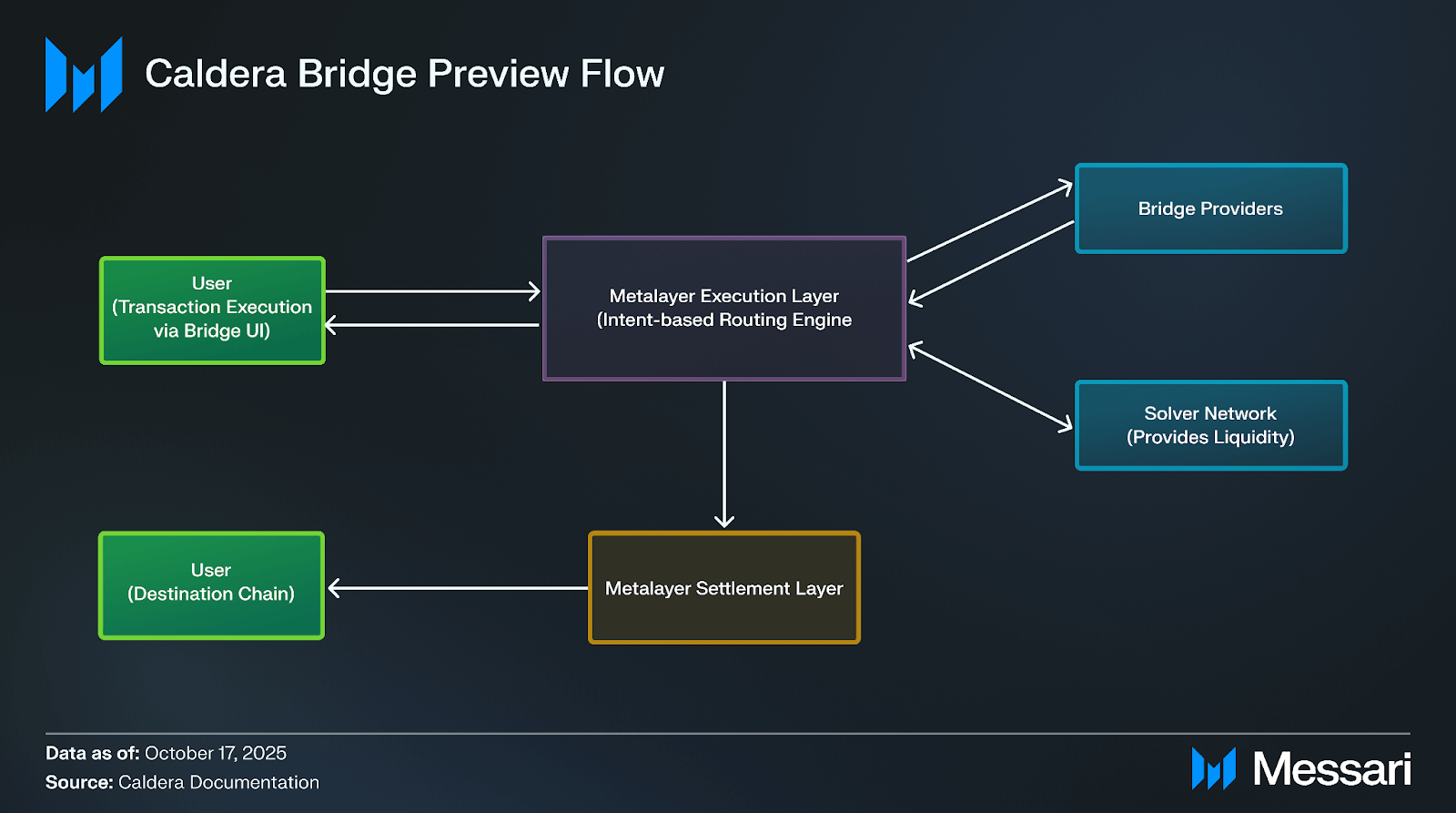
Caldera’s Metalayer is intended to solve these problems through two initiatives. The first is the Caldera Bridge Preview, which aggregates quotes from native bridges, intent-based protocols, and specialized providers to route transfers efficiently. We covered the aggregator in detail in our prior Pulse here.
The Metatoken standard provides a framework for cross-chain asset portability within the Metalayer. While intent-based bridging, provided by solutions like the Bridge Aggregator, is well-suited for routing major assets like ETH or USDC, the lack of deep liquidity can leave the long tail of tokens (i.e., governance tokens or memecoins) isolated on their origin chains. The Metatoken standard addresses the isolation of long-tail assets by enabling any ERC-20 token to be deployed cross-chain and exist natively across multiple networks, such as Base and BNB Chain.
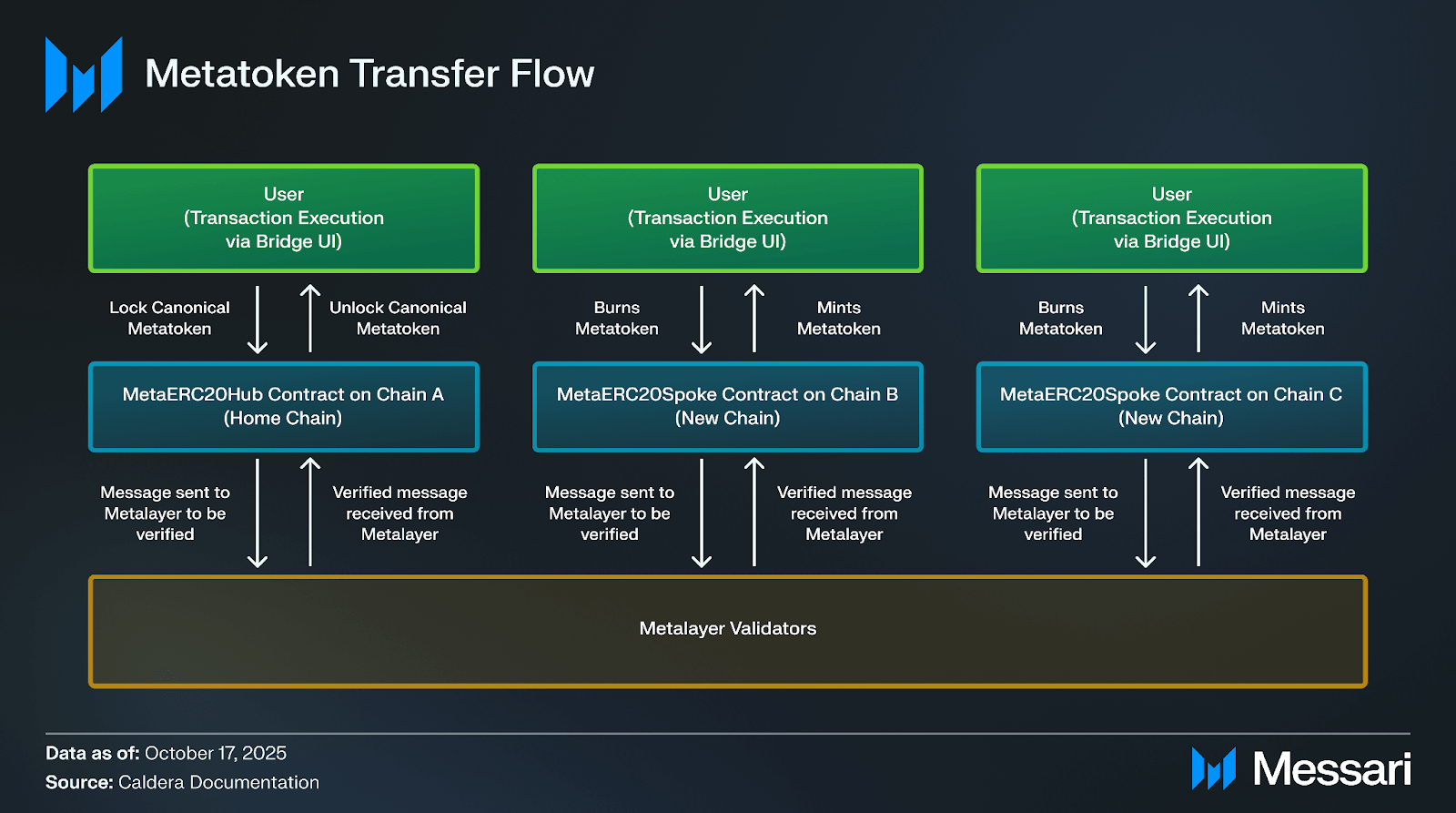
Metatoken uses a lock-and-mint mechanism. Tokens are locked on their home chain, then Metalayer messaging authorizes an equivalent mint on the destination chain. To move again, the wrapped version is burned on the current chain, and a new message authorizes a mint on the next chain. Returning to the home chain burns the wrapped tokens and unlocks the original.
Unified Supply: Issuers maintain a single global token supply, which removes confusion and the risk of unofficial wrappers.
Capital Efficiency: Direct accounting removes the need for bridging liquidity pools, which eliminates slippage and reduces operational complexity.
Expanded Network Effects: Using the Metalayer, tokens can extend into new ecosystems to integrate with additional applications and reach new users.
Faster exits from optimistic rollups: Metalayer-powered routes can get transfers around the 7-day challenge period for withdrawals from optimistic rollups.
Application-Owned Security: Issuers can set rate limits and other policies. Security is built on Metalayer's verified messaging.
Seamless User Experience:Deterministic contract addresses allow for a token to have the same contract address across every chain making verification simple, and transfers can confirm in seconds through Metalayer’s messaging system.
In combination, these features can help to convert isolated ecosystem tokens into composable, multi-network assets.
Stablecoin Module
The Stablecoin Module lets rollups issue a native stablecoin that operates across Metalayer-connected networks. The stablecoin maintains one unified supply and uses the same contract address on every chain.
Today, most rollups rely on a patchwork of wrapped stablecoins from different bridges, which fragments liquidity and forces applications to support multiple versions of the same asset. Multiple new chains have realized these problems and are launching their own native stablecoins like MegaETH and Hyperliquid.
Caldera aims to provide this ability for its ecosystem, through its Stablecoin Module, by giving projects a toolkit to launch a branded, white-labeled, yield-bearing stablecoin, that is integrated directly with the Metalayer for cross-chain connectivity.
Caldera partnered with M0 to build the module, which provides users with a widget, SDK, and API, so they can mint, deposit, and move stablecoins seamlessly across ecosystems.
Key advantages include:
Unified Liquidity: Each rollup can consolidate activity around a single native stablecoin rather than managing multiple wrapped stablecoins.
Instant Connectivity: Metalayer routing lets users move stablecoins across connected networks, and over time, on-ramp directly from CEXs and fiat gateways.
Sustainable Revenue: Rollups can capture a portion of stablecoin yield to fund their ecosystem’s growth, while the remaining share accrues to users as passive yield on their stablecoin holdings.
Chain Launches and Partnerships
Caldera continues to expand its modular rollup and interoperability stack into new verticals through new chain launches and partnerships.
Studio Chain Launch
Caldera partnered with the KARRAT Foundation on Oct. 23, 2025 to launch Studio Chain. Studio Chain is a dedicated appchain built with Caldera’s Rollup Engine on Arbitrum Orbit. The chain powers the KARRAT Protocol and launches with AMGI Studio’s flagship game My Pet Hooligan, which has over 500,000 downloads on Epic and Steam. The KARRAT token functions as both a gas and governance token, and aligns network operations with community participation.
To meet performance needs, Studio Chain is launching a rollup with low latency and predictable costs. The network introduces Resiliency Nodes, which are designed to improve uptime and security through open community participation rather than licensed operators. Through Caldera’s Metalayer, it connects to networks like Base and BNB Chain for interoperable gaming experiences and shared liquidity.
SANDchain Chain Launch
Caldera partnered with The Sandbox on Sept. 30, 2025 to launch their chain, SANDChain. The Sandbox is building a creator-focused blockchain designed to power the financial infrastructure of the creator economy. The protocol enables creators to own their revenue streams, tokenize their communities, and access programmable funding tools like Creator Vaults and Creator Tokens.
To support this vision, the SANDchain Foundation launched a dedicated chain using Caldera’s Rollup Engine and ZKsync’s ZK Stack. As a Caldera chain, SANDchain connects to the Metalayer from day one, which makes it easier for fans and patrons to onboard capital from major ecosystems. With Metatoken support for ecosystem assets, SANDchain can unify liquidity, streamline on-ramps, and provide a portable asset base for creators and partners.
Intuition Chain Launch
Caldera partnered with Intuition on Aug. 29, 2025 to launch their chain. Intuition is building a protocol that turns data and knowledge into programmable, onchain assets. To do this, the protocol allows users to make verifiable claims or "attestations" about anything (e.g., a smart contract's trustworthiness or a user’s reputation). Users would then be rewarded for accurate data and penalized for misinformation.
To scale this model, Intuition launched a dedicated appchain that settles to Base using Caldera’s Rollup Engine via the Arbitrum Orbit tech stack. This provides Intuition with the control and performance needed to handle large amounts of attestations. The partnership enables Intuition to focus on protocol logic while Caldera manages sequencing, batching, and settlement.
Through the Metalayer, Intuition also gains seamless cross-chain communication, and by adopting Caldera’s Metatoken standard, its native TRUST token can exist across multiple chains with a single supply and deterministic contract addresses.
B3 Partnership Developments
B3 is one of Caldera’s earliest partners and now runs a horizontally scaled gaming ecosystem with dedicated rollups for games such as Parallel and InfiniGods. support the Metatoken standard across its gaming L4s and the B3 Layer 3, enabling the B3 token to function as a universal currency across game chains. Players can earn on one game chain and spend on another without traditional bridge delays or fragmented wrappers. In addition, through the Metalayer, B3 also benefits from fast exit routes that avoid the 7-day challenge period on optimistic rollups, improving player UX and liquidity mobility.
Closing Summary
Caldera’s trajectory reflects a shift from pure rollup deployment to an interoperability platform. The Caldera Foundation’s ERA Reserve introduces a structural mechanism that converts ecosystem revenues into locked ERA and aligns validator security with long-term growth.
On the product side, Metatoken and the Stablecoin Module extend the Metalayer into asset portability and yield-bearing, chain-native liquidity. These releases aim to reduce fragmentation across long-tail tokens and wrapped stablecoins and to turn isolated assets into composable, omnichain capital.
Ecosystem growth continued with Studio Chain, SANDchain, and Intuition. Altogether, Caldera chains collectively hold about $326 million in TVL and have generated roughly $12 million in cumulative revenue. Taken together, these launches and metrics illustrate how Caldera’s stack, including the Rollup Engine, the Metalayer, and the Metatoken standard, is coalescing into a cohesive “Internet of Chains” spanning financial, compute, and content networks.
This report was commissioned by Caldera. All content was produced independently by the author(s) and does not necessarily reflect the opinions of Messari, Inc. or the organization that requested the report. The commissioning organization may have input on the content of the report, but Messari maintains editorial control over the final report to retain data accuracy and objectivity. Author(s) may hold cryptocurrencies named in this report. This report is meant for informational purposes only. It is not meant to serve as investment advice. You should conduct your own research and consult an independent financial, tax, or legal advisor before making any investment decisions. Past performance of any asset is not indicative of future results. Please see our Terms of Service for more information.
No part of this report may be (a) copied, photocopied, duplicated in any form by any means or (b) redistributed without the prior written consent of Messari®.
Kaleb was previously a research and governance analyst at 404 DAO. His primary interests are high performance L1 and L2 chains and innovative DeFi protocols.
Kaleb was previously a research and governance analyst at 404 DAO. His primary interests are high performance L1 and L2 chains and innovative DeFi protocols.