Build on Bitcoin: BTC Meets the EVM

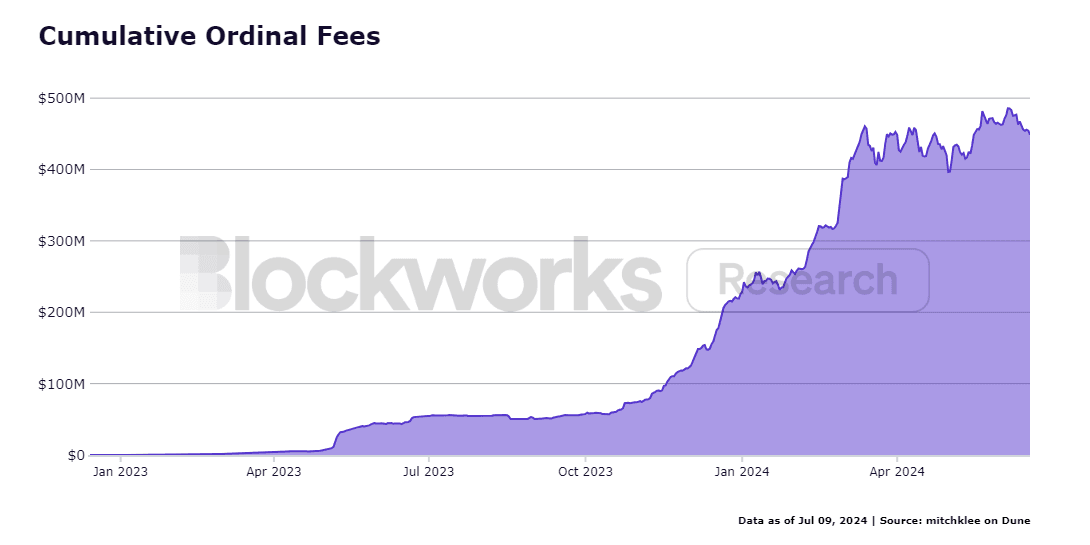
Over the past year, Bitcoin has unexpectedly emerged as a hub for NFT activity. Since the release of Ordinal Theory, a protocol for assigning arbitrary data to satoshis, the smallest unit of BTC, there has been a large uptick in Bitcoin network activity. The surge of transactions was so great, that inscriptions made up to 21.5% of total fee revenue for the first half of 2023, while total fees made up 5% of miner revenue. Inscription activity has exhibited volatility, and new standards like Runes only serve to continue the trend. Galaxy Digital predicts the inscription market to be a $5B opportunity in the base case (Galaxy). While inscriptions have shown clear signs of adoption, Bitcoin blockspace may become even scarcer if the ecosystem brings rollups to market. Currently, Bitcoin L1 is bottlenecked by scalability, where the average block confirmation time for Bitcoin is 10 minutes, with a measly 6 TPS, and 1 MB attributed to block size. For Bitcoin to become an execution layer, this dynamic is unsustainable long term and results in transaction types having surges before becoming unsustainable and dropping. Thus, a scalability solution is necessary to offload some of this execution.
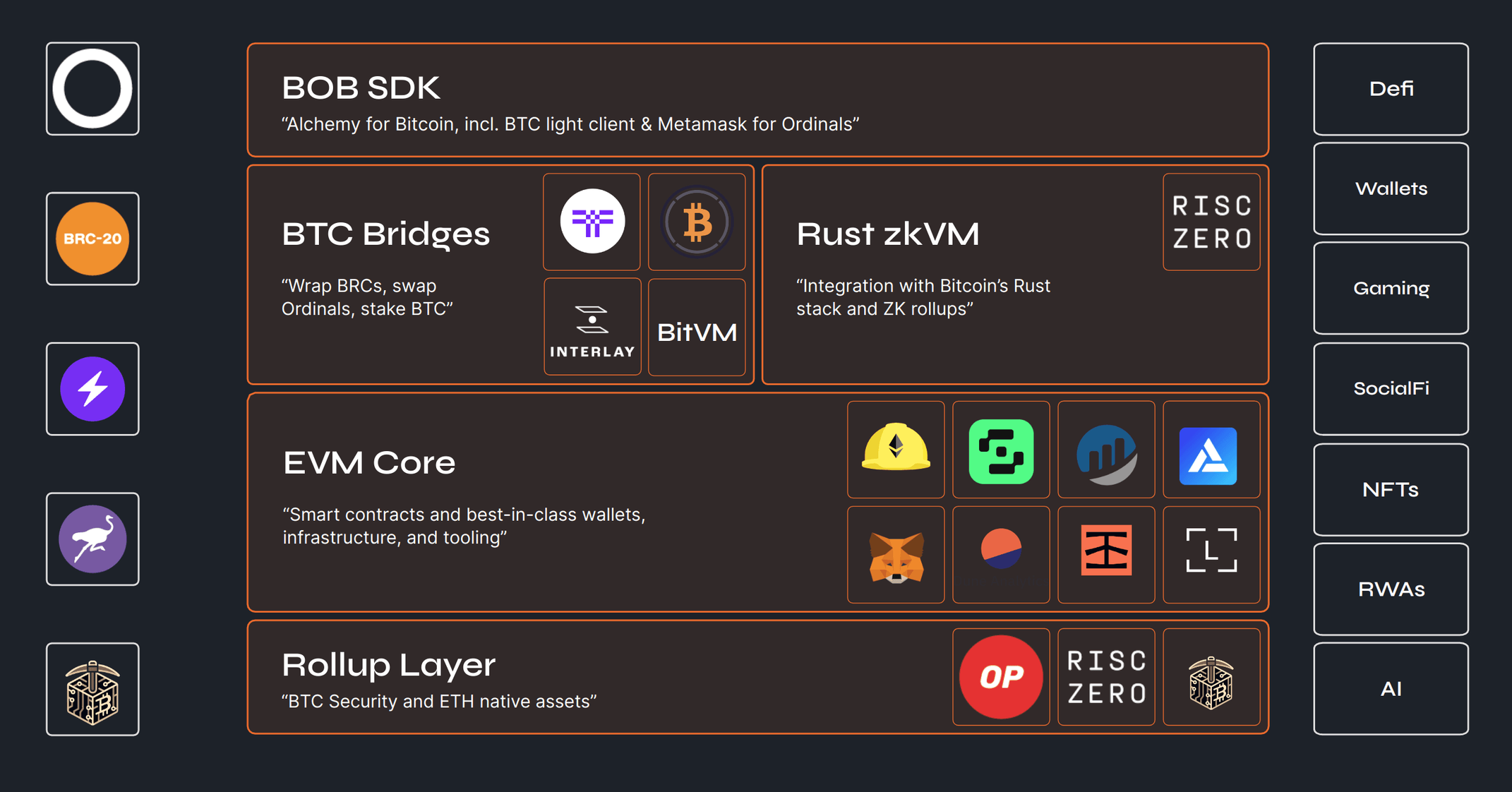
Build on Bitcoin is an OP Stack rollup that aims to serve as an execution layer for Bitcoin. BOB recently launched on Ethereum, with a four-phase roadmap to progressively couple its security with Bitcoin. BOB’s first phase begins with an ETH rollup to access native stablecoins, liquidity, on/offramps, wallets, and users. Currently, BOB serves as more of a sidechain to BTC, since it lacks a trustless permissionless bridge from Bitcoin L1.
BOB’s development team describes three problems for BTC L2s: programmability, ecosystem development, and liquidity. To address these issues, BOB relies on the popular OP Stack, which enables it to lean on the EVM, while utilizing Bitcoin for economic security. BOB will progressively decentralize, where an ideal future state includes the integration of a BitVM bridge. BOB’s core stack uses the BOB SDK, which it describes to be the “Alchemy for Bitcoin, including Bitcoin light clients and MetaMask snaps for Ordinals/Runes.”
Inflexible programmability remains as a critical obstacle to the development of Bitcoin rollups. Bitcoin script is Turing-incomplete, making Bitcoin L1 a poor place for smart contracts.With such bottlenecks, it is safe to say that Bitcoin programmability is still in its infancy. So far, two approaches have gained popularity in solving scalability: BitVM and Merged Mining. Merged mining is frequently employed in sidechains, which are distinct from Layer 2 solutions. The current infrastructure does not support proof verification on the primary Layer 1 (L1); instead, verification occurs on a separate L1 that merely has a bridge to the Bitcoin network. Consequently, most of these chains are essentially just EVM-forked sidechains. The BitVM is a new solution to create Turing-complete contracts on Bitcoin without requiring a soft fork. It leverages existing Bitcoin opcodes to emulate operations required for creating logic circuits. BitVM enables developers to perform optimistic execution of arbitrary computation offchain and complete fraudproof challenges onchain.
BitVM commits only a part of the data to the L1, which comes with large data management costs. Moreover, BitVM is still under research for optimization and decentralization. Under the current BitVM scheme, the verifier and prover must be predefined, making this model trust-minimized, but not trustless. However, there are conceptualizations that circumvent these limits, such as BitVM2.(BitVM2). Merge Mining is very different from BitVM: miners submit PoW solutions to two chains simultaneously: Bitcoin and some other network. The limitation of merged mining is the slow block production rate relative to PoS networks or Ethereum L2s. This introduces limitations in the sense that merged mining results in a slow block production rate relative to PoS networks or Ethereum L2s. For example, Rootstock, a sidechain secured by merged mining, has an avg 30s block time, whereas Arbitrum achieves 0.26s, and Optimism every 2s.
