Bittensor: Less Leakage, More Leverage

The upgrade improves TAO's value-capture machinery, and the cull proves the mechanism has teeth, but the same discretion that makes it work is the network's largest unpriced risk. The impact on the ecosystem splits cleanly.
Bull case: Tying emission to root\_proportion × price closes the TaoFlow cycling arbitrage and points inflation at subnets that hold price and return value to root. Cutting \~35% of emissions to subnets judged inactive is a material reallocation toward that goal, and if the freed TAO accrues to productive survivors, alpha yield per unit of inflation rises along with the quality of the root proportion TAO captures. The burn flag also gives the network a standing tool to attract and retain higher-quality subnets by starving fake-mining ones. This should, over time, lift the average productivity of the cohort from which TAO takes its cut.
Bear case: The same lever pushes the other way. Emission control is now discretionary, held by validators and a triumvirate whose burn criteria aren't public. It can drive builders off as readily as it disciplines them, starting with teams the market has still priced as active but cut anyway. The precedent is set: roughly a third of emissions are discretionary. Expect governance disputes and a hard dependence on the triumvirate's integrity.
The deeper repricing is of restraint, not decentralization. Bittensor was never priced as decentralized. Control has been visibly concentrated since before dynamic TAO, with the Triumvirate of Opentensor Foundation employees holding exclusive proposal rights and a Senate of top validators ratifying, a structure that itself replaced a single sudo key. What the market underwrote was the assumption that this concentration would be used sparingly and steered toward the handoff Const dates to within the next year and a half. The cull reprices that assumption. Concentrated control is no longer latent; it is an active, routine economic instrument, and holders paying for restrained stewardship should mark that expectation down even as they mark up the tokenomics. The price-based formula compounds the bear case for one cohort specifically, accelerating emission decay for maturing incumbents by design, but the chain-buys rewrite pairs that decay with stronger pool buybacks for the same low root\_proportion subnets, so the net effect on large established subnets is decay minus added buy pressure.
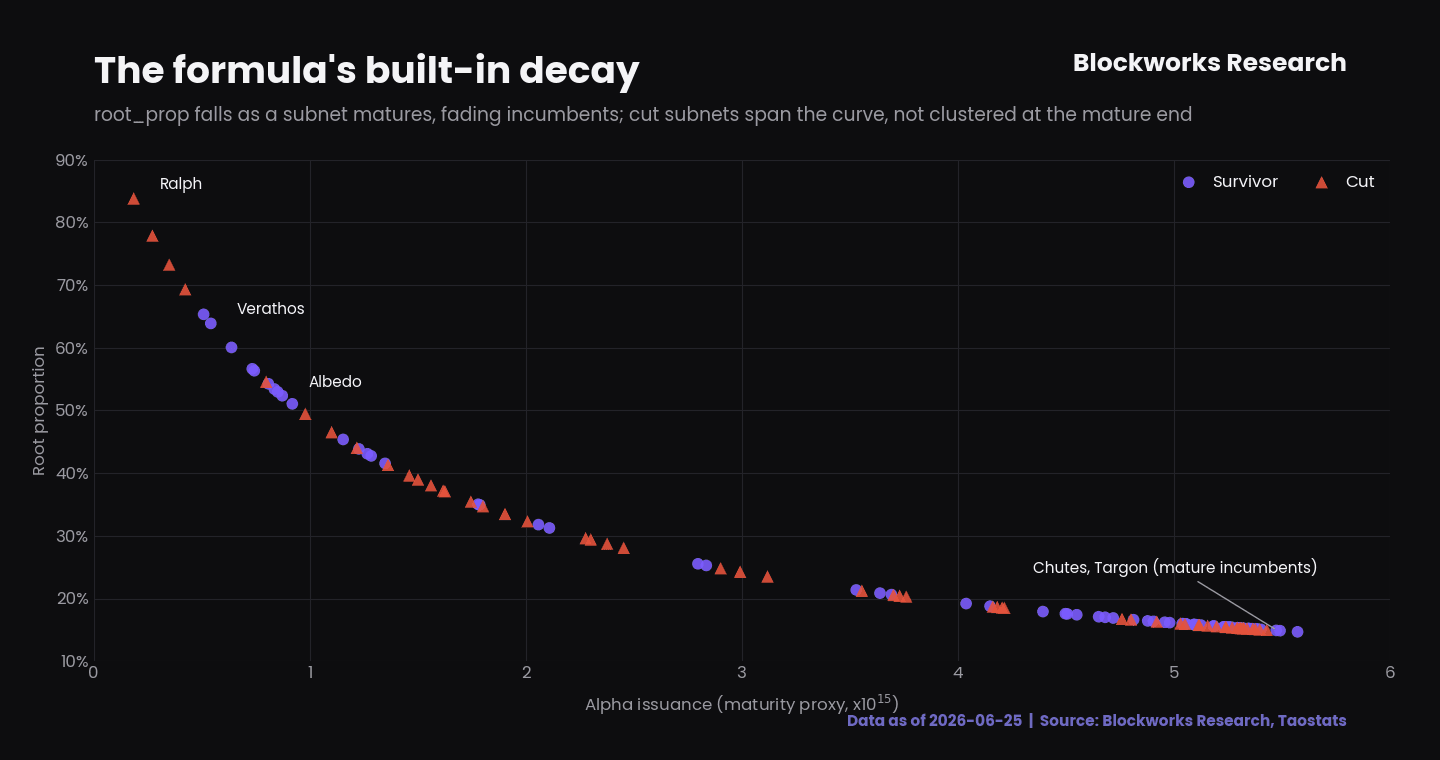
We remain Neutral on TAO, with wider variance on both sides than before. The mechanism upgrade is a genuine improvement to value accrual, and the willingness to move emissions shows the team will act on it. That same capacity, economic control sitting with a small group exercising it on a recurring basis, is the asset's largest unpriced risk. We would turn constructive on evidence of three things:
- The freed emission accrues to holders rather than to favored subnets.

Nick leads coverage on the DePIN and Proof of Work sectors. Previously led research and engineering at a DePIN-focused accelerator.