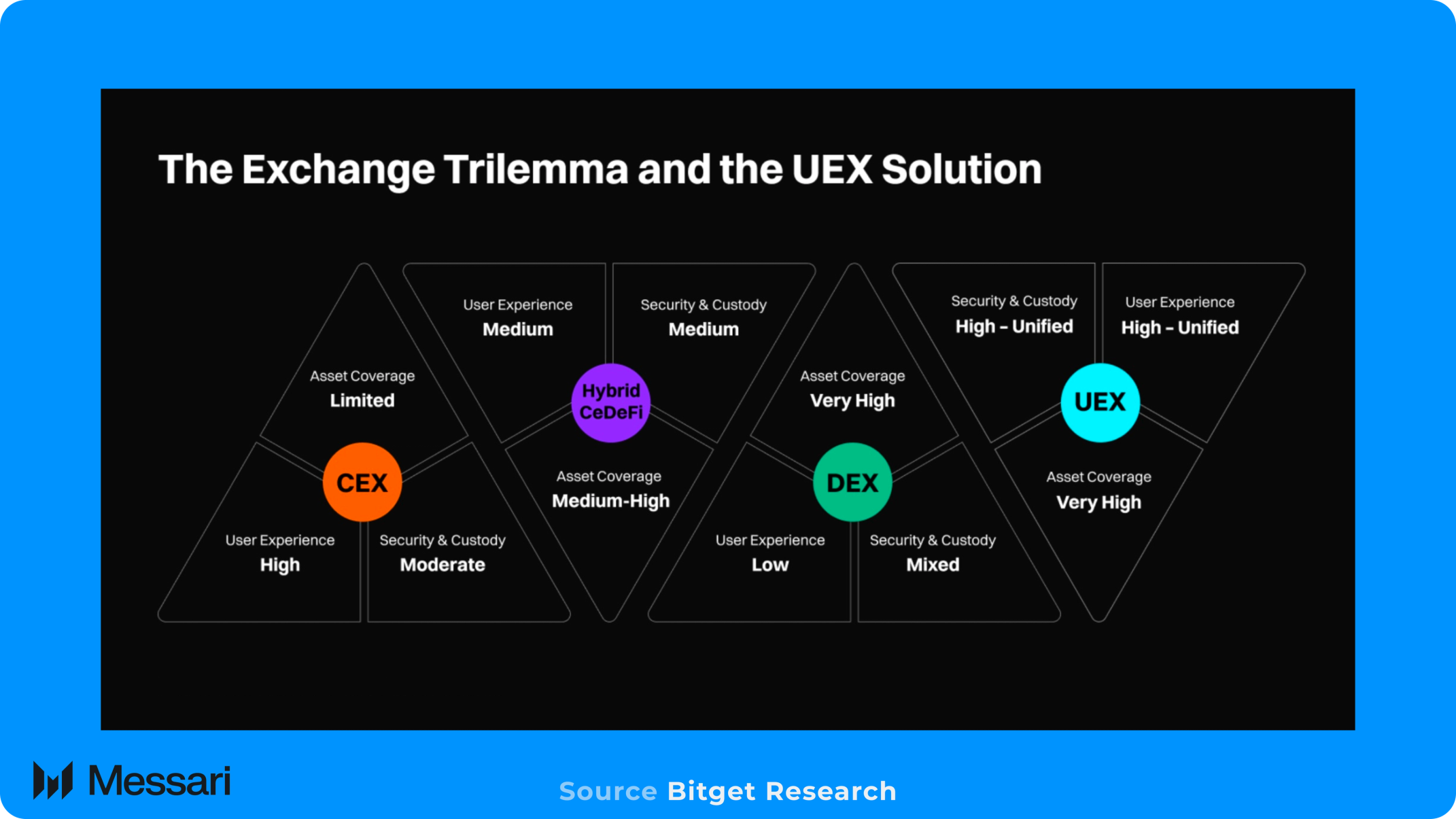
Bitget’s Universal Exchange (UEX) model combines centralized efficiency, decentralized accessibility, and traditional financial product offerings into a unified trading experience for retail and institutional participants. The UEX model comprises the core centralized exchange, Bitget Onchain, Bitget Wallet, Morph, and GetAgent.
Tokenized stocks are emerging as a high-growth vertical in the Bitget ecosystem. Since launching in July, a total of $17.1 billion in tokenized stock futures volume has been generated.
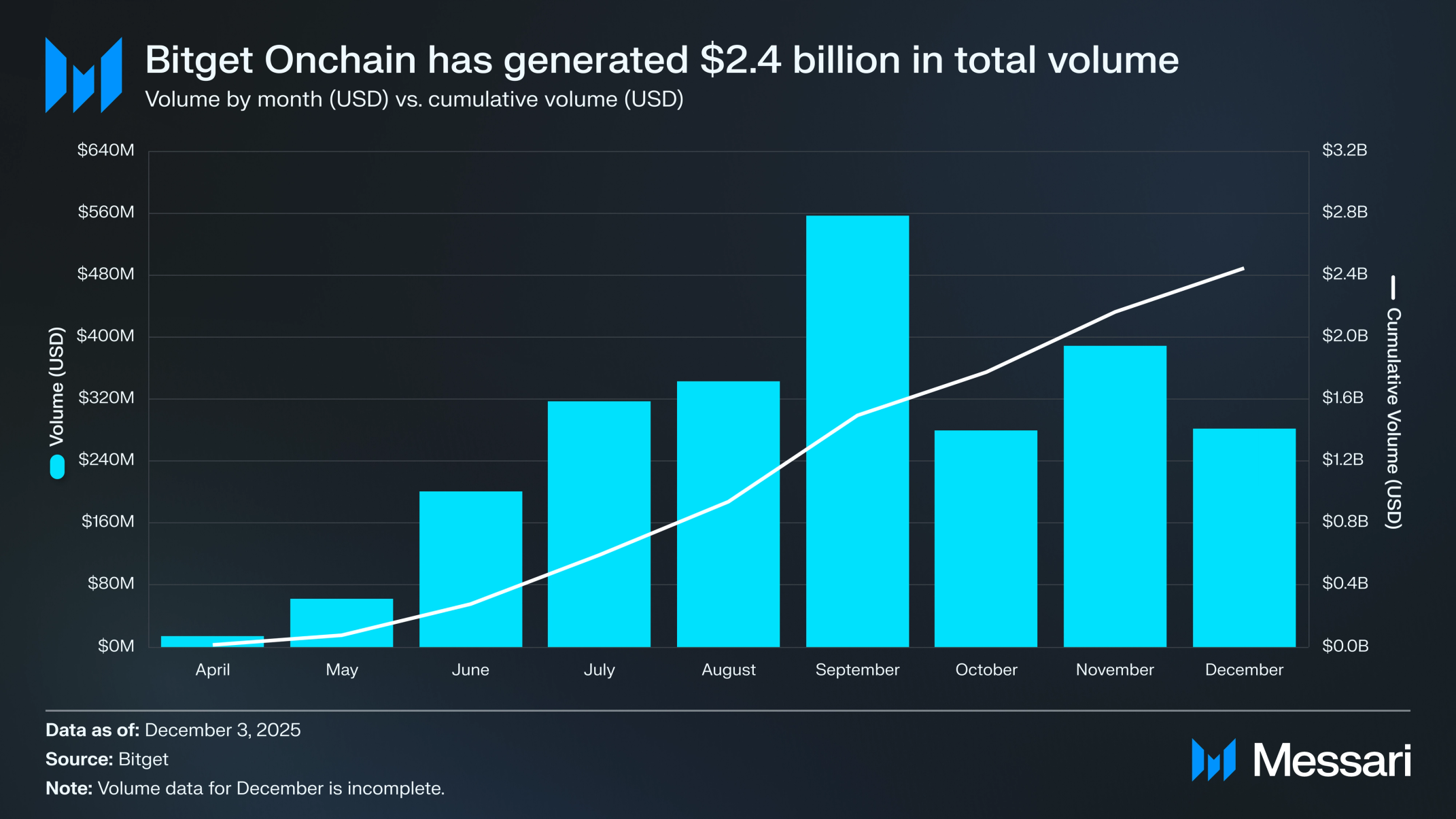
Bitget Onchain is the primary mechanism for integrating multichain access into the platform. Launched in April 2025, it enables users to trade onchain assets using CEX balances across multiple networks, generating over $2.4 billion in cumulative volume.
GetAgent is the platform’s AI assistant, designed to simplify the user experience as product coverage expands. Beyond market insights and guided execution, GetAgent has been used as a distribution channel for engagement campaigns.
Primer
Bitget is a universal exchange that aims to unify a centralized spot and derivatives exchange (CEX) with a broader suite of real-world asset (RWA) products and tooling. These products include Bitget Wallet, a decentralized non-custodial wallet with DEX capabilities, Bitget Onchain, an onchain access layer, tokenized stock trading, various institutional products, and yield opportunities for tokenholders. The CEX provides access to hundreds of assets and trading pairs, allowing users to buy, trade, and hold a diverse range of tokens on the platform. BGB is the platform’s native token, used within the Bitget ecosystem to access discounted trading fees, exclusive events, and participate in token sales. The token is also integrated with Morph as the network’s native governance token.
Bitget was founded in 2018 and is registered in Seychelles. Gracy Chen is the company’s CEO as of December 2025. Chen joined Bitget as a managing director in 2022 and was promoted to the role of CEO in May 2024.
To highlight transparency and solvency, Bitget utilizes a Proof-of-Reserve (PoR) system, which provides verification that the exchange holds 100% or more of its users' assets. The system utilizes Merkle-tree verification, a cryptographic method that enables users to verify their balances without disclosing account details. Bitget also maintains a separate protection fund, providing the platform with an extra layer of protection and underscoring its commitment to user security.
As tokenized assets, onchain trading, and institutional participation accelerate, fragmented trading infrastructure has become a growing constraint for global market participants. Demand is shifting toward platforms that consolidate execution, settlement, and asset access across crypto-native and traditional markets. The Universal Exchange (UEX) model emerges as a response to this structural shift rather than a standalone product innovation.
The crypto market structure has historically forced users into trade-offs across venues and rails: centralized exchanges provide low-latency execution and capital efficiency, while onchain venues provide composability, permissionless asset discovery, and transparent settlement. The practical result is fragmentation, with separate accounts, collateral pools, and workflow making cross-venue strategies slower and difficult for users to navigate. While centralized decentralized finance (CeDeFi) emerged to provide a hybrid approach, Bitget aims to offer a more comprehensive answer to the fragmentation problem.
Bitget’s Universal Exchange (UEX) model aims to consolidate these separate experiences into a unified product interface, enabling users to seamlessly transition between Bitget’s suite of product offerings with fewer operational steps. The approach aims to reduce transfer delays, account management complexity, and geographic constraints, while enabling strategies that are otherwise difficult when liquidity and collateral are siloed. Aside from the exchange’s core CEX offering, the UEX model is built on three hero products: tokenized stock trading on spot and futures markets, Bitget Onchain, and GetAgent, the platform’s AI trading assistant.
Bitget Onchain
On Apr. 7, 2025, Bitget announced the release of Bitget Onchain, aimed at bridging the gap between CEXs and DEXs. Powered by Bitget Wallet’s DEX infrastructure, the product is embedded into the platform, allowing users to trade onchain assets using CEX balances. This model extends onchain asset access through Bitget’s existing interface, enabling broader exposure to decentralized markets.
As of Dec. 22, 2025, Bitget Onchain supports trading on five networks: Solana, BNB Chain, Ethereum, Base, and Morph. All trades made through the product are subject to a 0.5% transaction fee, excluding the gas fees associated with onchain interactions. Notably, Bitget Onchain is custodial, as the private keys are held by the exchange rather than the user. However, the exchange also offers a self-custodial option through Bitget Wallet, providing users with further control over their onchain assets.
The adoption of Bitget Onchain has seen consistent progress since its release, rising from a total volume of $13.6 million in its first month to $282.1 million as of December 2025. Bitget Onchain’s usage peaked in September 2025, corresponding with volume trends in the broader crypto space.
As of December 2025, the top five tokens by volume on Bitget Onchain were launched on BNB Chain:
quq - A popular memecoin that leads the platform by volume.
TAKE - The native token of Overtake, a GameFi project.
KOGE - The governance token of 48 Club, the first DAO on BNB Chain.
RAVE - The governance token of RaveDAO, an onchain entertainment organization.
Tokenized Stocks
The tokenization of equities is quickly emerging as a clear example of product-market fit (PMF) for blockchain technology. The vertical offers advantages over traditional financial rails:
24-hour access: Unlike traditional financial markets, public blockchains operate without trading hours, enabling transactions to occur continuously around the clock.
Global Access: Public blockchains are permissionless, enabling worldwide participants to access markets that may have been previously unavailable.
Fractionalized Ownership: Tokenization enables investors to purchase a portion of a share, thereby broadening access to ownership for smaller, retail investors.
Fast Settlement: Traditional stock trades can take multiple days to settle, while tokenized trades settle within seconds.
Bitget’s expansion into this vertical was facilitated by the platform’s collaboration with Ondo Finance, a leading issuer of tokenized real-world assets (RWAs). Ondo allows Bitget users to trade tokenized equities, ETFs, and money market funds on the platform’s spot and futures markets, bringing crypto-native access to traditional financial assets. On Jul. 16, 2025, Bitget announced its entrance into Ondo’s Global Markets Alliance, an initiative that aims to facilitate RWA interoperability by aligning leading enterprises in the space. The participants in the alliance include, but are not limited to, Solana Foundation, LayerZero, Jupiter, BitGo, and Fireblocks.
As of December 2025, the exchange offers fee-free spot trading for tokenized equities, creating a strong incentive for early adoption. On the derivatives side, Bitget has implemented materially reduced fees, with a wide range of futures trading pairs receiving discounts of up to 90%. Tokenized stock products on Bitget trade on a 24/5 schedule, expanding accessibility across global time zones.
These incentives, combined with the accelerating demand for tokenized equity products more broadly, have led to rapid growth in on-platform trading activity. Between mid-October and the end of November, spot tokenized stock volume increased by 452% month-over-month, while futures volume rose by 4,468%. According to Bitget, 39.6% of this activity comes from East Asia, with meaningful participation also coming from Latin America, Southeast Asia, and Europe.
As of Dec. 3, 2025, Bitget has processed over $17.1 billion in tokenized stock futures volume since its launch in July 2025. The majority of this activity occurred in November alone, which accounted for $13.6 billion in volume. The exchange also recorded over $88 million in spot trading volume during the first week of December. This concentration of recent growth underscores rising demand for onchain equity exposure and reinforces Bitget’s positioning as a leading venue within the tokenized equities vertical.
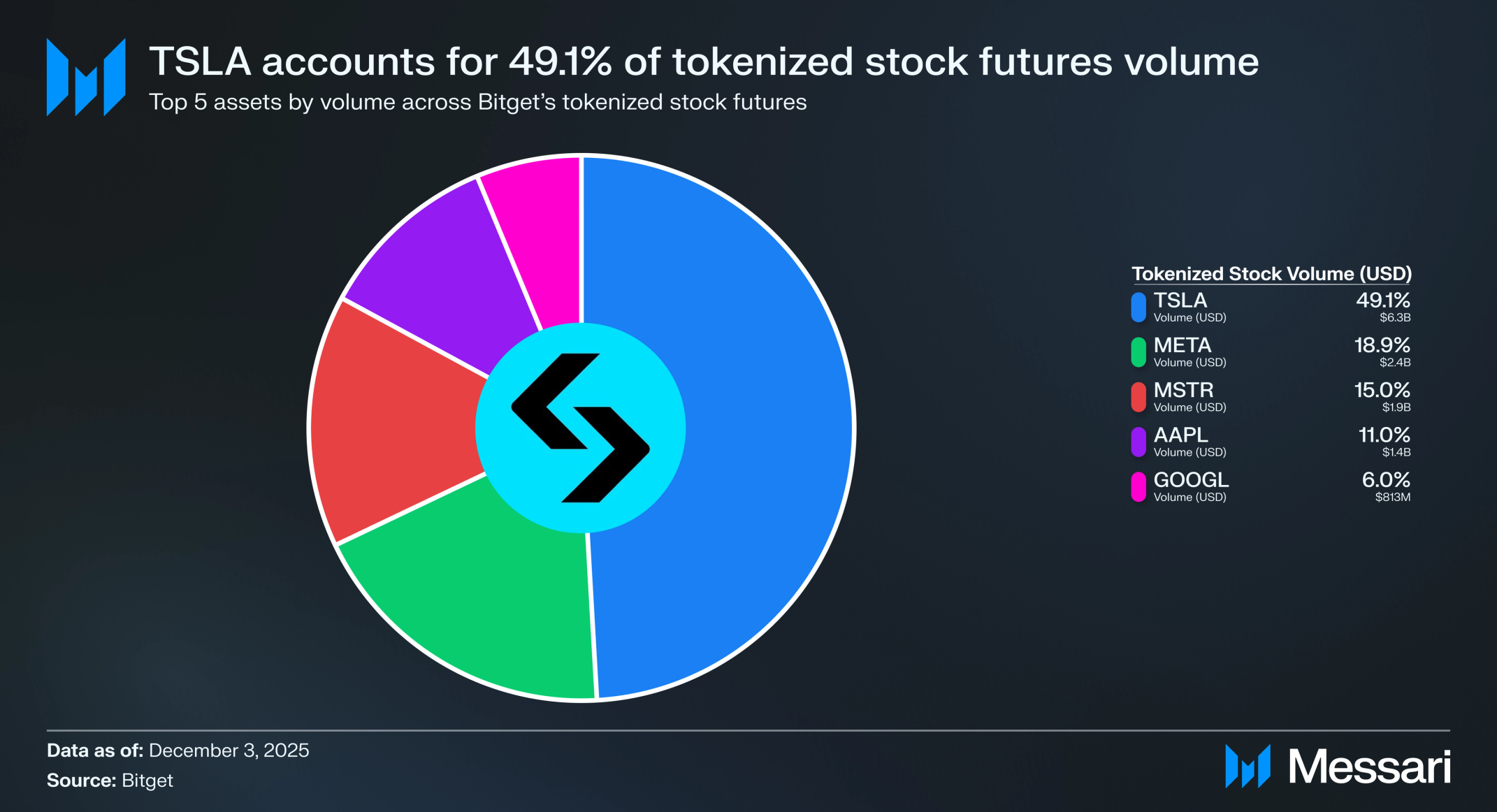
TSLA is the leading asset on the platform as of Dec. 3, 2025, generating over $6.3 billion on the platform. META, MSTR, AAPL, and GOOGL rounded out the top five, cumulatively generating over $6.6 billion.
GetAgent
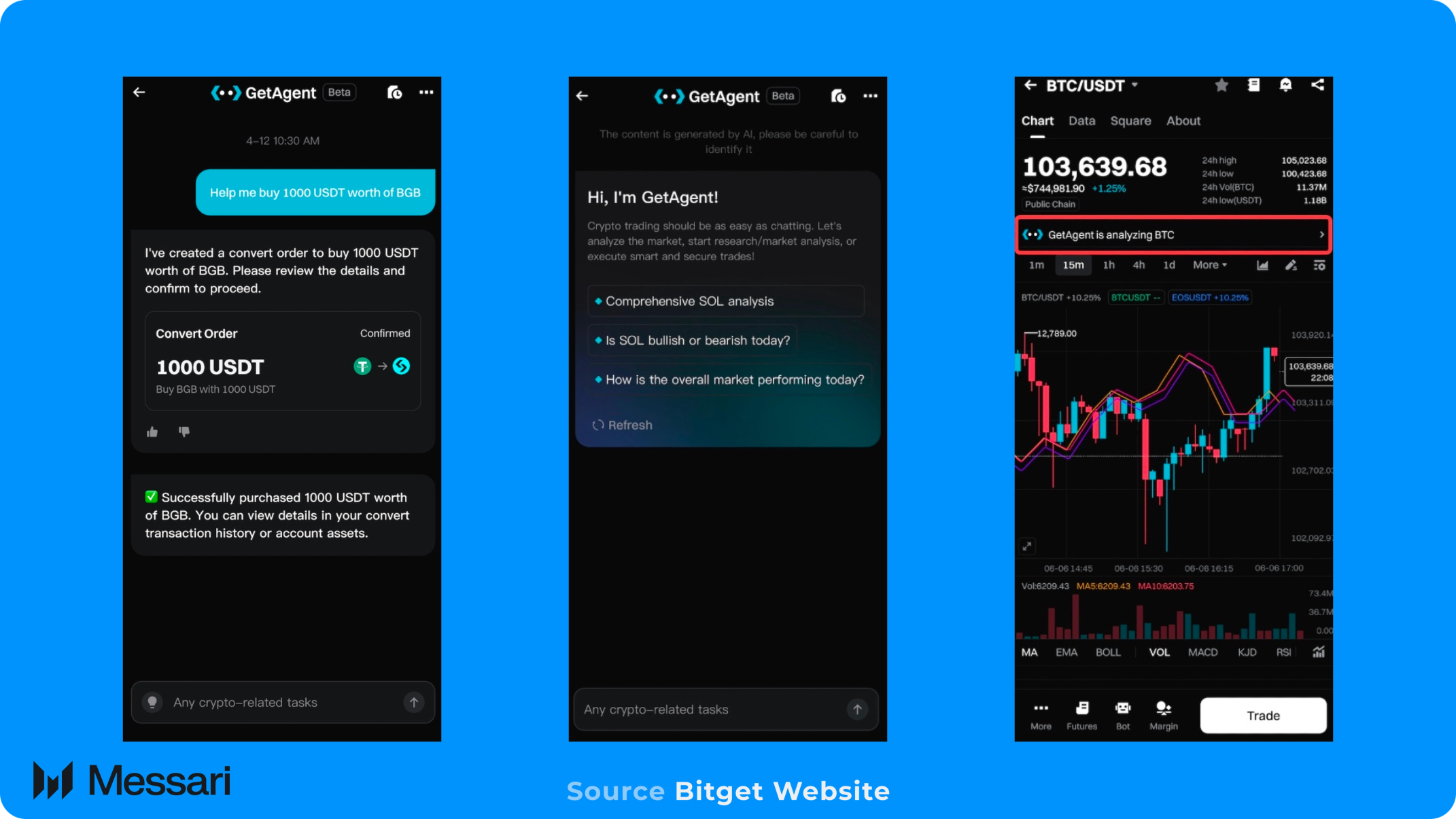
GetAgent is Bitget’s AI-powered trading assistant, designed to streamline market interaction across spot, derivatives, and emerging onchain products. As Bitget’s product surface expands, GetAgent increasingly serves as an execution and coordination layer rather than a standalone analytics tool. By combining market context, strategy guidance, and order execution within a single interface, it reduces friction for users interacting with complex products such as tokenized equities and onchain assets.
GetAgent is trained on crypto-native data and oracles, enabling in-depth analysis of tokens and market trends compared to traditional chatbots. The agent’s ability to leverage real-time market data gives users the ability to ask questions like “What is happening with the price of token XYZ right now?” and receive an explanation of market dynamics, qualitative information, and technical indicators surrounding the token. If a user subsequently decides to make a trade based on the response, they can leverage GetAgent to execute a trade order. After making the request, an order card is displayed for confirmation of the action. Once confirmed, the user can verify trade execution in the Order History tab.
Institutional Liquidity
Liquidity is the structural foundation of any trading platform and is often a limiting factor for institutional investors looking to deploy capital. To meet the needs of these allocators, Bitget has recently partnered with various liquidity providers to support both onchain and offchain trading on the platform. Bitget has announced strategic partnerships with multiple leading liquidity providers for digital assets, including Ampersan, DWF Labs, and Anti Capital, aimed at enhancing trading efficiency and market depth. These firms provide liquidity across spot, futures, and options markets, aligning with Bitget’s vision for a comprehensive experience where large-scale participants can interact with various products on the platform without concerns over liquidity constraints.
Institutional adoption on the platform has been a primary driver of growth in 2025. According to Bitget, the share of institutional participants in spot trading volume rose from 39.4% in January to 82% at the end of Dec. Additionally, institutional market makers increased their participation in the platform’s futures markets, with their share of total trading volume rising from 3% in January to 60% at the end of Dec.
The rise in institutional participation aligns with measurable improvements in order-book depth and execution quality across spot and derivatives markets. Higher institutional share has coincided with tighter spreads and increased liquidity resilience during volatile periods.
Beyond liquidity, Bitget has also built key infrastructure to support professional investors:
High API limits: Institutions, particularly high-frequency trading (HFT) firms, require high API limits to ingest market data and submit a large volume of orders with low latency. Bitget supports up to 200 requests per second to meet the needs of this user cohort.
Sub-accounts: The platform supports sub-accounts and robust custody options, enabling institutions to segment trading strategies and manage risk securely.
Loan services: Bitget offers loan services for institutional clients, enabling more advanced trading strategies, including hedging, leverage, and liquidity management. This is particularly relevant for HFT firms, which commonly execute margin trades and short sales, which require seamless borrowing features.
Fee structure: Institutions require a cost-efficient fee structure to support a high volume of transactions. Bitget is designed to support this need, with fees as low as 1.6 basis points (bps) and rebates up to 1.2 bps.
Closing Summary
Bitget’s UEX model is built around three product pillars: the core CEX, Bitget Onchain, and GetAgent. Together, they aim to reduce fragmentation between centralized and decentralized markets, while leveraging an AI-assistant as an information layer to support decision-making and guide execution. The CEX provides the execution engine and capital efficiency users expect from an exchange, while Bitget Onchain extends asset coverage through Bitget Wallet’s DEX infrastructure, enabling onchain trading using CEX balances. Trading of tokenized stocks on the platform has expanded rapidly, supported by fee incentives and accelerating demand, reaching $17.1 billion in cumulative tokenized stock futures volume as of Dec. 3, 2025.
Sustaining this growth depends on the depth of liquidity and institutional-grade infrastructure, particularly as Bitget broadens into onchain assets and tokenized traditional products that require consistent execution quality. Bitget has emphasized partnerships with liquidity providers and an institutional toolset, including high API limits, sub-accounts, loan services, and a fee schedule designed for high-volume trading, to support professional participation and reduce friction for systematic strategies. Taken together, the combination of a unified product surface, onchain and tokenized stock expansion, and a deliberate focus on institutional liquidity and services positions Bitget as a credible convergence point for banks and fintechs exploring crypto integrations. By reducing fragmentation across markets and workflows, the platform offers these participants a clear path to deploy capital and interact with the Bitget ecosystem.
This report was commissioned by Bitget. All content was produced independently by the author(s) and does not necessarily reflect the opinions of Messari, Inc. or the organization that requested the report. The commissioning organization may have input on the content of the report, but Messari maintains editorial control over the final report to retain data accuracy and objectivity. Author(s) may hold cryptocurrencies named in this report. This report is meant for informational purposes only. It is not meant to serve as investment advice. You should conduct your own research and consult an independent financial, tax, or legal advisor before making any investment decisions. Past performance of any asset is not indicative of future results. Please see our Terms of Service for more information.
No part of this report may be (a) copied, photocopied, duplicated in any form by any means or (b) redistributed without the prior written consent of Messari®.
Entering crypto in 2020, Shale has experience as a trader, angel investor, and co-founder in the space. He graduated from the University of Washington, studying psychology and business. His interests include DeFi and Consumer Crypto.
Entering crypto in 2020, Shale has experience as a trader, angel investor, and co-founder in the space. He graduated from the University of Washington, studying psychology and business. His interests include DeFi and Consumer Crypto.