Bitcoin Trends for 2020

From our Crypto Theses for 2020 - download the full report here.
1 For most people, it’s still “bitcoin”, not “crypto.” If you’re in the weeds, you forget that almost no one outside of the industry cares about anything but bitcoin. The reason is that you can explain it to a five year old. I don’t care what the ethereum crowd rants about (and I love ETH!), there will be no “flippening” this decade because after a crash like 2018, people will only want to invest in money that they view is safe, secure, and simple. Bitcoin’s got the lowest attack surface (because it’s feature-poor), the longest track record, and the easiest-to-understand analog competitor (gold). There just isn’t a strong anti-government counter-culture with Ethereum like there is in bitcoin (in fact the ETH community skews left, while BTC skews right), so it stretches credulity to think the strongest crypto narrative -- around government mismanagement of debts -- will attract people to ETH before BTC.
2 The halving only matters as a self-fulfilling prophecy. The halving narrative makes sense for high inflation assets because I think people don’t really understand the impact that persistent daily selling pressure has on a given asset. Some analysts say halvings are all priced in because the information is known up front, but that assumes the crypto markets are rational, which they are, umm, not. The truth is probably somewhere in between. In the early stages of a fixed emission network, perhaps people get too trigger happy to accumulate, and underestimate how few people will follow them in line as the mining machines whir. Later on, the stakes are lower. Intuitively, it makes sense that (other things equal), watching bitcoin inflation drop from 3.7% to 1.8% in six months will be less of a supply shock then Zcash going from 32% today to 12.5% next November. Either way, sample sizes of two are not very scientific, and bitcoin needs bigger macro catalysts than a marginal 2% point reduction in inflation rates.
On the other hand, the halving does throw into stark relief just how limited bitcoin’s supply really is. So the buzz around THAT could very well spark new demand. It’s powerful to know that just two U.S. companies that report on their ongoing crypto purchases, Grayscale and Square, will, on average, purchase the majority of new network issuance every single day come Q3 2020.
3 There’s only one bitcoin. I think we can call the fight when it comes to taking Bitcoin Cash any more seriously than another alt-coin like Litecoin. The reality is even bleaker for those hailing Bitcoin SV and some of the other garbage further down the fork list. The odds are low we ever see another meaningful hard fork of bitcoin unless 1) it becomes obvious that the security of the network is under stress from too-low block rewards, or 2) developers soft-fork in a “too good” privacy upgrade that forces supporting exchanges to fork away for compliance purposes. At current prices and sub-2% inflation, the mining industry shrinks to ~$2 billion annualized in May, while securing ~$700 billion in annual economic transfers, about in line with what the credit card companies do on a fee basis. I think about this as more of a 2022 or 2023 issue to keep an eye on if transaction fees don’t begin to take a more meaningful percentage of the block rewards or the BTC price stays stagnant (or drops further).
4 Lightning It’s tough not to be disappointed with the Lightning Network’s lack of growth this year. Granted, it was a big milestone to have Bitfinex come online as the first major exchange to support LN. And granted, I’m aware that there could be some fully private channels and bitcoin locked in lighting that is under-counted there. And yes, fine, granted active nodes have at least grown 5x (nice work, Casa). Still, $6 million in channel capacity? In comparison to DeFi apps on Ethereum, that would only be good for #8 in terms of adoption, between Nuo and Bancor. Woof.
All that said, I’ll double down on my prediction from January, that Lightning Network will have it’s irrational exuberance moment, and blow up 50x YoY in USD growth to $100mm in channel capacity (but 2020 vs. 2019). It’s hard for me to believe Cash App won’t release some features that spark that given Jack’s 2018 investment in Lightning Labs, the addition of bitcoin core developer Matt Corallo to the bitcoin team in April, and the expansion of the group this fall.
There will likely be an inverse correlation between the number of assets a wallet / exchange supports and its likelihood of adding Lightning Support in the near-term. So begins the separation of the “bitcoin exchanges” from the “shitcoin exchanges”? Speaking of exchange support, BitMEX research has an epic five part series on LN that you should read up on over the holidays if you want to learn more about the Lightning Network and are intrigued by some of the new payment applications it could power. (1 2 3 4 5)
5 Layer 1 Privacy My co-founder Dan nailed this prediction last year regarding bitcoin privacy: “Lightning could start to be used as a privacy layer for BTC transactions. There will be a lot more talk of privacy solutions for layer-1 on bitcoin, but no progress that impacts end users.” I spent an hour looking around for the bitcoin roadmap to see if there were any target dates proposed by the community for when privacy features like Dandelion (obfuscates the IP address of the first node that broadcasts a transaction), Schnorr signatures (among other things obfuscates multi-signature transactions, which combined with “CoinJoin” could turn a pool of bitcoin transactions into a Monero-like jumble), and Taproot, which could bring more scalable private smart contracts to bitcoin. I suppose it’s unknowable exactly when some of these will be soft-forked into the protocol, but I’d expect a soft-fork that enables Schnorr signatures by Q3, and almost certainly by year end as that upgrade is the linchpin of most of the exciting feature additions bitcoin developers are studying.
6 It’s maddening to keep up with bitcoin and ethereum roadmaps. Bitcoin’s doesn’t really exist, and Ethereum’s never gets hit on time. Thank you to LucasI Nuzzi of Digital Asset Research for this brilliant graphic that at least helps to organize the state of innovation and the long-term roadmap within bitcoin.
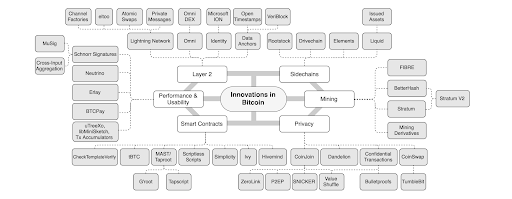
He saved me from ripping out what remains of my hair, and I at least can feel good knowing that I have a categorized cheat sheet to reference for when our team pieces together timelines from John Newberry’s excellent Bitcoin OpTech newsletter and pairs them with the plain English explainers of Bitcoin Magazine’s Aaron van Wirdum. Outside of Lightning and the major privacy upgrades, I’m most excited about some of the boring-but-important work that’s being done on the mining pool software front. Keep bitcoin (as) decentralized (as possible).
7 Bitmain will not go public in 2020. Bitmain may be battling back after a rough patch, but the company is still a shadow of its former self. Although, they’ve now filed a confidential registration document with the SEC to go public in the U.S., I’d be surprised if they actually pulled the trigger in 2020. Their valuation will be dramatically lower than the $12 billion they had hoped to target in 2018. Their top comp, Canaan Creative, dove 45% in its first two weeks of trading post-IPO last month. The timing couldn’t be worse for Bitmain financially going into the May halving during a sideways crypto market amidst stiffer competition than ever before. You may have also heard they recently had some founder drama that might need settling in court.
8 Mining is back, baby! Denver-based miner Crusoe Energy Systems is opening a fourth bitcoin mining facility in the Rockies having recently closed $70 million in new funding for its new locations. The company is part of a cohort of firms who have set up shop in the U.S. to take advantage of the recent shale boom, including Bitmain and DCG-backed Layer1. What’s interesting is that these data centers merely use excess natural gas supply that would otherwise be lost to “gas flaring”, when the energy companies literally burn capacity because they have too much inventory that might be more expensive to store or ship.
How about that? Energy-efficient miners!
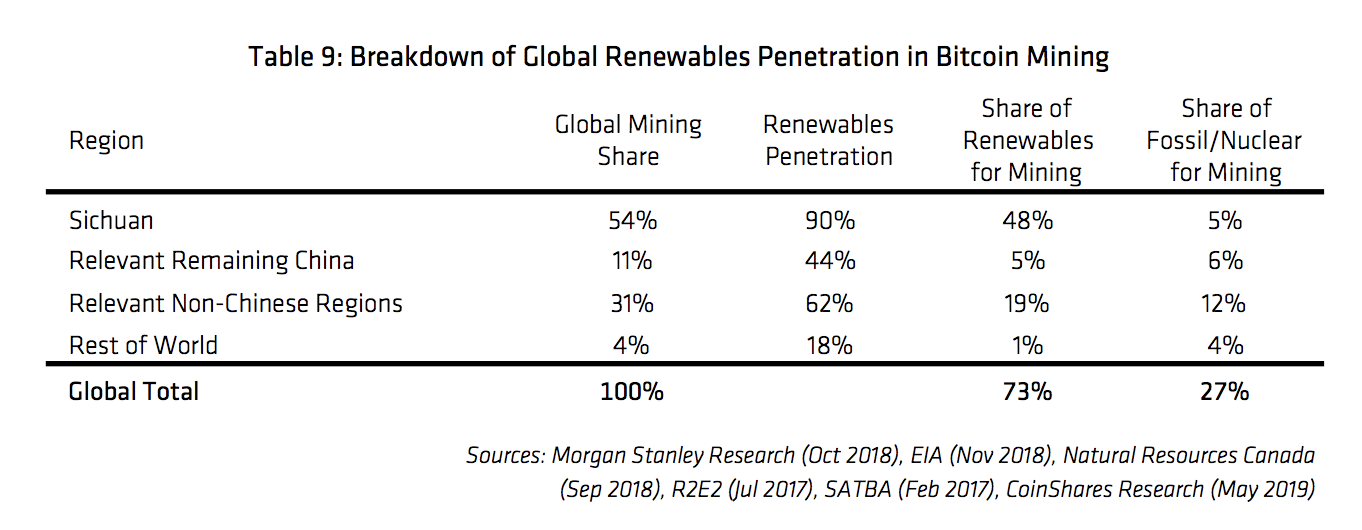
It’s a welcome development from a network risk standpoint to have more diversified mining capacity by country. And if Bitmain’s IPO does pan out, I’d expect it to spark even more facilities development in the U.S. in 2020, even despite the upcoming halving. CoinShares published its latest report on Bitcoin mining last week, which found that one Sichuan province, Sichuan, accounts for 54% of global mining. Risky geopolitically, but also a net positive for the environment today as the 90% of that capacity is powered by renewables.
9 Sidechains, Finally? Similar to Lightning, Bitcoin sidechains haven’t yet gained much traction since Blockstream’s much hyped whitepaper in 2014. We still seem far off from having a realized vision of trust-minimized sidechains, but “federated” (i.e. consortium-managed) sidechains like Liquid and RSK are starting to see some pick-up.
BTSE, one of the 23 initial launch partners for the Liquid network, is planning to raise $50 million in one of the first and highest profile token offerings on the Liquid network. The token would function similarly to existing exchange tokens with BTSE using 30% of all revenue to buy back and burn tokens. There was much gnashing of teeth from critics on crypto twitter calling out the hypocrisy of the Bitcoin community who had otherwise spent years criticizing ICOs and token projects. While my bias is that exchange tokens - as quasi-securities with actual company revenues to support them - are much more interesting products than your run-of-the-mill 2017 “utility” token. But I agree with the skepticism around BTSE (pitch deck). No way they raise the $50 million they’re looking for. It’s a year late and an ERC-20 short.
Money on Chain, a DeFi startup, recently revealed it was launching a DeFi platform on RSK. The platform would offer a Bitcoin collateralized loan system similar to MakerDao on the RSK sidechain. The bull case is that DeFi on Bitcoin could leverage Bitcoin’s liquidity and stability to offer a compelling alternative to DeFi based on Ethereum. The bear case is that it will be difficult to bootstrap a DeFi ecosystem on Bitcoin from scratch using federated sidechains. Not only may builders be skeptical of relying on a federated “trust” model, but they may also be anxious about forgoing the composability of Ethereum’s burgeoning DeFi ecosystem.
Bitcoin sidechains are a lesser version of Ethereum’s fundraising and lending infrastructure until proven otherwise. (*ducks for cover*)
10 BTC Privacy Canaries. There’s a larger societal war on privacy taking place, and when it comes to crypto, Monero and Zcash are on the front lines. Monero should, in theory, be the most difficult asset for exchanges to support from a compliance standpoint because all their transactions are anonymized by default via the protocol’s ring signature scheme.
But it’s Zcash that will ultimately be the asset to watch as a privacy canary in the regulatory coal mine. Zcash offers unshielded “t-addresses” alongside its spookier “z-addresses” (fully anonymous). Because exchanges can default to supporting the t-addresses and verify the sender (in theory), Zcash should be at less risk of delisting by most of the major global exchanges. If the asset struggles with exchange support, it’s a sign that bitcoin privacy upgrades will also present massive compliance risk.
The Multicoin team gave an excellent primer on privacy that I recommend reading in its entirety to get a better sense of the important trends to watch out for in 2020, especially. Multicoin draws a different conclusion than I do (that privacy chains are worthless themselves, as privacy is a forkable feature into any network), but the team sells short the power of the privacy-by-default meme, and their write off of ZEC because its performance has been horrible ignores the impact high inflation rates has had (temporarily) on Zcash’s attractiveness as an asset.
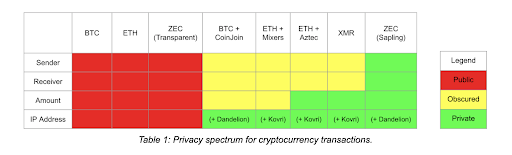
From a technical standpoint, even Multicoin concedes Zcash is best in class. Their argument instead is that bitcoin’s privacy by obscurity is “good enough.” We’ll see. If your life depended on doing a series of crypto transactions privately, wouldn’t you transact in the green zone? If your answer involves a coin other than bitcoin, there's an investment case for that coin.
Other privacy coins that rely on proof-of-work face an uphill battle. If you look at the pressure Zcash has faced in the first three years leading up to its first halving in Q4’2020, it’s impossible to get excited about Grin, where it will take twice as long for its inflation to drop to ZECs level. That’s too much sell-side pressure for too long. Disqualifying from a pragmatic standpoint, and it’s got an inorganic mercenary community of VC-miners to boot.

Prior to founding Messari, Ryan was an entrepreneur-in-residence at ConsenSys, and on the founding teams of Digital Currency Group, where he managed the firm’s seed investing activity, and CoinDesk, where he led the company’s restructuring & annual Consensus conferences. He has been an investor & prolific writer in the crypto industry since 2013.