Bitcoin October 2025 Update

Market Commentary
With official labor data sidelined amid the ongoing government shutdown, investors turned to ADP’s private payrolls report for directional insight into U.S. employment momentum. The release showed private sector payrolls rose by 42,000 in October, marking a modest rebound after September’s contraction and the first positive print since July. The uptick offers tentative evidence of stabilization following a short-lived downturn in job growth, though ADP’s chief economist characterized the recovery as “tepid and uneven.” Gains were concentrated in education, healthcare, and select service industries, while cyclical sectors such as leisure, hospitality, and professional services continued to shed jobs, reinforcing the view that labor market resilience remains sector-specific rather than broad-based.
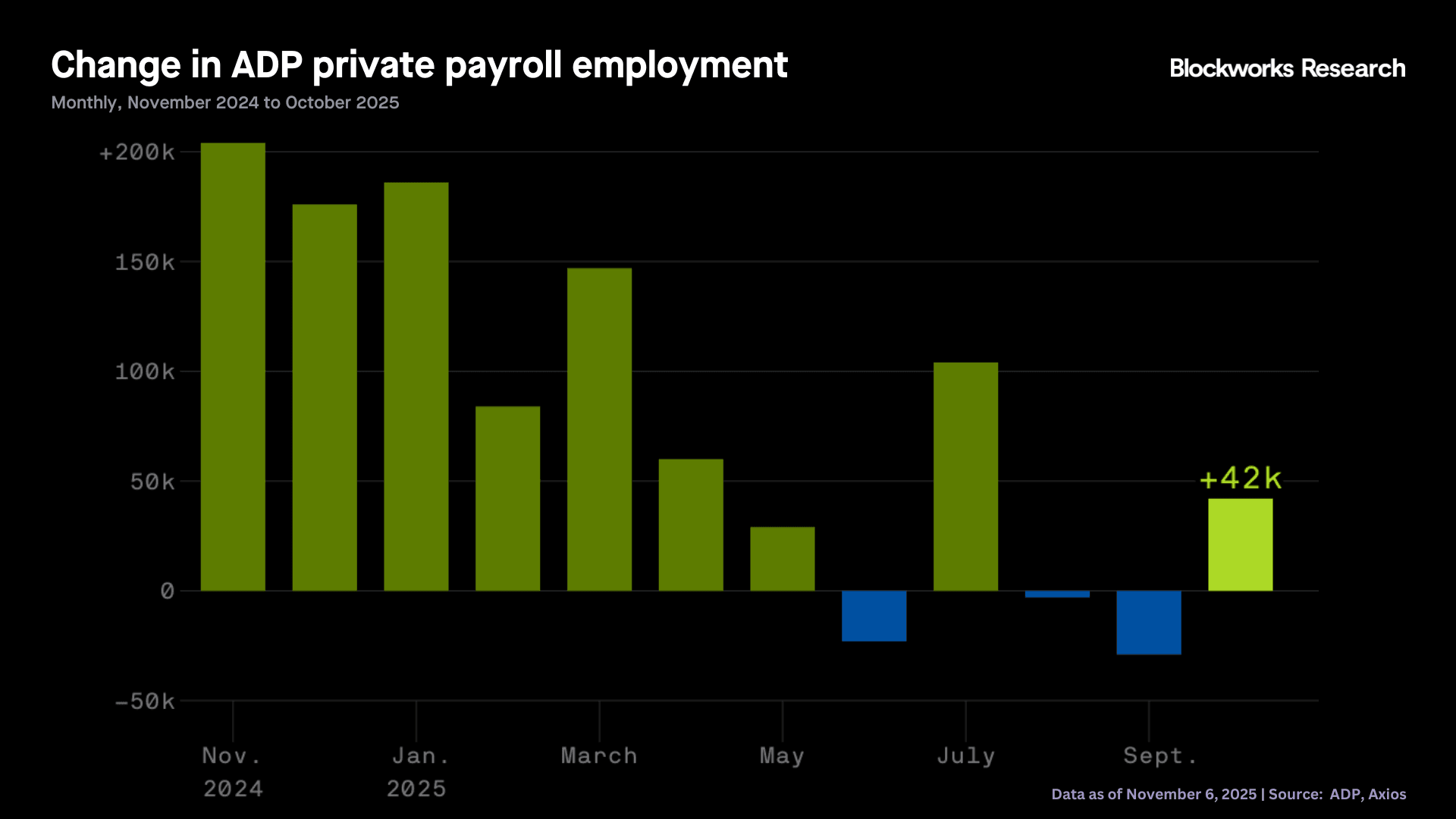
The data provide ammunition to both sides of the Fed debate. On one hand, the return to positive hiring signals that the labor market is not collapsing, arguing against urgent rate cuts. On the other hand, the subdued pace of job creation (well below pre-summer levels) highlights a cooling employment backdrop consistent with easing inflation pressures. Investors will look to Friday’s delayed official payrolls data, once released, for confirmation of whether this stabilization marks a turning point or a temporary pause in the broader labor slowdown.
Flows
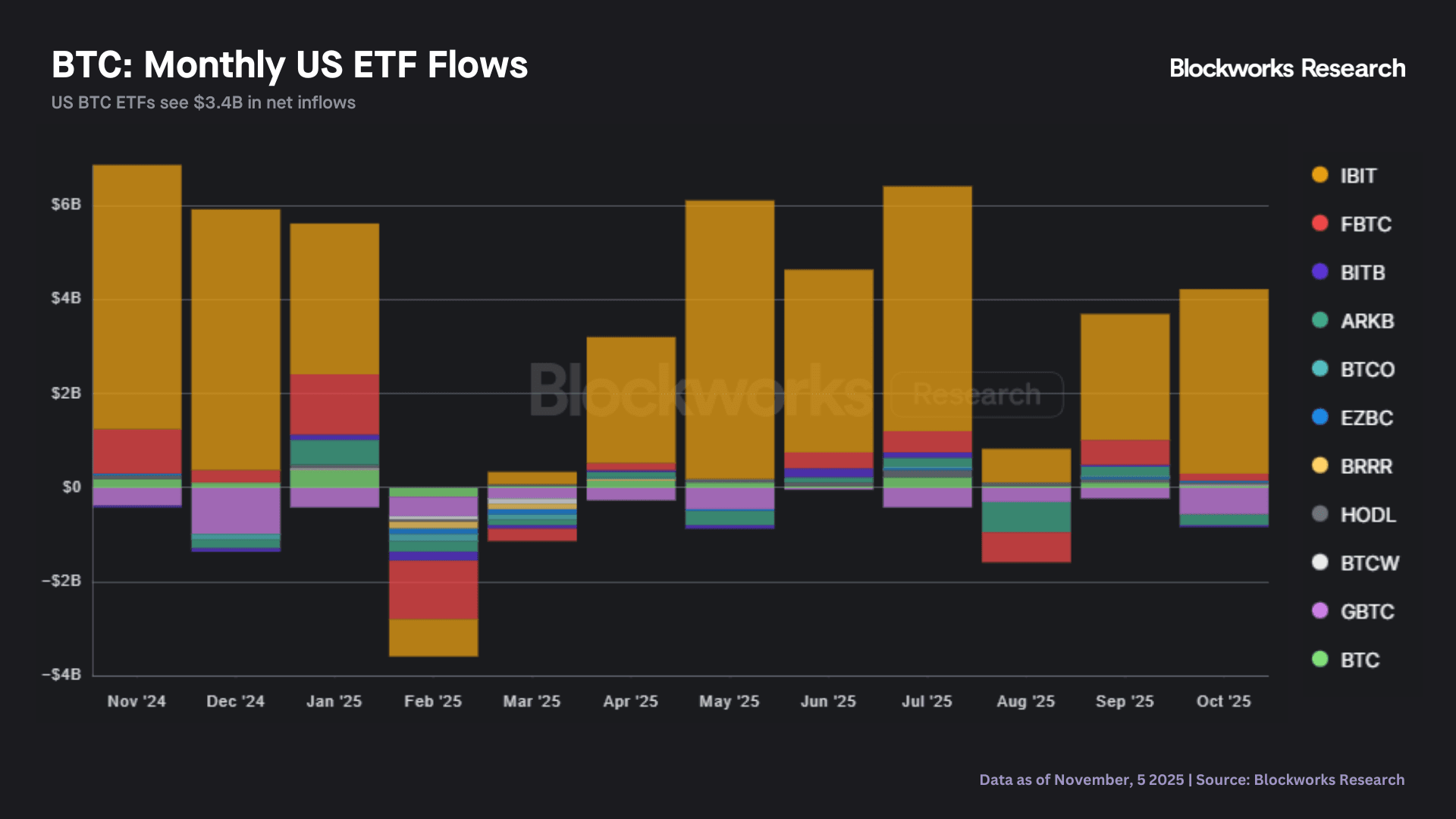
Bitcoin ETF flows extended their recovery in October, recording net inflows of roughly $3.4B following September’s strong rebound. The sustained demand reflects improving market sentiment and growing institutional participation as risk appetite returned to the crypto complex. BlackRock’s IBIT once again captured the lion’s share of inflows, maintaining its dominant market position, while Fidelity’s FBTC and Bitwise’s BITB contributed smaller but consistent additions. However, despite these sizable inflows, they proved insufficient to steady the market amid a wave of cascading liquidations that unfolded through October, underscoring the limits of ETF demand in counterbalancing broader market deleveraging. The continued alignment between ETF inflows and BTC price momentum reinforces the role of these vehicles as a leading indicator of investor sentiment and liquidity trends. The first two trading days of November have already seen nearly $750M in net outflows. DATCOs were relatively inactive in November, with aggregate holdings flat MoM. This continues the trend seen with August’s modest <4K BTC accumulation and September’s ~7.7K. Market-adjusted NAVs (mNAV) across listed BTC treasury companies continued to soften through October, though the pace of compression moderated relative to prior months. After an early-month rebound attempt, NAKA and SQNS extended their declines, underperforming as broader crypto market weakness and equity liquidations pressured sentiment. MSTR again proved more resilient, with its mNAV holding within a narrower range despite increased volatility in BTC spot markets. By month-end, dispersion across the group narrowed to near-year lows, reflecting a continued convergence in relative performance. The uniformity suggests that idiosyncratic equity factors have largely been overshadowed by direct BTC price sensitivity, as investors treat treasury-linked names as leveraged proxies for spot exposure. The ongoing compression underscores a market still in risk-off mode, with limited differentiation among BTC-heavy balance sheet companies. The structural decline in BTC exchange reserves persisted through October, with balances sliding below 2.4 million BTC, marking a fresh multi-year low. Reserves fell roughly 2% MoM and are now down about 20% year-over-year, extending the steady outflow trend that began in early 2024. Despite heightened market volatility and October’s liquidations, onchain data suggest that structural outflows have remained intact, underscoring the resilience of longer-term holders. Below we show the BTC balance on centralized exchanges.

Marc covers Ethereum, Bitcoin and their L2s. Previously led Ethereum and DeFi research at CoinShares.