Bitcoin May 2024 Update

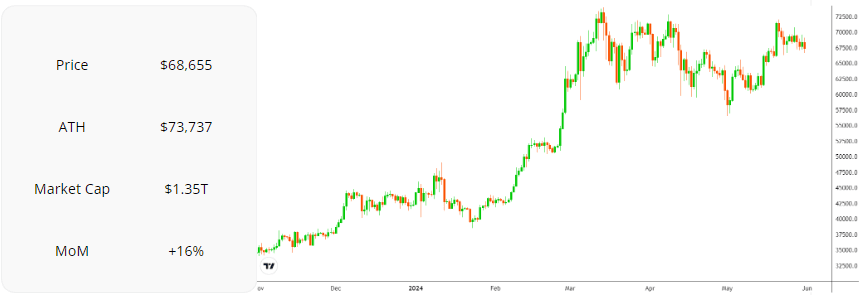
Market Commentary:
In May, markets rose as inflation declined but remained elevated above the Federal Reserve’s 2% target rate. The Consumer Price Index (CPI) slowed for the first time this year, helping to ease worries about sticky inflation. The report showed overall prices increasing 3.4% YoY, compared to the reported 3.5% in March. Moreover, core inflation (which strips out food and energy prices) rose 3.6% YoY compared to 3.8% in March. Housing is the sector garnering the most attention as it was the largest factor in the core CPI’s monthly increase while rent prices rose 0.4% for the third straight month. The Producer Price Index (PPI) rose 0.5% (above the expected 0.3%) largely due to a jump in services. This comes after March’s PPI saw a 0.1% dip (revised down). Fed officials will likely need more signs of cooling inflation before lowering interest rates. While the US economy seemingly remains sturdy, data showed retail sales were flat in April while March’s data was revised downward to 0.6% (from 0.7%). This conveys that consumer spending is coming off its high point, which the Fed would like to see in order to justify decreasing interest rates later this year. Odds of a rate cut have slightly increased to an estimated ~50% chance in September. These reports saw the S&P 500 hit an all-time high of 5,321 and end the month 4% up, similarly, the NASDAQ rose 5%, resuming its upward trend for 2024. Gold remained steady, hitting an all-time high of $2,436 before retracing to $2,346.
The institutional buy-in of BTC is evidently underway. Filings from Q1 show that larger TradFi entities are holding the recently launched spot BTC ETFs. These companies included Renaissance Technologies, Bracebridge Capital, Point72, JPMorgan, Millennium Management, and notably Wisconsin’s pension fund. Interestingly, investment advisors made up the bulk of these holders (60%) followed by hedge funds (25%). Furthermore, over half (13) of the top 25 US hedge funds bought BTC ETFs in Q1.
On the US political aisle, there were a few noteworthy events in May. Oklahoma passed a crypto bill set to go into effect on November 1, 2024. This legislation makes Oklahoma the first state to codify the rights of its citizens to run a node, mine, and self-custody their BTC. Donald Trump, the Republican nominee for the 2024 presidential election, expressed support for cryptocurrencies during an event with his NFT buyers at Mar-a-Lago, and his campaign now accepts crypto donations. The Senate voted to overturn the SEC’s SAB121, an accounting rule that would have made it more difficult for firms to custody digital assets. However, this was later vetoed by President Biden. The U.S. House Approved the FIT21 Bill (279-136) – the first major cryptocurrency bill to pass the House. The bill now moves to the Senate, where its fate is uncertain due to a lack of a corresponding bill and unclear support. Further, the relevant Senate committees haven't engaged in the same level of scrutiny on cryptocurrency matters as the House. However, the importance is likely more symbolic of the shifting tides within the political crypto sphere and possibly the end of “Chokepoint 2.0”.
TradFi Markets:
BTC continues to enhance the risk-adjusted performance of investment portfolios. The Sharpe ratio is a measure of risk-adjusted return that helps investors assess the performance of an investment compared to its risk. As shown below, adding 5% BTC to a traditional 60/40 portfolio would have pushed the Sharpe ratio above 2.0 in May.

Marc covers Ethereum, Bitcoin and their L2s. Previously led Ethereum and DeFi research at CoinShares.