Behind the (Difficulty) Bomb: Breaking down Muir Glacier and the future of Ethereum's Ice Age

Last week, the Muir Glacier hard fork activated on Ethereum at block 9,200,000, introducing a single code change, EIP 2384, to delay the Difficulty Bomb for another 4,000,000 blocks. This upgrade marked the third time Ethereum core developers called to push back the Difficulty Bomb in a little over two years.
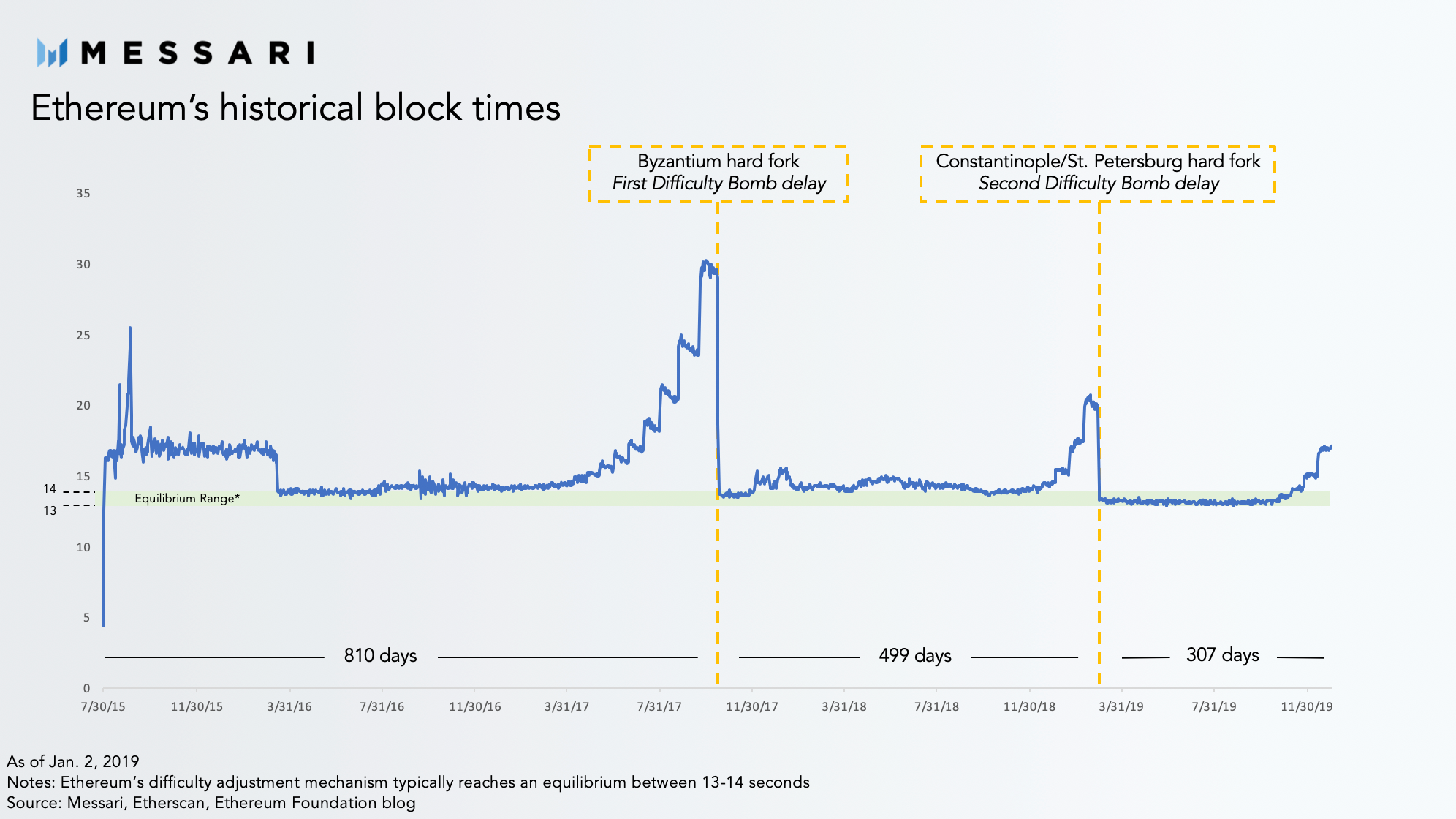
Despite being unloved, the Difficulty Bomb serves to facilitate the transition to Ethereum 2.0. It’s an inherent piece of the original Ethereum codebase that artificially adds to the network’s difficulty level every 100,000 blocks. As the difficulty rises without a corresponding increase in hash rate, block times begin to increase, at first gradually, then exponentially (as seen in the chart above), beyond their ideal 13-14 second range. These increasing block times degrade the usability of Ethereum’s current Proof-of-Work (PoW) chain (in a sense, “freezing” transactions, hence it’s alternate name, the Ethereum Ice Age) and act as a not-so-gentle reminder for users to switch to Ethereum 2.0.
But Ethereum 2.0 is still about two years away from full deployment, and the presence of the Difficulty Bomb was threatening to push block times above 30 seconds by Feb. 2020. Although the timing was suboptimal, one can understand why core developers clamored for a second hard fork within the last month (the first being Istanbul on Dec. 7) rather than wait until the Berlin upgrade (anticipated for Q2 ‘20) to help preserve Ethereum’s short-term functionality.
By immediately removing the artificial difficulty additions, Difficulty Bomb delays like Muir Glacier restore Ethereum block times to their intended range. This severe shock to the difficulty level also impacts other on-chain metrics to varying degrees.
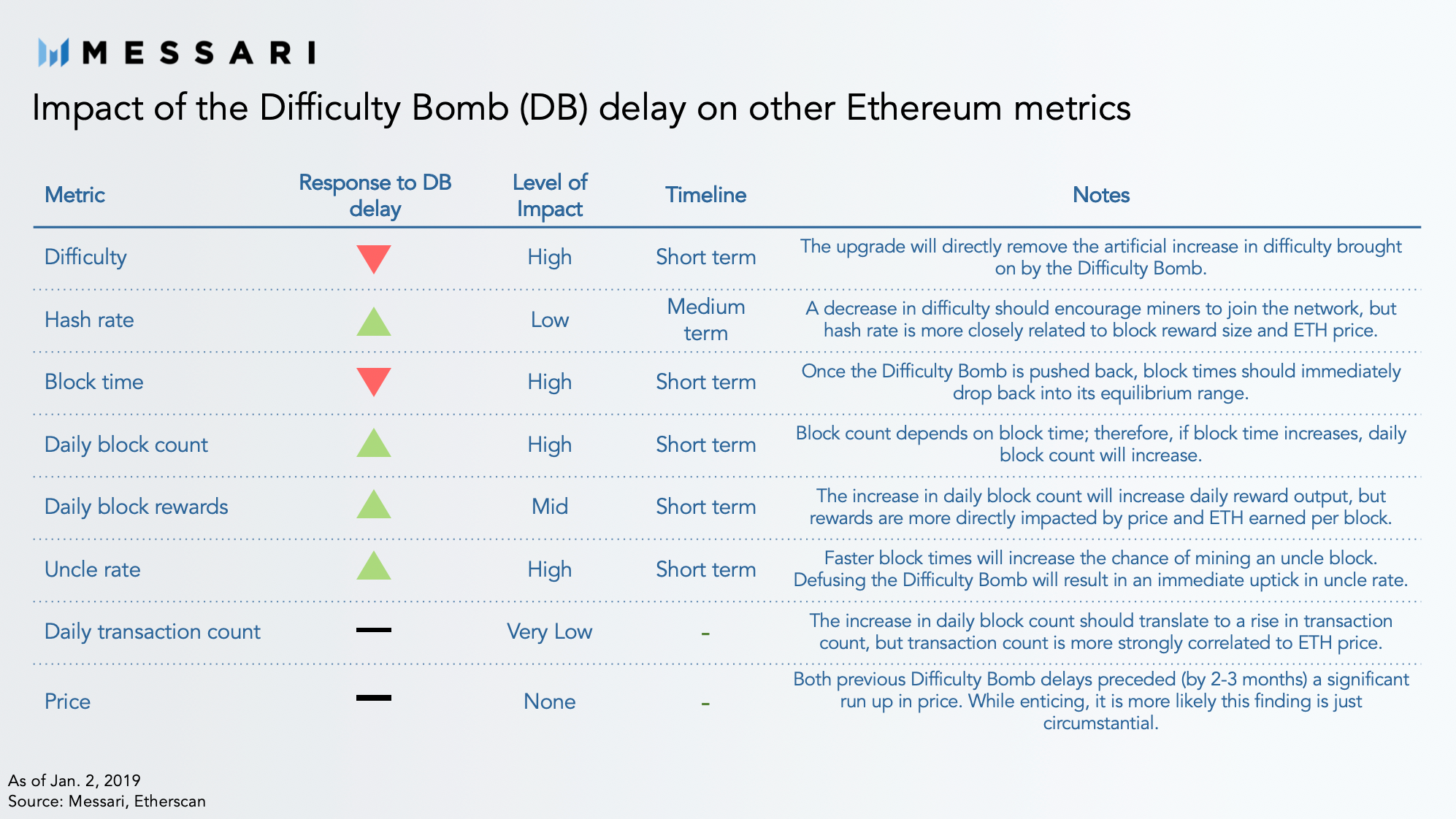
Most of these findings are logical: block time impacts the daily block count, which determines the daily miner rewards. Faster block times also lead to an increase in uncle rate, which can be problematic for miners -- though Ethereum rewards miners for discovering valid uncle blocks to offset this potential issue. On the flipside, network hash power remains largely unaffected in the short term, as difficulty is a lagging indicator of hash rate. But the decrease in mining difficulty should increase mining profit margins and entice more miners to join the network, assuming ETH price remains stable (spoiler: it won’t).