Base: Signs of Early Success

Base officially launched its mainnet on August 9, 2023, and has shown early signs of success after more than a month of live operations. Numerous incumbent DeFi protocols on other networks have deployed on Base, such as Velodrome (Aerodrome), Uniswap, Stargate, and others, as well as Base-native protocols such as friend.tech. Base is now the third largest Ethereum L2 with nearly $400M of TVL despite confirmation from the Coinbase team that there will be no BASE token. The Base core development team has signaled that one of its primary focuses over the coming year will be decentralizing Base, and the OP Stack more broadly, in cooperation with the Optimism Collective and Optimism Labs. Coinbase’s L2 brings in significant revenue from the centrally operated sequencer and has even surpassed Arbitrum and Optimism in daily transaction count on numerous occasions. The growth of L2s has significantly reduced the amount of congestion on Ethereum mainnet, and Base is proving to hold an important role in helping scale the longest tenured smart contract-enabled L1.
For a refresher on Base and the OP Stack, we recommend reading our previous report that went live prior to Base’s mainnet launch.
Decentralizing Base
The OP Stack is an MIT-licensed public good, meaning anyone can use/modify the OP Stack any way they see fit. However, any chains building on the OP Stack that want to be considered a part of the ‘Superchain’ are expected to opt into a social contract, which is referred to as the ‘Law of Chains’, and is currently open for feedback on the Optimism governance forum. The Optimism Collective, consisting of the Citizens’ House and the Token House, began with governing a single chain (Optimism), but will now be responsible for governing the common standard that many chains are built upon (OP Stack). Coinbase helped draft the Law of Chains and has confirmed that Base will embody the ideals within the social contract to support the Superchain’s development. The primary goals laid out by the Law of Chains include ensuring the credible neutrality of blockspace, supporting shared upgrades/maintenance across the Superchain ecosystem, and making key infrastructure, such as sequencing services, available to all chains at an affordable price point.
Coinbase has agreed to share either 15% of Base sequencer profits or 2.5% of Base sequencer revenue, whichever is higher, with the Optimism Collective to fund public goods. This could result in a formidable revenue stream for the Optimism Collective based on initial Base sequencer data to date, with EIP-4844 expected to further improve L2 margins. EIP-4844 will increase the DA bandwidth of Ethereum for rollups, and therefore lower costs for L2s to submit transaction batches for settlement. It is possible these cost savings will be passed on to users, but we believe that there is room for L2s to keep a portion of the cost savings given how low L2 transaction fees already are and the price insensitive nature of L2 users. While Base’s revenue share will likely be insignificant on its own, it sets an important precedent for future Superchains and could fuel open source innovation in the public goods sector. The 15% take rate on profit is winning out for now, but this could change depending upon what percentage of post EIP-4844 savings are passed on to users or if it will be internalized. Coinbase will have the opportunity to earn up to 2.75% of the OP token supply, or ~$165M at OP’s current FDV, over the next 6 years as it works on the OP Stack alongside Optimism Labs. Coinbase will also hard cap its voting power to 9% of the votable supply in an effort to support decentralization.
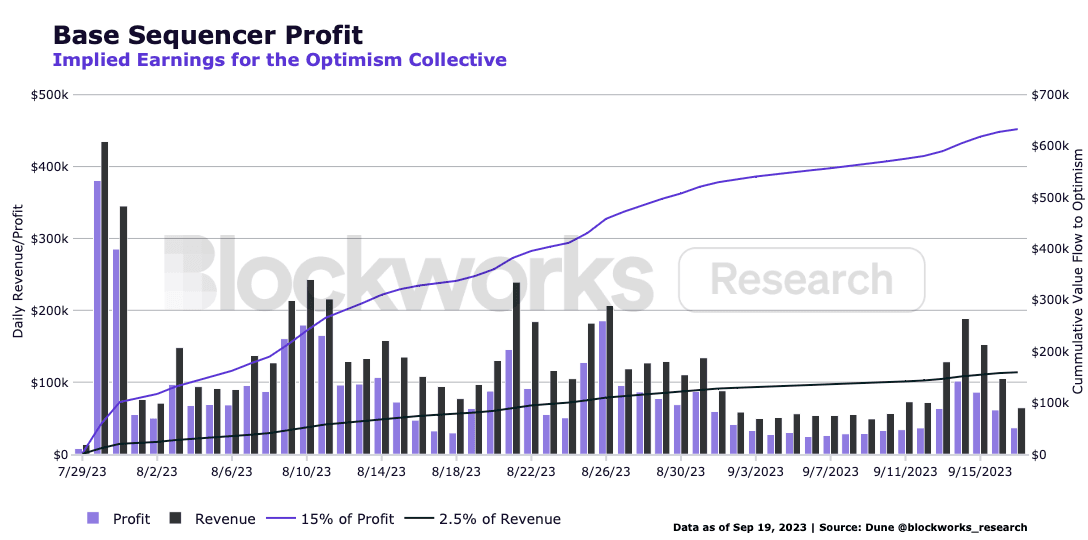
Coinbase has worked with Optimism Labs effectively in the past, which is exemplified by their research on EIP-4844 and later by improving the OP Stack’s throughput by implementing improved compression techniques to more efficiently post calldata to the L1 and enabling the batcher to post multiple transactions in each L1 block instead of just one at a time. Coinbase will continue contributing at the technical level, such as working to improve OP-Geth, the first implementation of the OP Stack, developing OP-Reth alongside Paradigm to improve execution client diversity while introducing a second client that supports fault proofs, helping establish a security council that can move nimbly in the event of a catastrophic bug, and building out tools like Pessimism that help monitor the Superchain’s health in real time. The key takeaway from Coinbase’s commitment to the OP Stack in lieu of Base’s launch is the sheer momentum around building an open-source framework for easily deploying scalable, and eventually, decentralized rollups.

Sam leads coverage on Ethereum, L2s, Aave, Compound, as well as NFTs and gaming. Previously worked on a hedge desk at UGC.