BarnBridge: For Those Seeking Smarter Alpha

The following report was written by Messari Hub Analyst(s) and commissioned by BarnBridge, a member of Messari Hub. For additional information, please see the disclaimers following the article
Investing in crypto can be rewarding, or stressful, or, perhaps more likely, a combination of both. As new capital moves into this burgeoning asset class, many will find the volatility poorly suited for the faint of heart. After all, what good does it do if a portfolio is up 100% one day only to be down 50% the next?
Fortunately, DeFi does offer a few protocols for those wanting to see less volatility. One that comes to mind is BarnBridge, a team working to create products structured to help investors sleep soundly at night.
BarnBridge Background
BarnBridge is a cross-chain risk management protocol founded in 2019. The protocol provides composable solutions for investors to hedge against interest rate fluctuations and price volatility. In September of 2020, Barnbridge closed an initial $1M seed round for 7.5% of token supply, giving the project a $13.3M valuation. The seed round comprised both venture funds and founders in the industry. Among the prominent investors were Fourth Revolution Capital, ParaFi Capital, Kain Warwick from Synthetix, and Stani Kulechov from Aave.
Capital raised during this seed round was stored in a temporary incubator DAO called Launch DAO, managed by the project founders, seed investors, and advisors. This gave the team an opportunity to get started on their roadmap before the protocol’s official release. Full transition to the full protocol DAO - BarnBridge DAO - occurred in Q1 2021 and granted community members management of the protocol.
The community at BarnBridge DAO has overseen the release of multiple DeFi products. Examples include SMART Yield, a product allowing investors to capture fixed rate yields, and SMART Exposure, a solution offering investors an easy way to rebalance portfolios. Their latest product is SMART Alpha, designed to hedge investors against price fluctuations - or to provide leverage for bullish theses.
SMART Alpha Overview
Launched in September 2021, SMART Alpha allows investors to calibrate exposure to financial assets by taking a senior or junior position in an aggregated pool. Those on the senior side are better protected when the underlying asset decreases in value but forego upside when it increases; the opposite applies for junior users who take leverage on price volatility. In other words, the junior side is bearing price risk given up by the senior side.
How much risk is shifting between counterparties? Well, junior and senior outcomes are determined as a function of junior dominance, or the percentage of the asset pool composed of junior tranche deposits. If junior dominance is low, seniors receive lower downside protection and juniors are more exposed to price changes. Conversely, when junior dominance is high, more investors are bullish, so seniors are protected more and juniors hold less leverage on their trade. BarnBridge adds two limits quantifying the extent of downside protection:
- Senior downside protection is limited to 80% of junior dominance
- Senior downside protection is capped at a maximum of 35%
Note investors are rewarded for taking the contrarian thesis as the skew of junior vs. senior dominance will directly affect corresponding rates of return. Hence, the downside protection or amount of upside given up by seniors really depends on the broader market environment. This is an important component of understanding how SMART Alpha works.
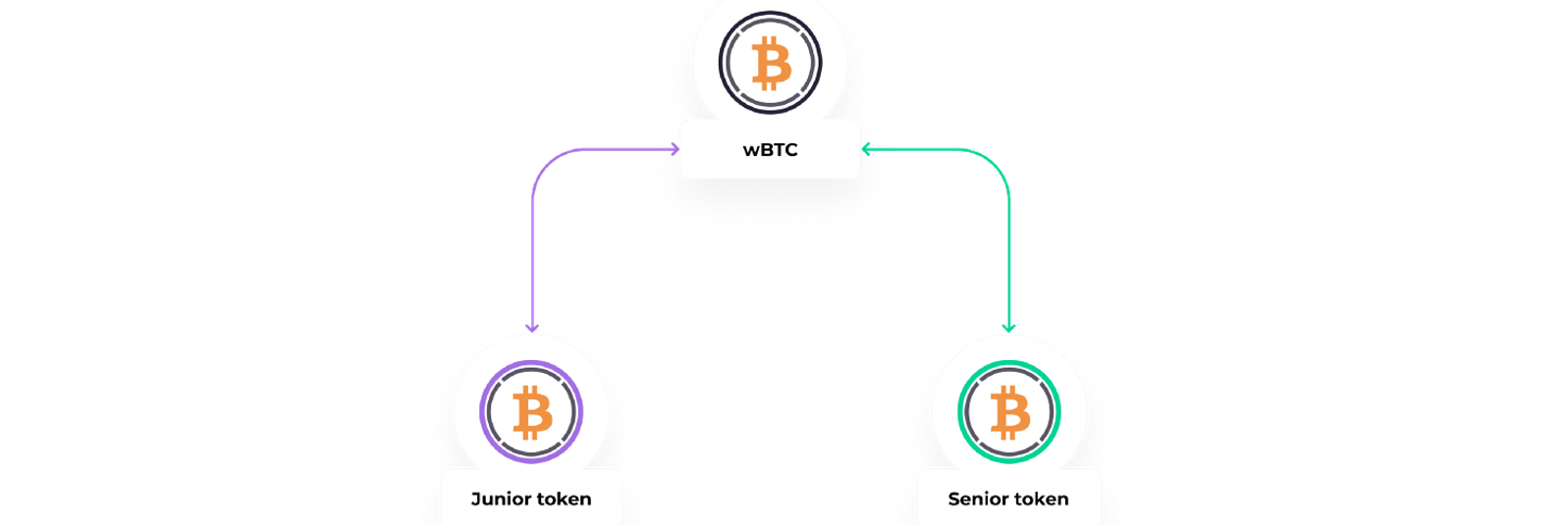
Once capital is allocated into the pool, both junior and senior tranche holders receive a tokenized ERC-20 asset signaling their stake in the pool. Ownership on the junior side may provide a bb_junETH token, for example, whereas the senior side may receive a bb_senETH token. Just like other tokenized assets, these ERC-20 tokens are composable and can be utilized for other lending or trading applications.
Every SMART Alpha asset pool runs on an epoch-based timeline and can be recalibrated once per interval, meaning any user can deposit the underlying asset in either the senior or junior pool prior to the next epoch. This can be several days in advance or with merely minutes to spare. While epoch parameters can be adjusted for each asset by community vote, the default epoch period advances weekly on Mondays at 14:00 UTC.
Protocol revenue is earned through a fee taken at the end of every epoch. The fee currently stands at 0.5% of a given week’s profits (i.e. asset price declines and the senior side is covered by junior investors, then the fee would be taken from the amount juniors cover for the seniors; vice versa if the price goes up) and applies to the winning side only. Should an asset price appreciate during the period of time, BarnBridge would receive the fee out of the upside given to the junior side from the senior pool; if the price depreciated, BarnBridge would take the fee from the downside mitigation provided by the junior side.
So SMART Alpha offers a little bit of both worlds. It’s easy to imagine someone wants leverage on trades, but who wants to take the other side? BarnBridge envisions the ideal user of senior tranches to include project treasuries, collateralized borrowers, and investors with an appetite for low risk. All three of these user bases want to decrease volatility and achieve some level of price predictability. Project treasuries, in particular, can utilize their large positions to serve as a reliable source of liquidity, helping reduce junior dominance and increase leverage for risk-taking investors. Those who foresee a local top in the market can also use senior positions to shield potential losses while keeping some upside should further gains materialize.
Any non-rebasing ERC-20 asset pair with a Chainlink price feed can be made into a SMART Alpha pool – and the network isn’t only limited to Ethereum. BarnBridge is operational on Binance Smart Chain, Polygon, Avalanche, and Arbitrum as well. But Ethereum has by far the largest TVL and serves as the best indicator of activity.
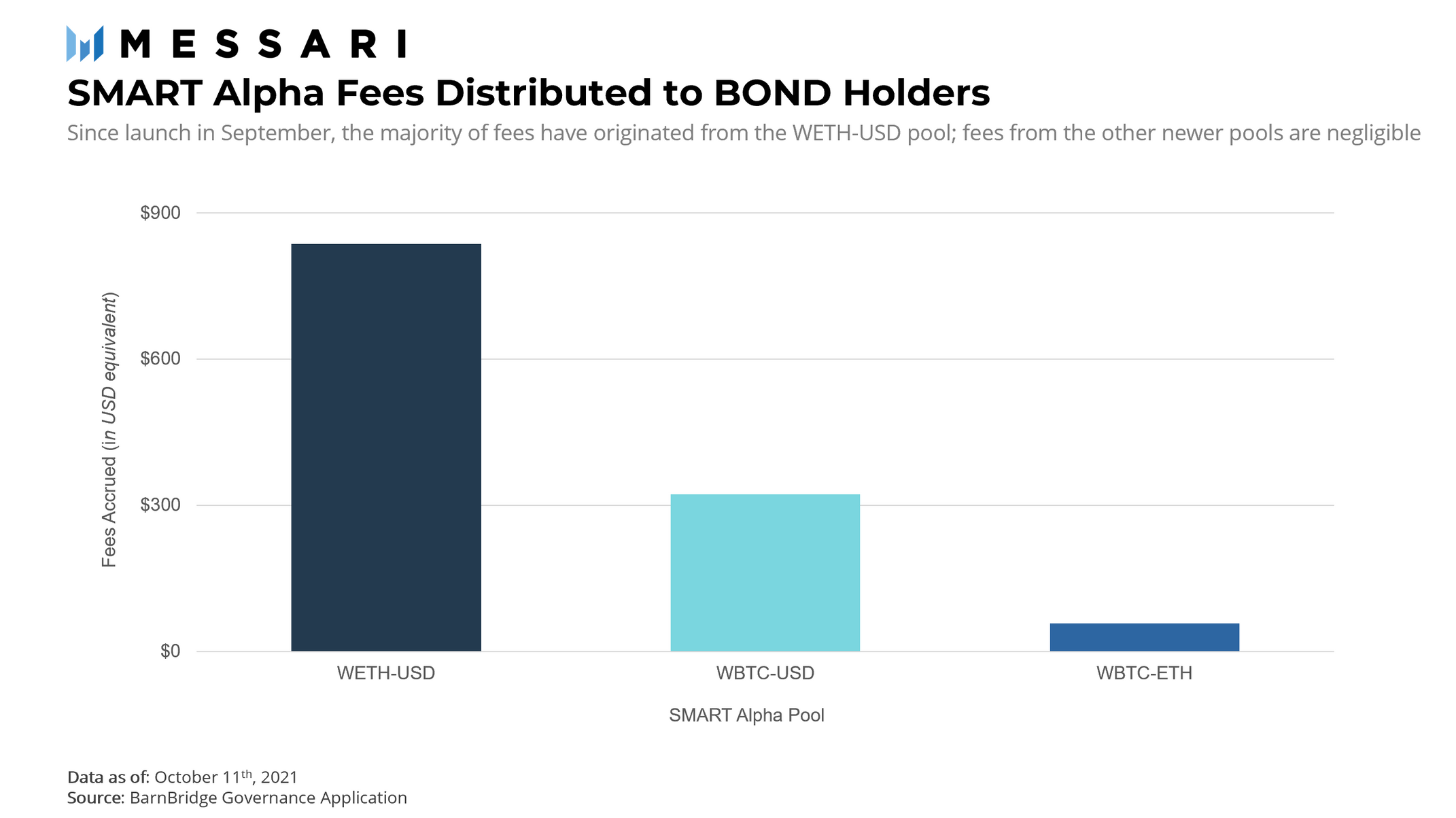
Narrowing down to Ethereum shows eight smart contracts active as of October 11th. The original four are in their fifth epoch and offer traditional ETH, BTC, and USD pairings. Four others were created later and consist of blue chip DeFi-USD pairings using AAVE, UNI, LINK, and SUSHI. Given the short time since launch for all eight pools, it’s understandable SMART Alpha fees, as seen above, have yet to pick up.
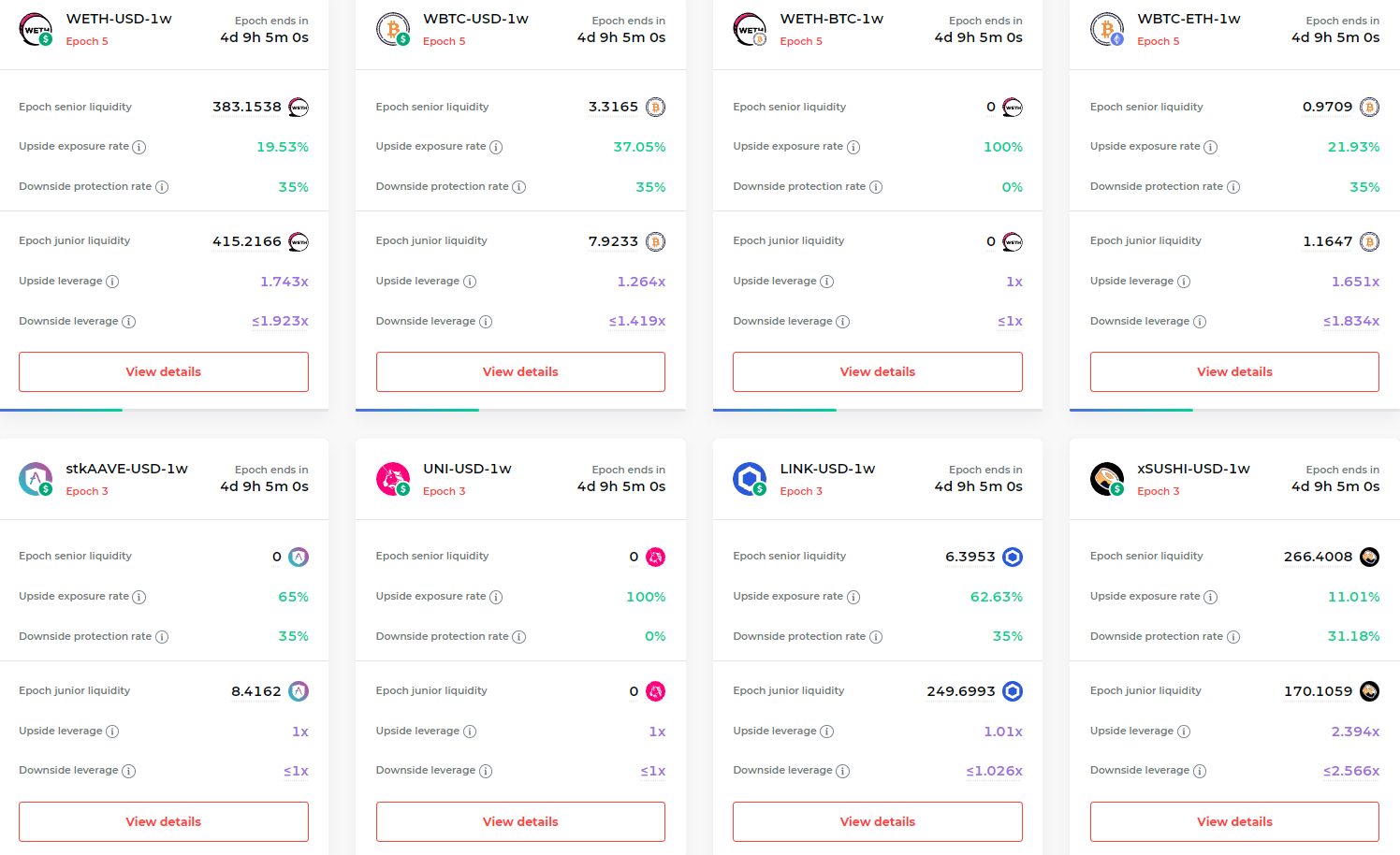
Source:BarnBridge Smart Alpha Pools
Visualizing SMART Alpha Scenarios
To better understand how the product works in practice, a series of visualizations are below. Suppose an investor wants to take a position in the WETH-USD pool. Selecting the pool in the BarnBridge user interface above pulls up relevant details:
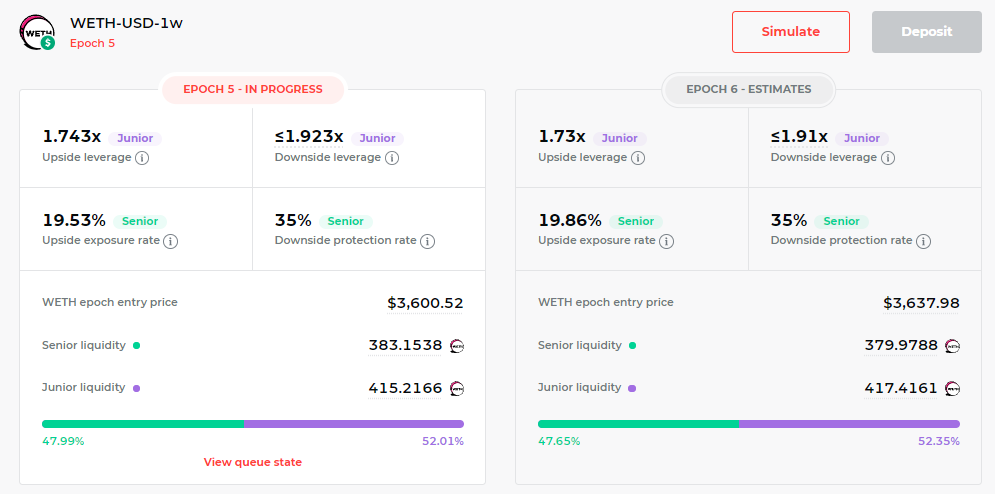
One of the key points of data is the green/purple bar on the bottom highlighting the split between senior and junior percentages. Junior dominance hovers over 50% in Epoch 5, corresponding with the bullish mood found in mid-October. Smart investors can use the split between the two pools as a benchmark of broader investor sentiment.
Now let’s simulate the scenarios:
>50% Junior Dominance
The first scenario uses 52.01% as the junior dominance to keep things consistent with real life sentiment in Epoch 5. Suppose during the course of the epoch, ETH appreciates 10%. In this case, investors in the senior pool return 1.95%; junior investors return 17.42%. The result is in line with expectations since senior holders forego investment returns to the junior side.
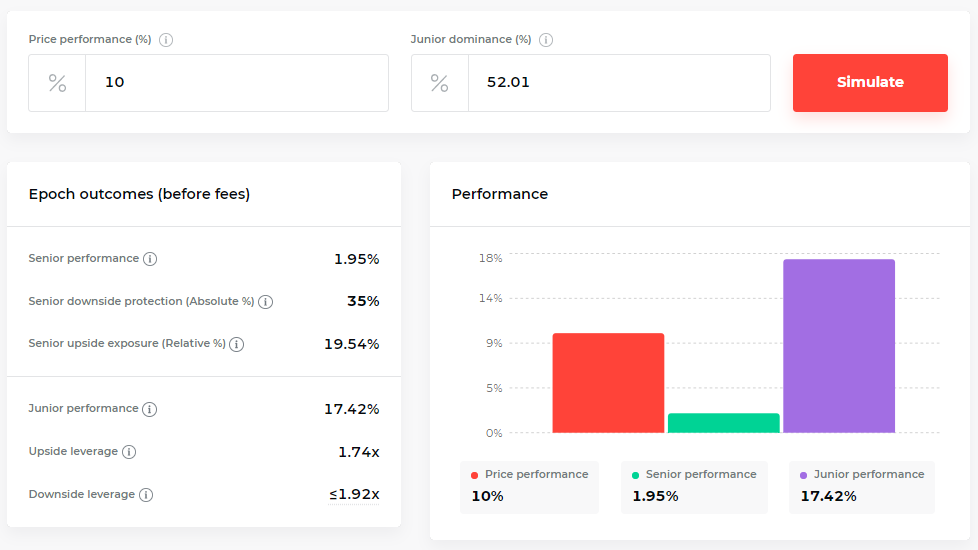
Scenario #1: Positive price performance with >50% junior dominance
Conversely, if the price were to fall 10%, senior position holders have downside protection. In fact, those in the senior pool do not see any loss in their investment. Unfortunately for anybody leveraged on the other side, they see their investment decrease 19.23%.
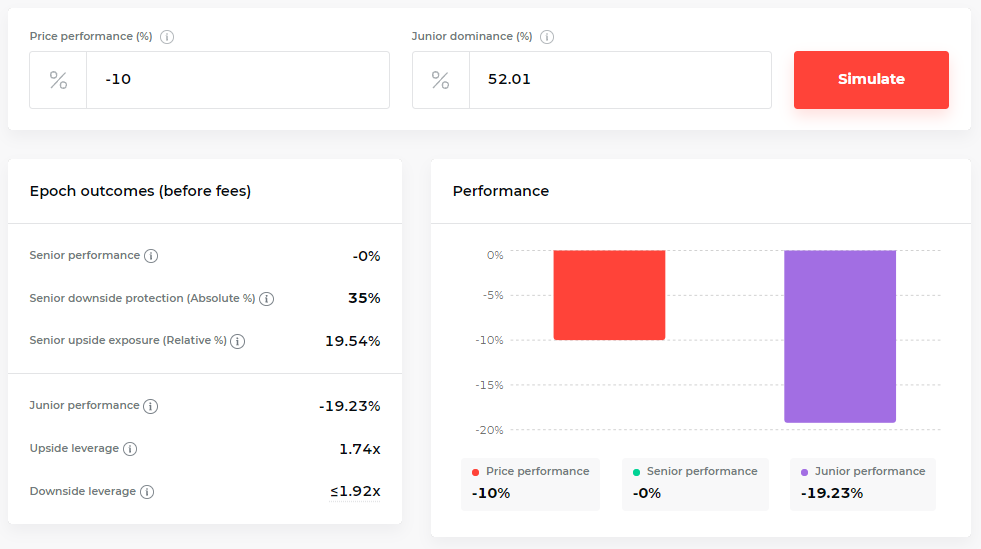
Scenario #2: Slight negative price performance with >50% junior dominance
Downside protection only extends so far. The example provided gives 35% maximum senior downside protection. If ETH fell 40% during the week, seniors would begin to feel the negative effect of the market. Juniors, of course, would see a more dramatic effect.
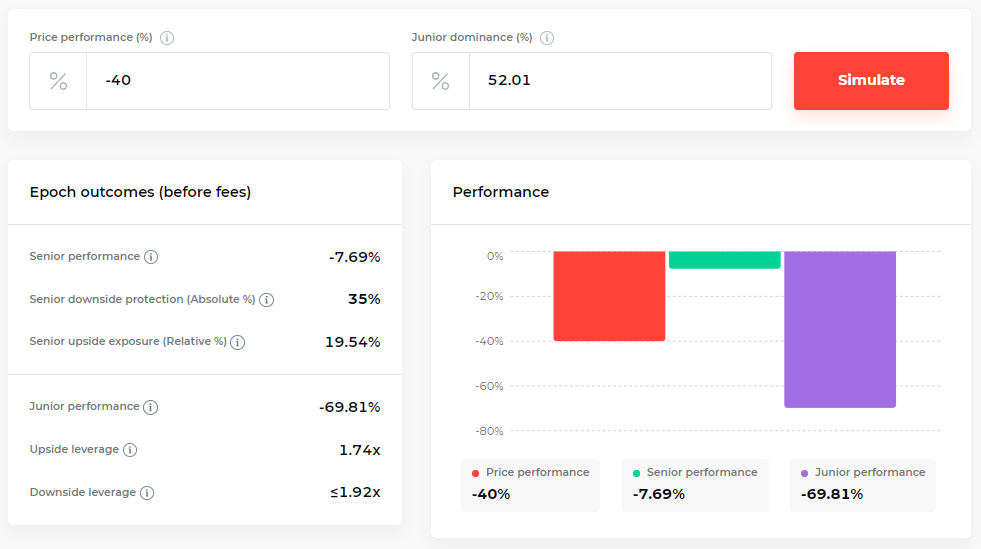
Scenario #3: Strong negative price performance with >50% junior dominance
<50% Junior Dominance
What about when market sentiment is bearish and junior dominance is under 50%? The results are similar but the magnitude of returns changes.
The simulator provides another glimpse into the results. Starting with the 10% positive return, senior upside is again capped while the junior pool outperforms the market. However, compare the 19.61% return with the 17.42% earlier when junior dominance exceeded 50%. Since market sentiment was decidedly more bearish than previously, those who took the contrarian bet earned higher returns.
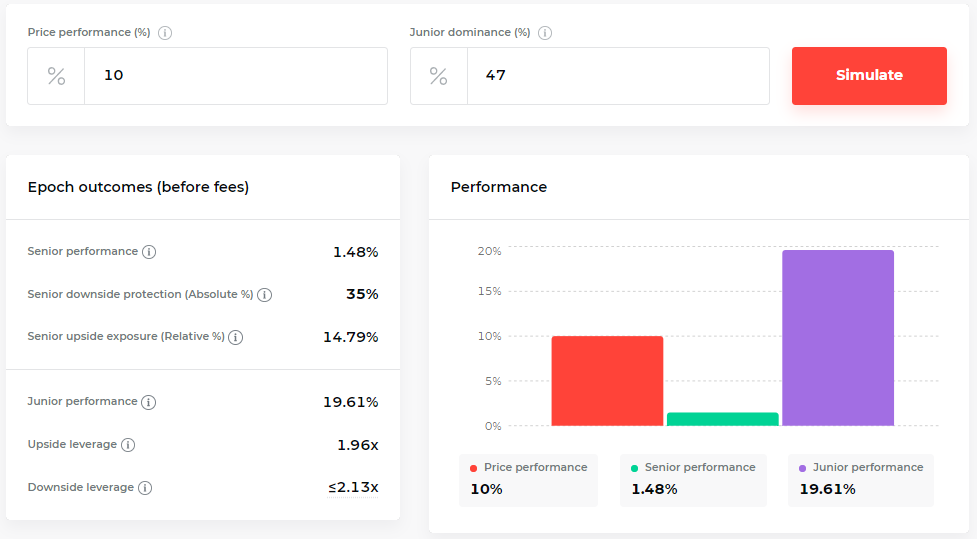
Scenario #4: Positive price performance with <50% junior dominance
Scenarios 5 and 6 produce comparable results to scenarios 2 and 3 with junior performance exposed to higher amounts of leverage due the senior/junior divide. Note senior downside protection remains capped at 35% in our examples. Since downside protection is at max 80% of junior dominance, downside protection only begins to shrink when junior dominance falls to around 43.75%.
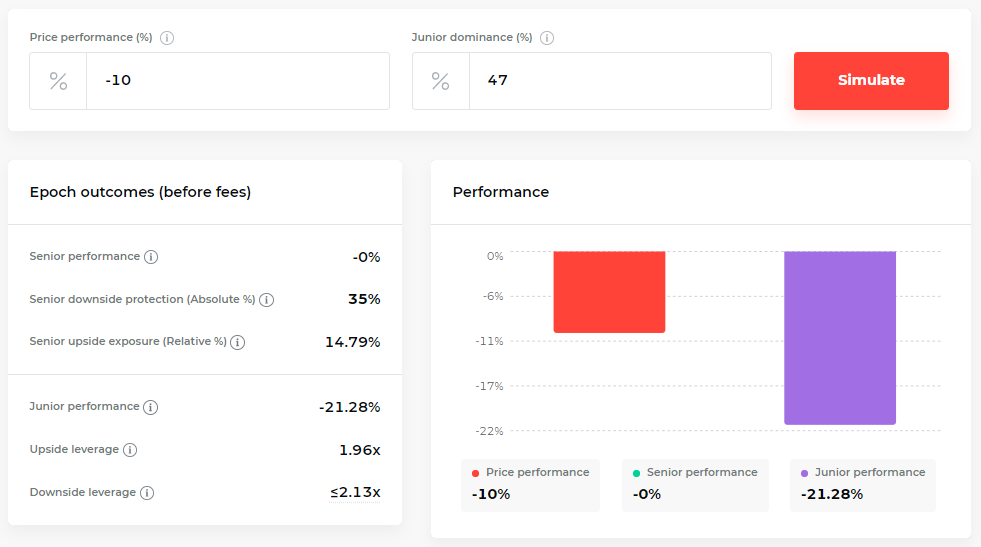
Scenario #5: Slight negative price performance with <50% junior dominance
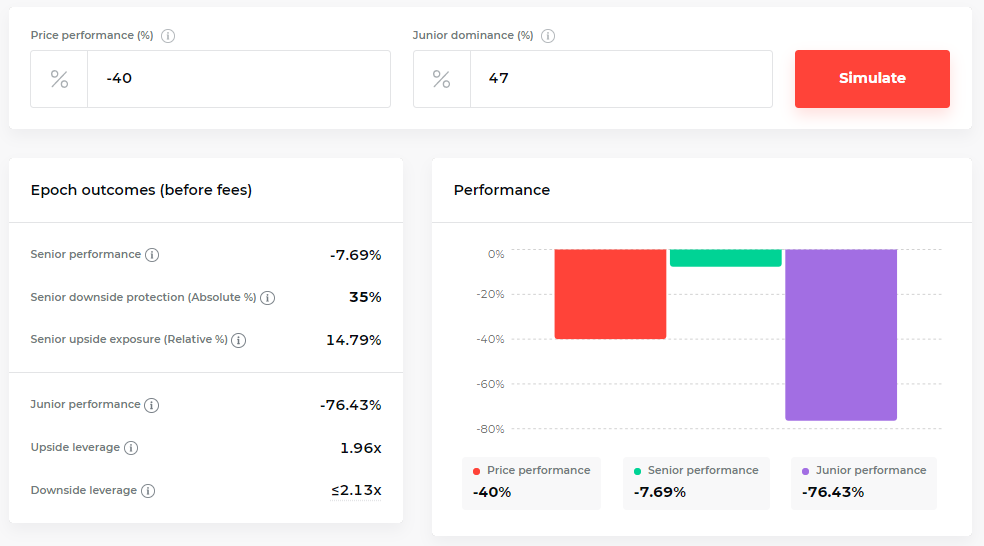
Scenario #6: Strong negative price performance with <50% junior dominance
As one can see from the examples, SMART Alpha offers investors a way to take on leveraged exposure to assets. This brings similarities to another popular product, perpetuals (perps), but SMART Alpha has four main differences:
- SMART Alpha is a long-only product: Investors are unable to take short positions on assets, so even those taking the senior side of the pool must have some degree of faith in the underlying asset.
- Junior investors cannot be liquidated: Seniors take an increased percentage of downside after full downside coverage is surpassed. Those in the junior pool begin to see an asymptotic result with each additional percent loss affecting them less and less. BarnBridge’s dashboard might show 5x upside leverage and 5.5x downside leverage on the interface, but the true risk/reward tradeoff is much more appealing.
- SMART Alpha is composable: As mentioned earlier, juniors and seniors receive a token representing their capital in the product which can be used in other DeFi platforms. Investors can allocate or stake these composable tokens to increase their investment returns, making the product potentially more capital-efficient if attractive opportunities are found.
- Leverage is likely limited: Leverage on the platform is based on junior dominance and junior dominance is unlikely to grow disproportionate enough to achieve the 20x or more leverage attainable using perps (for context, junior dominance on an asset would have to be around ~10% to get 10x upside leverage). Some might call this a feature; others may call it a bug.
The protocol is a unique way of introducing asset tranches to DeFi but those interested in the product should understand potential risks. The introduction of tranched price exposure is new and has yet to be tested at scale. This presents one of the biggest risks to investors if mismanagement of pool parameters and mispricing of assets lead to unforeseen events. These risks will fade if SMART Alpha gains traction, but early adopters should acknowledge them nonetheless.
Conclusions and Takeaways
BarnBridge expects commercial activity to increase in the next few months. The project team plans to partner with other DeFi protocols to integrate SMART Alpha’s tokenized assets into the broader money lego ecosystem. Timelines for those partnerships are unclear at the moment.
What is certain is the broad usability of this newest product. Some investors will be ready to go all-in on the market; others may be more cautious. Both parties may ultimately find themselves on the opposite side of each other in a BarnBridge pool, searching for smarter alpha.

Jerry joined Messari as a Research Analyst after working in management consulting. He graduated with a B.S. in finance and a minor in computer science from Indiana University's Kelley School of Business.