Bancor in 2021: A Promising DEX Challenger?

Launched in 2017, Bancor was the first automated market maker (AMM) built on Ethereum. In the years since, several other AMMs have emerged, with Uniswap dominating the sector based on trading volumes and total liquidity. Today DEXs have reached aggregate trading volumes north of $1.75 billion per day with AMMs leading the way.
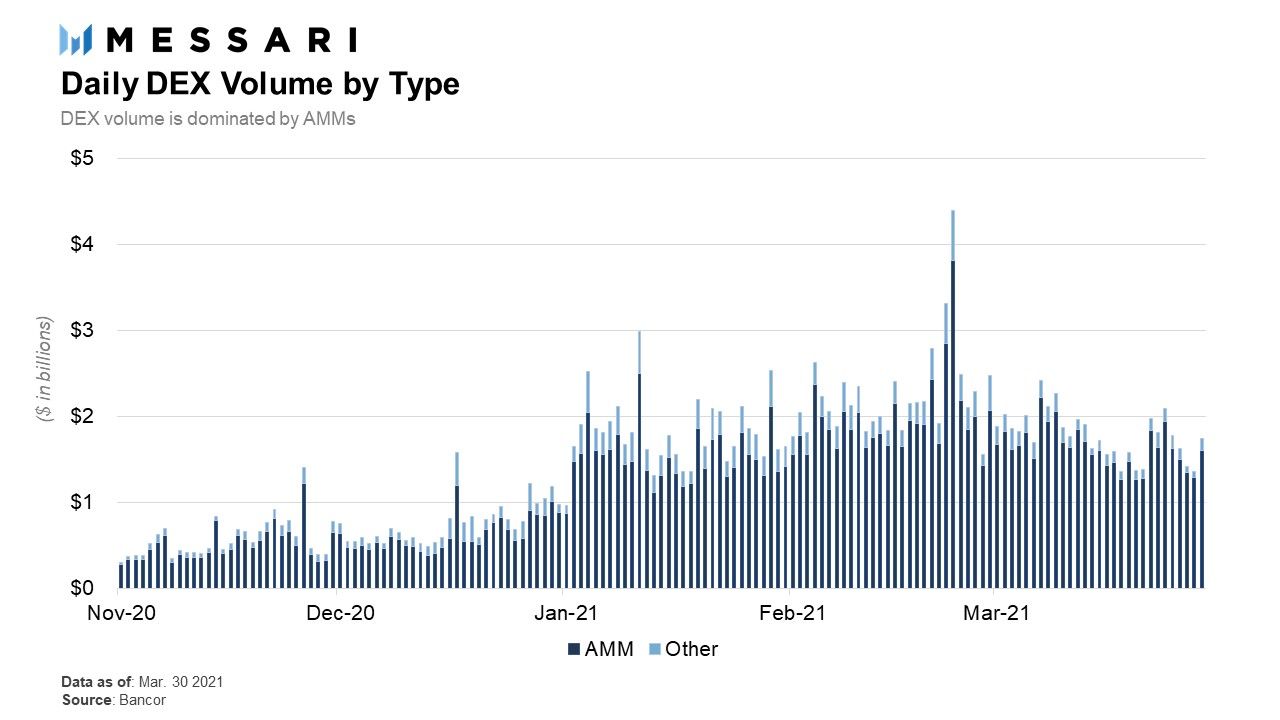
Still, while AMM’s have been an important innovation in DeFi, allowing anyone to earn passive income by providing liquidity to a pool that others can trade against, some pain points exist. Liquidity providers can only provide liquidity using multiple tokens and liquidity providers are exposed to impermanent loss. In October 2020 Bancor launched its version 2.1, aimed at solving these two pain points. A few months later, Bancor released phase 1 of its Vortex feature which is designed to add utility to staked BNT tokens.
This report discusses the implications of the two updates, Bancor’s performance to date, and the role of Bancor’s governance token, BNT.
LP & Impermanent Loss Insurance
Bancor identified two pain points that liquidity providers face, the need to pair assets before providing liquidity, and impermanent loss. It tackled both issues by leveraging its governance token, BNT.
As a refresher BNT is one side of every Bancor trading pair. In v2.1 liquidity providers now have the option to contribute just one side of a trading pair to a liquidity pool. Historically if you were a holder of say WBTC and wanted to earn fees by providing liquidity you would have to swap half of your WBTC into BNT before depositing into a Bancor liquidity pool. However, with Bancor v2.1, a user may now choose to deposit only WBTC to a WBTC/BNT pool.
