Babylon has created the primitive to Stake on Bitcoin and secure other chains in exchange for yield.
They have achieved this by leveraging cryptography and key protocols such as Bitcoin timestamping and Cosmos’s inter-blockchain communication (IBC).
Through Babylon, other networks can receive more accessible and affordable economic security and leverage certain aspects of Proof-of-Work (PoW) to cover the security blindspots of Proof-of-Stake (PoS).
Babylon seeks to achieve a similar goal as EigenLayer, except with the highest market cap asset, Bitcoin.
As the second-highest market cap asset, Ethereum has expanded past its initial goal to be “the world computer” and now has become a security layer for other networks through EigenLayer and almost 100 rollups building on top of it. One of the primary security sources for blockchains is a significant amount of capital funneled through a desirable asset that can be staked such as ETH. Creating an asset that can achieve this in practice is difficult and expensive. To solve this problem, projects like EigenLayer take an already secure and desirable asset like ETH and utilize it to secure other blockchains rather than bootstrap it with high token emissions.
In just five months, EigenLayer has attracted over $13 billion in Total Value Locked (TVL) showcasing that ETH is a desirable asset to be used for shared security since it has amassed the most decentralization and highest market cap by a large factor amongst the PoS blockchains. If this model of sharing security is so desirable with ETH, then why not do the same with the only more desirable and secure asset, Bitcoin?
Babylon is a protocol working to create Bitcoin staking, which would allow BTC holders to share over $1.2 trillion of economic security with other networks in exchange for a staking yield.
Babylon Architecture
Babylon raised $18 million led by Polychain and Hack VC to build a security and aggregation layer between any PoS Blockchain and Bitcoin that enables Bitcoin staking. The staked BTC remains on Bitcoin mainnet while Babylon uses cryptography and the Inter-Blockchain Communication Protocol (IBC) to translate the staked asset and delegate Bitcoin security to other networks in exchange for yield for the BTC staker.
For example, if a BTC holder wanted to stake their assets they could go to Babylon, select which eligible networks they would like to stake towards, and then lock up their BTC in exchange for yield in the other network’s token (claimable on the consumer network). That way the staker gets to keep holding their BTC while earning additional yield all while the PoS network inherits the economic security of Bitcoin.
Key Components
Bitcoin Staking and Security
Babylon uses a concept called “Remote Staking,” similar to EigenLayer, to avoid trusting third parties such as bridge providers or custodians. Remote staking involves locking, staking, and slashing a particular asset on its home chain in a self-custodial manner while earning a yield on a separate network. In the case of ETH in EigenLayer, it is on Ethereum; in the case of BTC in Babylon, it is on Bitcoin. To achieve this seamlessly, you typically need capable smart contract functionality like what you would find on Ethereum. However, Bitcoin's scripting language intentionally limits expressiveness, making it difficult to build complex applications.
Builders have three options: build within Bitcoin constraints, introduce centralized trust assumptions (custodians, sequencers, etc.), or risk waiting for a Bitcoin soft fork that may provide additional functionality such as OP_Cat which paired with innovations such as BitVM would allow for more complex applications to be built on Bitcoin mainnet. Babylon has built native staking functionality on Bitcoin that does not introduce centralized trust assumptions and achieves the ability to stake BTC today.
Bitcoin Staking Contract: Instead of smart contracts like on Ethereum, Bitcoin has Unspent Transaction Output (UTXO), which is when the output of a transaction can serve as input for another. Customizing how UTXOs operate is done through Bitcoin Script and emulating covenants, which customize Bitcoin transaction management and allow the creation of applications on Bitcoin. Babylon uses the above tools to create a time-locked self-custodial vault where a BTC holder stakes their assets on Bitcoin for a chosen period of time. Only holders can redeem their assets upon the end date using their private key. In the event that the holder misuses their stake to attack another network, they will have their stake slashed.
Slashing: Because Bitcoin Script is minimally expressive, one can not simply send proof that a staker took a malicious action and expect Bitcoin to slash the stake. Babylon’s clever design requires BTC stakers to use their private key to lock, unlock and slash their stake. Since the primary attacks against blockchains are validators signing opposing blocks to orchestrate a double spend attack, in the event that the private key for any BTC staker is used to sign blocks twice at the same time, the private key is leaked so that the BTC can be sent to a burn address. The way that private keys are leaked is through extractable one-time signature (EOTS) which is supported by the Bitcoin blockchain through Schnorr Signatures.
Timestamping: One protocol enabling non-custodial Bitcoin staking is Babylon’s Timestamping protocol. This allows PoS Blockchains to publish arbitrary data to Bitcoin and retrieve timestamps that can be used to protect wrongfully censored or important transactions, enable faster unstaking times, and synchronize networks receiving security via BTC staking to the Bitcoin blockchain. Blockchains post the hash for any “important” transactions to Bitcoin through Babylon which aggregates these hashes from all blockchains opting into this service and checkpointing a cryptographic proof onto Bitcoin.
Babylon Chain
Babylon Chain serves as core infrastructure for the Bitcoin staking protocol, acting as an aggregation and coordination layer between Bitcoin and other networks. Despite Bitcoin providing the infrastructure and economic security for staking, Babylon Chain houses the following protocols and functionalities to make it a reality:
Enabling Bitcoin timestamping for other blockchains to synchronize them with Bitcoin
Providing a marketplace for BTC stakers to be matched with other networks
Communicating staking and validation information between networks.
Bitcoin is an expensive and slow network to operate on. It makes submitting timestamps for every PoS blockchain difficult, as it would congest the Bitcoin Blockchain. Babylon's purpose as its own chain is to ensure decentralization and scalability for this coordination layer and promote a quality developer and user experience for Bitcoin staking.
Babylon’s network leverages the Cosmos SDK to seamlessly aggregate and communicate messages and arbitrary data between Bitcoin and other blockchains via the standard IBC (inter-blockchain communication) protocol. IBC-enabled chains can send important transactions and timestamping data from one chain to another. By leveraging IBC, Babylon can seamlessly aggregate checkpoints of important transactions from any IBC-enabled chain and create cryptographically verifiable checkpoints on the Bitcoin Blockchain.
Consumer Chains
Consumer chains are any PoS blockchain seeking to use Bitcoin’s economic security through Babylon. The current prerequisites for integration are the following:
Opening an IBC connection with Babylon. Through that, the chain will send signed block headers to Babylon and receive Bitcoin time stamps of their transactions with proof.
The blockchain utilizing this service then has validators that run these light modules, which allow this network to synchronize with Bitcoin via the timestamps and interpret them to make critical decisions such as voting power, stake, slashing, etc.
Technical Concepts
Slashing and Stake Management
Babylon introduces a novel cryptographic framework designed to integrate Bitcoin staking and slashing mechanisms into the security of other Proof-of-Stake (PoS) blockchains. At the heart of this system are Extractable One-Time Signatures (EOTS), a special form of cryptography that ensures the integrity of block signing and penalizes misbehavior. The process involves an extra layer of consensus, known as the finality round, which comes into play after the base consensus protocol functions on the consumer chain. A block reaches finalization only after gathering EOTS signatures from more than two-thirds of the Bitcoin stake involved. This mechanism effectively ties all safety violations to double signing within the finality round. Should any validator attempt to attack the protocol by signing two different blocks at the same blockchain height, the EOTS system ensures that their private key is leaked.
This private key leakage enables the network to slash the malicious staker's Bitcoin, serving as a deterrent against dishonest behavior. What makes EOTS particularly suitable for this application is its compatibility with Schnorr signatures, a cryptographic scheme natively supported by Bitcoin. This compatibility means that the leaked private keys can be directly used to execute slashing transactions on the Bitcoin network, thus penalizing the violators. The system also addresses the challenge of enforcing penalties on a blockchain like Bitcoin, which lacks native support for smart contracts and complex transaction types. By focusing on the direct consequence of key leakage for safety violations, Babylon sidesteps the need to process complex evidence on the Bitcoin blockchain. Instead, it leverages cryptographic and consensus mechanisms to ensure that any safety violation inherently results in the necessary evidence for slashing: the offender's private key.
PoW vs. PoS Security
In the landscape of PoS blockchains, security challenges such as long-range stake unbonding attacks and liveness attacks, which include censoring or stalling the chain, are of significant concern. Long-range attacks exploit the ability of stakers to potentially fork a blockchain by using their stake to sign blocks on an alternative chain, after unbonding their stake from the original chain. To mitigate this, PoS chains often implement lengthy unbonding periods, like the 21-day period common on PoS chains, to ensure security. However, this creates inefficiency and liquidity issues for stakers and can delay processes for different protocols. Babylon aims to address these issues by leveraging the security and immutability of Bitcoin. It aggregates and checkpoints the unbonding transactions of PoS chains onto Bitcoin, serving as a canonical source of truth in the event of a fork. This not only significantly reduces the unbonding period from weeks to hours but also enhances the overall security of transactions on PoS chains.
Furthermore, Babylon raises the threshold for liveness attacks on PoS chains, where a third of validators can potentially censor transactions. By checkpointing to Bitcoin, Babylon allows a supermajority of validators to override censorship attempts, provided they achieve a 1/2 + 1 majority, effectively upgrading the censorship resistance of these chains which typically require 1/3. The security model of PoS chains, contrasted with PoW chains, reveals a fundamental difference: PoS security is more subjective and contingent on the consensus of validators through social consensus in the case of attacks, which can remain static unless the number of stakers changes. In contrast, PoW security, exemplified by Bitcoin, is more objective and grows with accumulated hash power over time, making transactions increasingly secure as more blocks are mined. Babylon's checkpointing mechanism introduces this dynamic security feature to PoS chains by anchoring their state to the Bitcoin blockchain, which acts as a constantly observing server, thereby reducing reliance on perpetually online validators and mitigating the risks associated with long unbonding periods. This innovative approach not only provides a solution to some of the inherent vulnerabilities of PoS mechanisms, such as the potential for fork creation post-unbonding but also enhances the adaptability and resilience of these chains against attacks, bringing the robust security principles of PoW into the PoS ecosystem.
Adoption and Outlook
Before fully launching, EigenLayer gained significant traction amongst restakers and other networks seeking to consume Ethereum economic security through its Active Validated Services (AVS). Babylon is in its testnet phase and has garnered significant traction. In just 48 hours after its February launch of the Bitcoin staking testnet, Babylon was able to amass over 100,000 stakers, indicating early demand to utilize BTC beyond its current holdings.
Additionally, Babylon has amassed over 35 partnerships with consumer chains tapping into Bitcoin's economic security via Babylon. Despite being testnet partnerships this can be comparable to the 13+ AVSs announced with EigenLayer.
Some of their partnerships consist of the following networks: Talus, Cosmos Hub, Osmosis, Akash Network, Injective, Sei, Stride, B Squared Network, Nubit, and many more. The above projects range from networks like the Cosmos Hub, which already have a $4.2 billion asset powering the network, to high-throughput blockchains such as Sei, Decentralized AI projects like Talus and Akash Network, or even Bitcoin L2s and DA layers like B Squared and Nubit.
Implications
Babylon’s unlock for Bitcoin staking and shared security enables many tailwinds ranging from accelerating the $10 billion BTC yield market to improving consumer blockchains' business model and economics.
Bitcoin Yield
According to DefiLlama, the current market size for single-sided Bitcoin yield is over $10 Billion of which $4 Billion is actively earning yield, with the typical yield falling between 0.01% and 1.25%, and requires trust in some version of a bridged or wrapped BTC. BTC holders want to earn a yield on their idle assets, but with low yields and centralized trust assumptions, the incentive is not as high to lock up their BTC. Celsius capitalized on this in 2021 by offering a competitive 8% yield to BTC holders, and before their implosion, they attracted 43,000 Bitcoins, currently valued at almost $3 billion. One can extrapolate that there is a demand for idle BTC holders to earn a yield on their assets, but, currently, the main points of friction are low yields, centralized trust assumptions, and risk.
Babylon offers self-custody BTC staking, lower trust assumptions than the above options, and higher yields with staking rates for PoS blockchains ranging anywhere from 2.36% to 17%, which in many cases is a 50x increase over common BTC yield. This combination of factors can increase the demand for Bitcoin staking well past the current $10 Billion Bitcoin yield market.
Babylon vs. EigenLayer
With EigenLayer, other networks pay a certain amount via their own token emissions to rent Ethereum security. This makes sense economically because the current ETH staking rate is approximately 3.58% because of its higher market cap and demand to secure the network. Networks with less staking demand create higher staking rates to attract economic security, often paying out 17% in the case of Cosmos Hub. Because EigenLayer restakers are already earning Ethereum staking rewards, AVSs can set a significantly lower staking rate because of the premium and existing demand for ETH. However, the only crypto asset valued higher is BTC, which can be assumed to mean that Babylon could undercut EigenLayer’s pricing to give better economics to AVSs along with shared security from the most secure blockchain. Effectively, because BTC has a lower interest rate premium than ETH and nearly all other crypto assets, consumer chains utilizing BTC as a security asset can pay out less emissions (an operating cost) for the same economic security – a competitive advantage for the consumer chain and thus for Babylon.
Bitcoin Staking Derivatives
Ethereum has over $113 billion currently staked at under 30% of its current circulating supply, powering a vibrant liquid staking (LST) economy with a TVL of over $54 billion. On top of LSTs are systems like EigenLayer, valued at almost $14 billion in TVL, which currently enables a liquid restaking token (LRT)ecosystem with $10 billion in TVL. With BTC valued at over $1.3 trillion, less than 10% of its current circulating supply would need to be staked with Babylon to compete with Ethereum’s staking ecosystem. With Bitcoin staking unlocked, there is the potential for projects to build an entire liquid staking and restaking ecosystem on top of Babylon such as Ankr’s LST on top of Babylon.
Reduced Security Budget
As mentioned in the above Bitcoin Yield section, other PoS blockchains spend a significant amount of their token emissions to attract security to their network. For example, app chains like Osmosis spend $47 million annually to attract stakers. This is primarily because their assets are less desirable than BTC or ETH. However, if app chains were to use Bitcoin for economic security because of the existing demand and value in holding BTC they would be able to spend far less on their security budget. This unspent capital could instead go towards user and application growth on their network to make their token more valuable.
Bitcoin Scaling
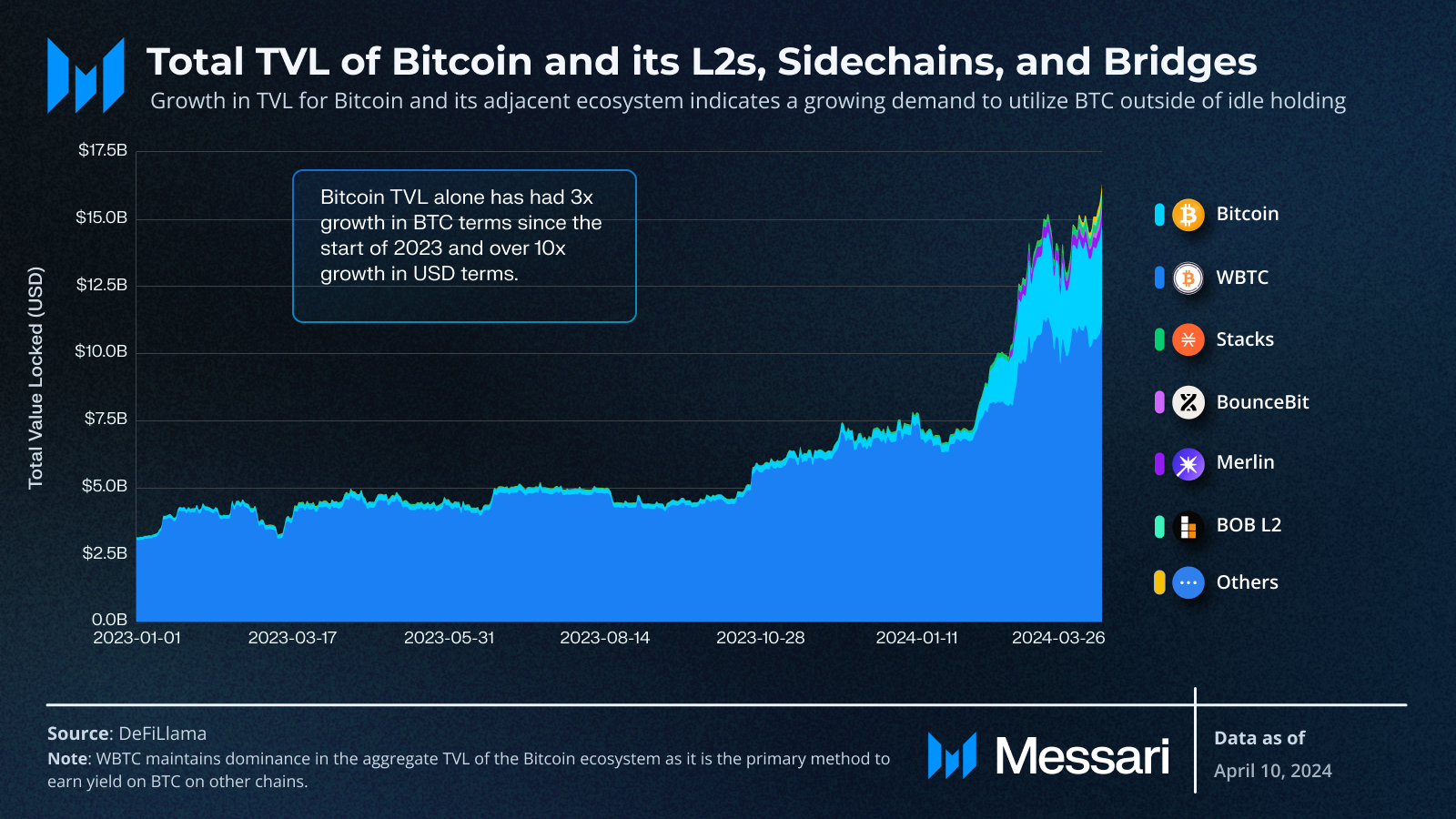
In the last year, the number of Bitcoin scaling projects has hit over 30, and Bitcoin, its bridges, and scaling solutions have collectively reached over $12 Billion in TVL according to DeFillama. Despite this uptick in demand from users and developers, the lack of expressivity for Bitcoin script, limited Data Availability (DA), expensive blockspace, and long upgrade time make it difficult to scale Bitcoin or create valuable trust-minimized applications for Bitcoin holders at scale. Babylon takes advantage of this Bitcoin momentum along with utilizing existing functionality in the Bitcoin script and cryptography supported by the Bitcoin blockchain to help scale Bitcoin and provide a meaningful application to Bitcoin holders within its constraints.
Cosmos vs. Ethereum
Ethereum and Cosmos are headed toward a similar solution but are approaching the same problem from two different directions. Ethereum already has a hub of security being the most decentralized and economically secure PoS blockchain. To scale, Ethereum relies on rollups that have shared security with Ethereum. The problem of the ecosystem is interoperability and composability amongst the fragmented rollups.
Cosmos is solving the problem from the opposite side. The ecosystem already has a fixed framework for interoperability (IBC) and a framework to scale via app chains (Cosmos SDK). Still, the problem is not having a valuable hub of security that can be shared at scale. There have been many attempts, such as with interchain security from the Cosmos Hub. However, ATOM does not have the same economic security potential as ETH or BTC. With Babylon, Cosmos chains can receive shared security from the only other ecosystem more secure than Ethereum, potentially making the Cosmos ecosystem a true rival of the Ethereum ecosystem.
Challenges
Bitcoin Staking Conversion
As discussed in the above section, less than 10% of the current Bitcoin circulating supply would need to be staked for Bitcoin staking to be competitive with Ethereum staking. However, a significant portion of Bitcoin holders HODL in the traditional sense with 25% of the BTC supply being idle for over 5 years and 67% being idle for over 1 year according to Coinshares. Along with it not being the culture for holders to do anything with their BTC, with past occurrences such as with Celsius there may be friction in getting holders to lock their BTC up.
Reliance on IBC
As mentioned in the Babylon Architecture section, Babylon utilizes IBC to aggregate data and communicate between Bitcoin and any PoS blockchain. This is an essential prerequisite to the Bitcoin Staking or Timestamping protocols. The primary reason is that IBC natively has the ability to pass arbitrary data and validator messaging between different chains seamlessly. However, because of this requirement, Babylon's current addressable market is for the 91 Cosmos chains as they support IBC out of the box. However, a project called Composable is building support for IBC to other networks such as Ethereum, Polkadot, Solana, NEAR, and TRON. Additionally, a project known as LandslideAVAX is expanding IBC support to the Avalanche ecosystem of chains. The expansion of support for IBC could mitigate this challenge for Babylon.
Babylon’s Future
Babylon is seeking to achieve what EigenLayer is on a path to. They are doing so instead of ETH security with the more significant and higher market cap Bitcoin security. Unlocking a new primitive of Bitcoin staking, making economic and Bitcoin security more accessible to other chains, and providing yield to idle BTC are elements that can catalyze Bitcoin's current explosive trajectory. With EigenLayer potentially valued at $3 billion —$15 billion when sharing Ethereum’s $427 billion security, it is safe to say that Babylon can be a force to be reckoned with when sharing Bitcoin’s $1.4 trillion security.
All content was produced independently by the author(s) and does not necessarily reflect the opinions of Messari, Inc. Author(s) may hold cryptocurrencies named in this report. This report is meant for informational purposes only. It is not meant to serve as investment advice. You should conduct your own research and consult an independent financial, tax, or legal advisor before making any investment decisions. Nothing contained in this report is a recommendation or suggestion, directly or indirectly, to buy, sell, make, or hold any investment, loan, commodity, or security, or to undertake any investment or trading strategy with respect to any investment, loan, commodity, security, or any issuer. This report should not be construed as an offer to sell or the solicitation of an offer to buy any security or commodity. Messari does not guarantee the sequence, accuracy, completeness, or timeliness of any information provided in this report. Please see our Terms of Service for more information.
No part of this report may be (a) copied, photocopied, duplicated in any form by any means or (b) redistributed without the prior written consent of Messari®.
Nikhil is a Researcher focused on Web3 Infrastructure and Decentralized AI. Previously he was leading BD at Upshot and prior to that was working on growing Avalanche at Ava Labs.
Nikhil is a Researcher focused on Web3 Infrastructure and Decentralized AI. Previously he was leading BD at Upshot and prior to that was working on growing Avalanche at Ava Labs.