Ascending Everest: Avalanche Scalability Through Subnets

Avalanche introduced subnets as a scaling solution that enables participants to interact with smart contracts across blockchains in a permissionless manner. Scalability refers to a network’s capability to handle a growing workload without congesting the overall network’s performance. For a blockchain to truly handle request volumes rivaling that of Web2 applications, such as Twitter, Venmo, or gaming, scalability solutions are needed.
A prime example demonstrating the need for scalability was shown in Yuga Labs’ recent Otherside NFT sale. On May 1, Ethereum transaction fees temporarily soared 600% in response to a drastic increase in transactions during the mint event.
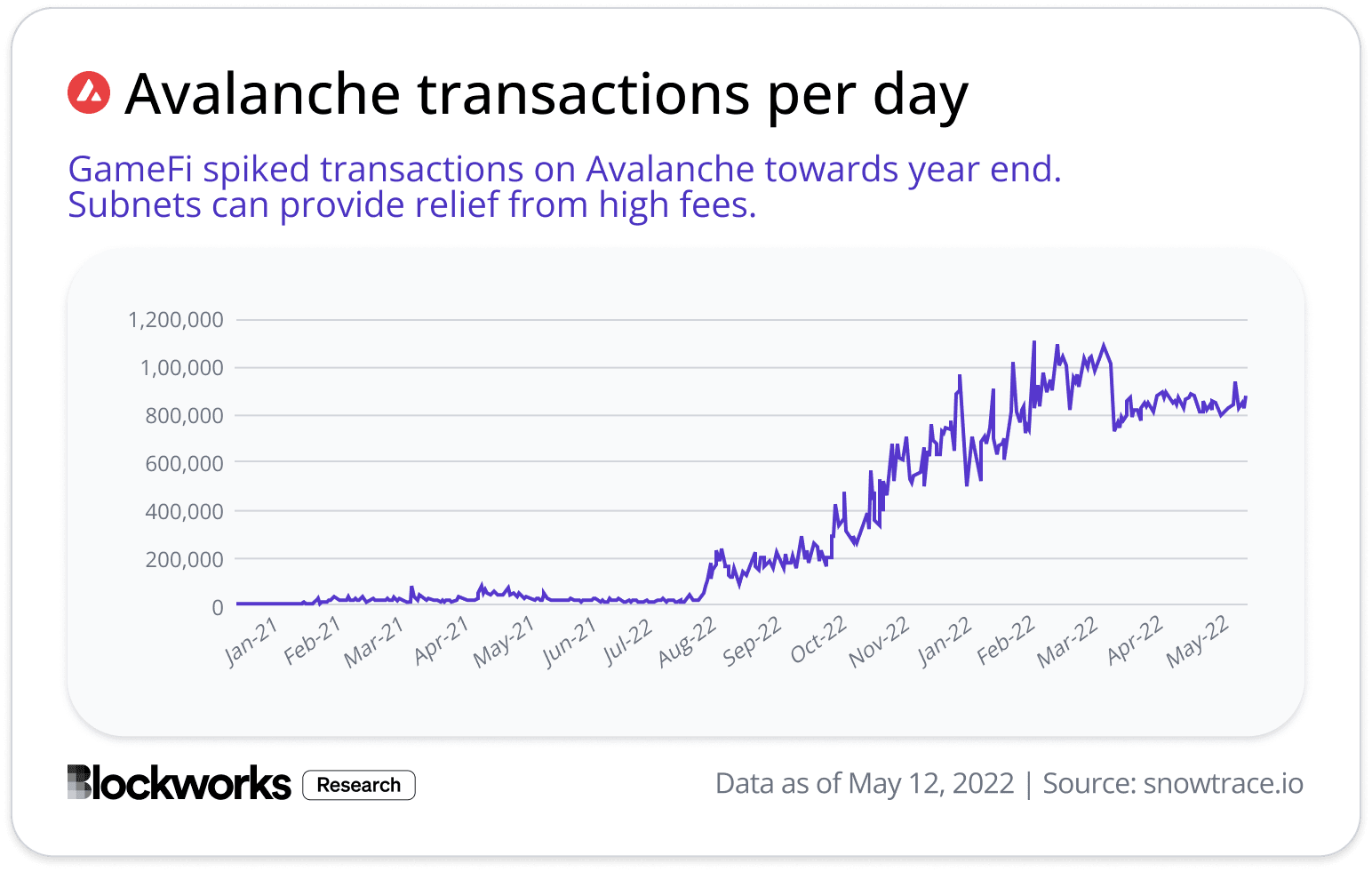
Although Avalanche offers quick transactions right now, it is not immune to the scalability issues caused by large transaction volumes, as seen on other EVM networks. While volume has grown to still manageable levels, spikes can cause problems.
Avalanche subnets enable participants to easily deploy their own Layer 1 blockchains. Subnets can be a single customizable blockchain or a group of custom blockchains that are validated together. This architecture serves as a tipping point for the Avalanche network due to its enablement of a theoretically infinitely scalable blockchain that supports the easy development of an uncapped amount of application-specific chains.
Current Scaling Solutions
Scaling solutions can fall into one of two categories - vertical scaling and horizontal scaling, where vertical scaling involves focusing on strictly processing more transactions through several different solutions, such as increasing the block size, increasing validator storage, or using more advanced processors. Vertical scaling can still hit a point where a system reaches capacity, and enhanced processor and memory loads can increase network validator expenses. For example, Solana enables high throughput and cheap transactions through vertical scaling, but the network requires nodes to run on computers with 1.5TB+ SSD disk space, a 300 Mbit/s connection, and a 128GB RAM CPU with 12+ cores. Such processing power can be quite expensive when compared with Ethereum’s requirement of 500GB+ SSD disk space, 25 Mbit/s connection, 4-8GB RAM CPU with 2-4 cores. Increased hardware requirements can lead to a network being more centralized due to a higher barrier to entry for nodes.

Pibblez leads coverage on emerging L1s, infrastructure, and stablecoins. Previously worked as a Research Analyst at Kraken.