Avalanche's Bid for the Smart Contract Market

Avalanche launched with a bang.
Two months after raising $42 million in a public token sale, the newest Ethereum competitor watched its AVAX token appreciate 720% within hours of launching. The price has backtracked since reaching a near $7.00 peak. But AVAX token sale participants who bought at $0.85 (or lower depending on the selected vesting schedule) just a few months ago have done well.
While getting off to a hot start is a good sign, Avalanche will face an uphill battle maintaining its newly found premium. The Smart Contract Platform market is a well-funded and overly crowded one. And it’s not stale either as nine such platforms have launched in 2020 with a few more on the horizon.
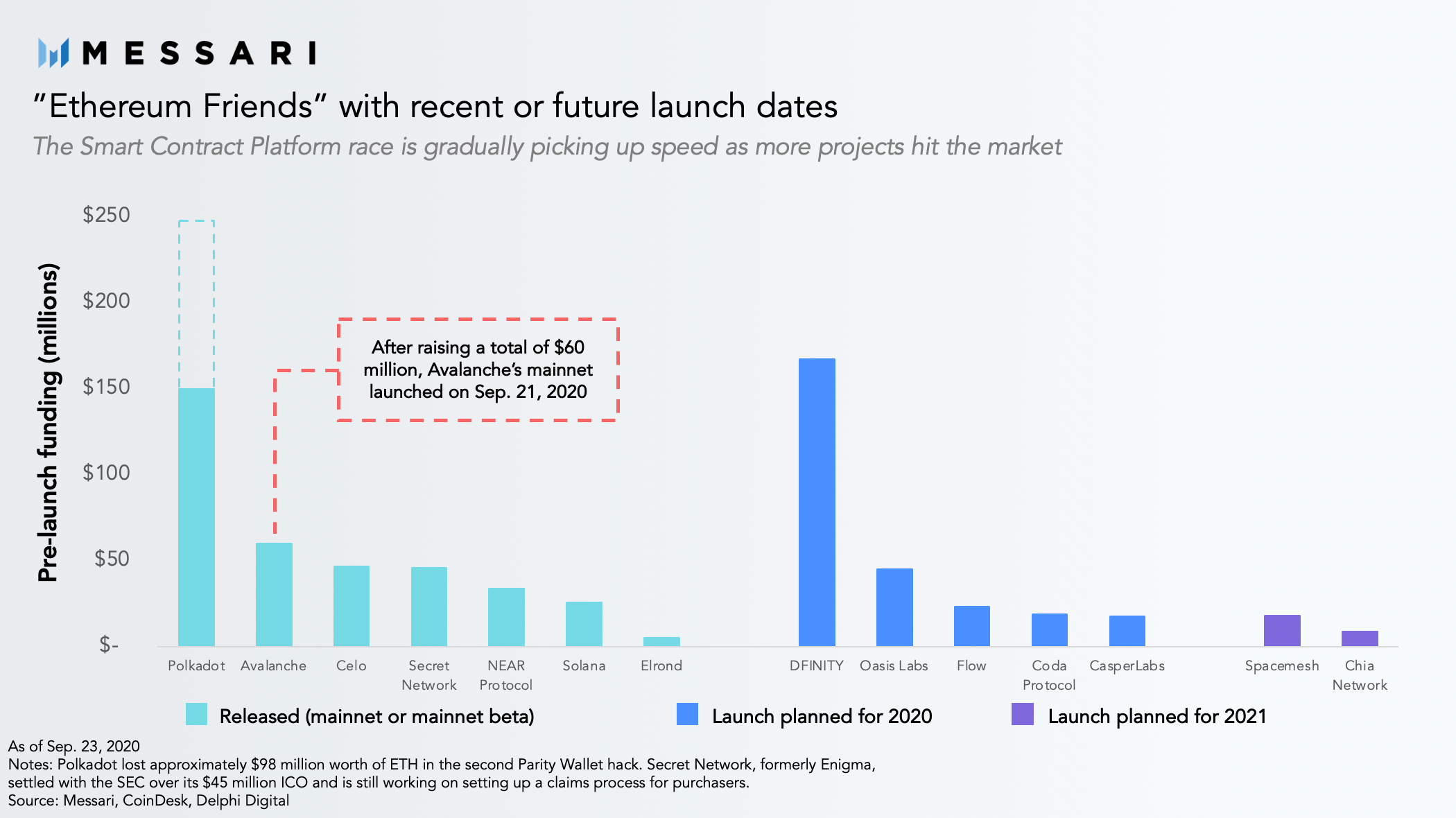
Avalanche’s road to success will depend on its ability to differentiate itself from these competitors while capitalizing on any outflow of Ethereum users or projects due to rising fees. While intangibles like community support and team proficiency have an impact, these differentiating factors might boil down to Avalanche’s design and strategy.
WTF is Avalanche
At a glance, Avalance looks like your standard ETH Killer. It’s a platform for building applications that uses staking instead of mining for Sybil resistance to avoid “computational waste.” It also employs a new family of consensus mechanisms discovered by an esteemed cryptography professor. Better yet, Avalanche can process thousands of transactions per second (on a testnet). But a closer look reveals there’s more going on underneath the hood.

Wilson Withiam was a Senior Research Analyst at Messari. Previously, he worked at Circle Research where he conducted research on cryptoassets. He graduated with a B.Sc. in Kinesiology and Exercise Science before studying computer science and economics at UConn.