Attention AI Devs: Decentralized GPU Marketplaces are Here

Last week, the Akash Network successfully activated the Mainnet 6 upgrade, marking the debut of the first decentralized GPU marketplace. This couldn't have come at a more opportune moment, given the unprecedented shortage of GPUs spurred by the rising demand for training AI models.
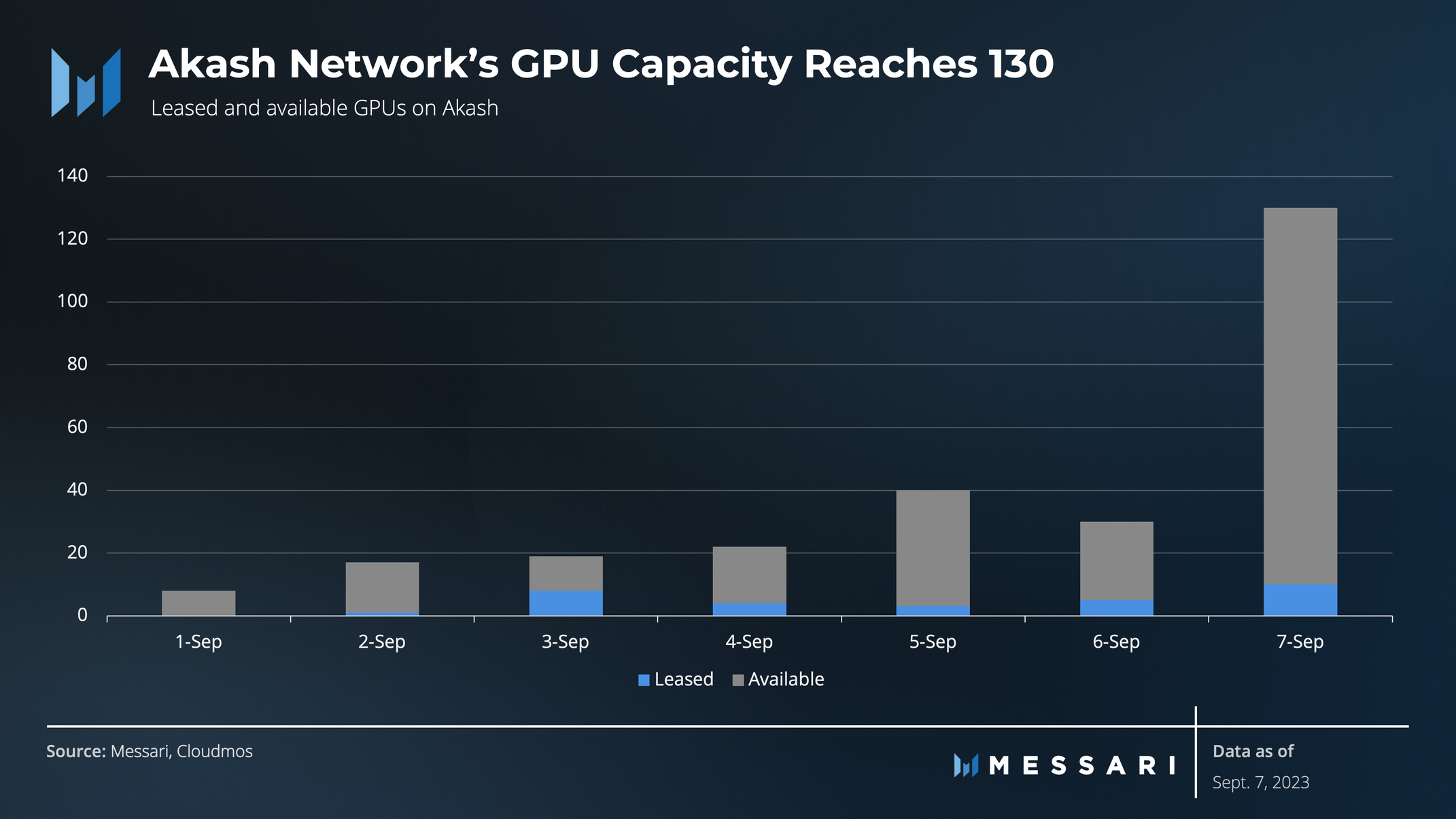
Since its launch, the network's GPU capacity has been rising steadily, recently surging to 130 GPUs. This substantial increase is primarily due to Foundry, a leading decentralized infrastructure operator responsible for the world's largest Bitcoin mining pool, bringing online a cluster of 48 NVIDIA A100s. Additionally, 16 NVIDIA H100s will also be available on the network soon.
Given that the GPU network has been operational for just a week, there's considerable potential for more providers to come on board. While its current GPU count is a drop in the bucket compared to start-up cloud providers like CoreWeave, boasting over 45,000 GPUs, the potential of decentralized networks shouldn't be underestimated. After all, Livepeer has already demonstrated this with its arsenal of over 70,000 GPUs.
Greg Osuri, Akash's founder, shared in a tweet that Overclock Labs, the company that created Akash, has “access to thousands of H100s and A100s and we’re optimizing for 70-90% utilization rate.”
The strategy of incrementally introducing supply, aligned with the rising demand, might be prudent. However, to machine learning developers, an abundant GPU reservoir could be the key attraction, prompting a deeper exploration into Akash.
Akash ML

Sami Kassab is an Enterprise Research Analyst focusing primarily on Web3 Infrastructure and Bitcoin. Sami previously spent 5 years as an Aerospace Engineer designing aircraft engines and missile & defense systems.