As Aptos moves towards technically realizing its vision of becoming “the global trading engine,” real adoption and growth are happening in stablecoin, RWA, and blue chip DeFi application usage.
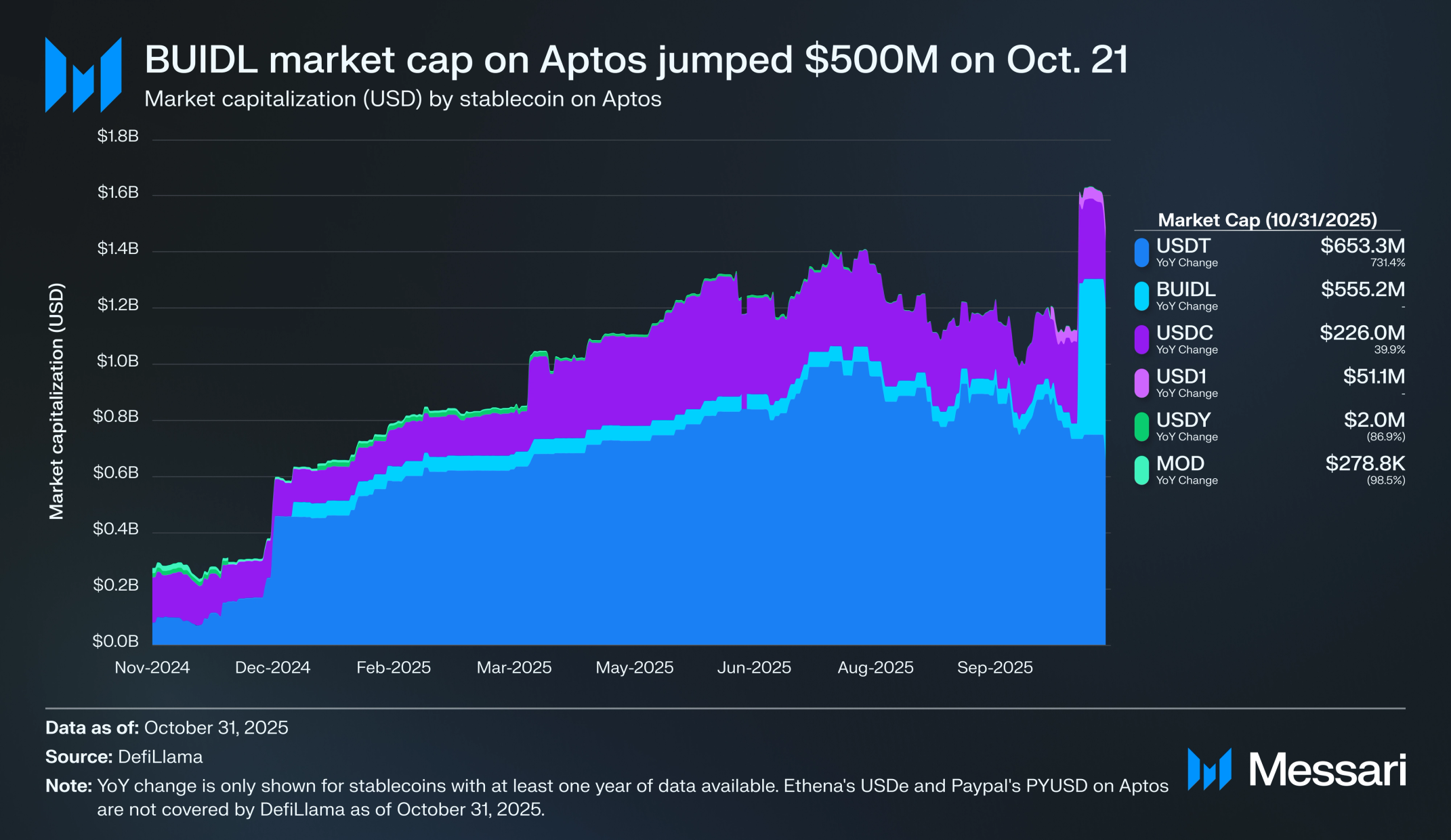
Aptos closed October with a record month-end stablecoin market cap of $1.49 billion, up 48.8% month-over-month (MoM) from $1.0 billion at the end of September following a $500 million jump in the market cap of BlackRock’s USD Institutional Digital Liquidity Fund (BUIDL) on Oct. 21.
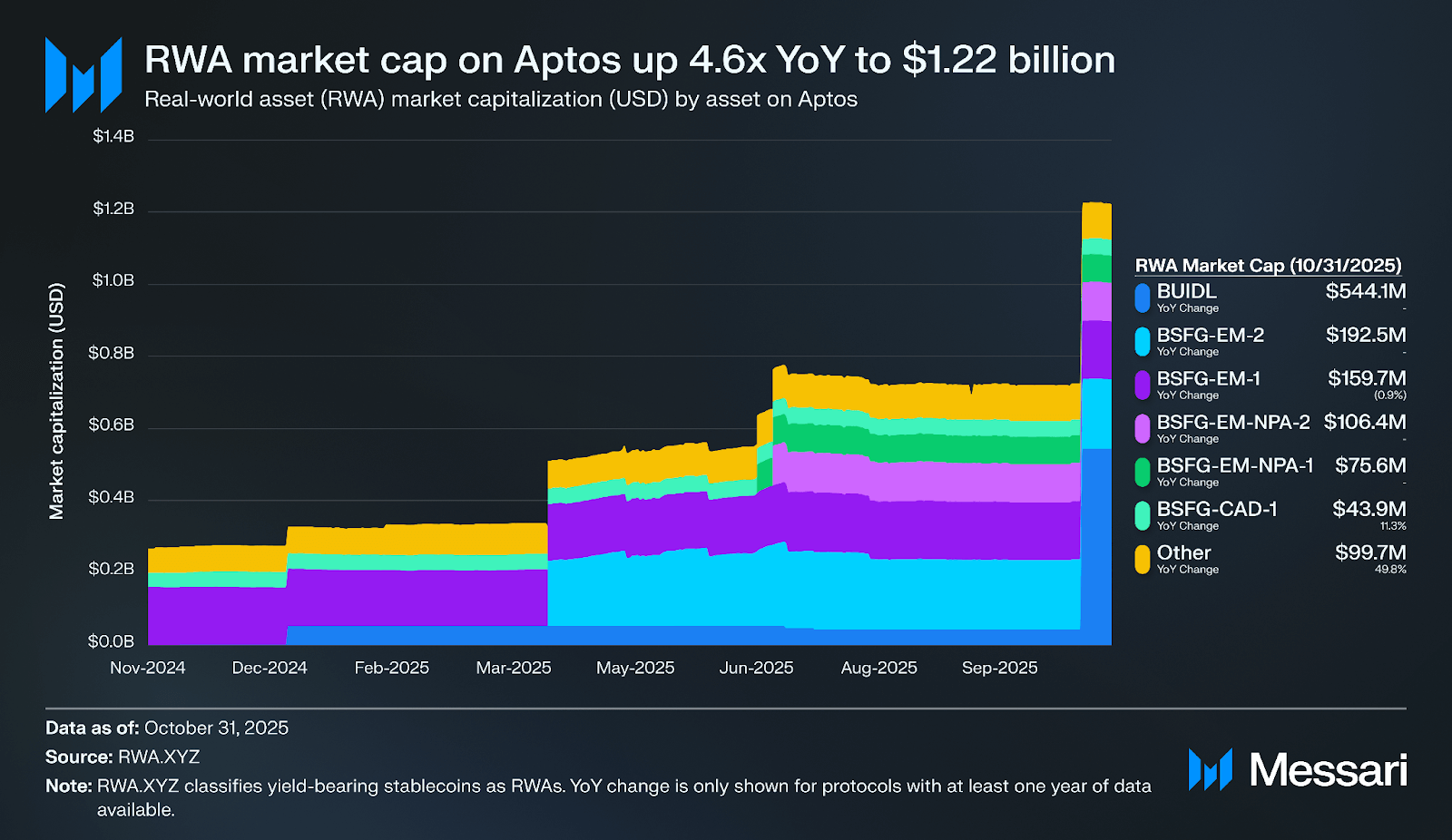
The $500 million increase in BUIDL’s market cap drove Aptos’ RWA market cap to an all-time high monthly close of $1.22 billion as Aptos RWA issuance stands out from competitors' chains for its diverse and balanced distribution of institutional investments, including private credit, institutional funds, and U.S. Treasuries.
World Liberty Financial’s USD1 stablecoin launched on Aptos on Oct. 6, with over $40 million onboarded in the first few weeks, while LayerZero announced in September that it is bringing PayPal’s PYUSD stablecoin to Aptos via PYUSD0.
Monthly stablecoin transfer volume is near record highs, closing October at $62.73 billion, while the median transaction fee in October was $0.0005, demonstrating the network's scalability and user-friendliness as adoption grows amidst integrations from payments providers including Bitso, Yellow Card, Coins.ph, and Sphere Pay.
Primer
Aptos (APT) is a Layer-1 blockchain designed around the core tenets of scalability, safety, reliability, and upgradeability. Aptos was born out of Meta’s Diem and Novi projects, eventually launching in October 2022. Core developer Aptos Labs raised about $400 million in two 2022 private investor rounds.
Aptos’ technological stack features many novel aspects, including the Baby Raptr consensus mechanism, the Optimistic Quorum Store mempool protocol, the Block-STM parallel execution engine, and the programming language Move. Aptos Move, which builds on the original Move language created by the Diem and Novi teams, offers enhanced flexibility and safety compared to other Web3 programming languages. Aptos Move is being co-developed by multiple protocols.
Other key features aim to improve user experience and safeguards, including accounts where private keys are decoupled from public keys, transaction pre-execution to explain the outcome of a transaction before a user signs it, and transaction expiration time and sequence numbers. Development of the Aptos network and growth of the Aptos ecosystem is primarily led by Aptos Labs and the Aptos Foundation. For a full primer on Aptos, refer to our Initiation of Coverage report.
On Oct. 21, the market cap of BlackRock’s USD Institutional Digital Liquidity Fund (BUIDL) on Aptos jumped $500 million to $554.6 million. As a result, Aptos closed October with a record month-end stablecoin market cap of $1.49 billion, up 48.8% month-over-month (MoM) from $1.0 billion at the end of September. First launched on Aptos in November 2024, BUIDL is 100% backed by U.S. Dollar cash, U.S. Treasury bills, and repurchase agreements, with daily accrued dividends paid directly to investors’ wallets as new tokens each month.
USD1 Launches on Aptos
Earlier in October, World Liberty Financial’sUSD1 stablecoin, fully collateralized by short-term U.S. government treasuries, launched on Aptos. World Liberty Financial (WLFI) is an onchain financial infrastructure provider that will enable lending and borrowing services via a segregated instance of the Aave V3 protocol on Ethereum and is also working to tokenize real estate developments. The project is cofounded by U.S. President Donald Trump’s sons Eric Trump, Donald Trump Jr., and Barron Trump, among others.
Multiple incentive campaigns kicked off for USD1 upon its launch on Aptos, including:
Rewards for providing liquidity to the USDC-USDT-USD1 tri-pool on Tapp Exchange.
A prize pool of up to $1 million for tokens traded on Booster.fun paired with USD1. Since the launch of USD1 on Aptos, all new tokens launched on Booster.fun have been paired with USD1 exclusively for liquidity.
Aptos-native wallet Petra also launched gas-free swaps and sends for USD1 on Nov. 3 through Nov. 10, while Bybit added support for USD1 on Aptos on Oct. 24.
Stablecoin Landscape, Transfer Volumes, Payments Partnerships, and More
As of Oct. 31, USDT remained the largest stablecoin by market cap on Aptos, while USDC fell to the third spot due to the market cap growth of BUIDL in October. The network closed the month with $62.73 billion in stablecoin transfer volume, the seventh-highest among all chains, and its second-highest month ever, trailing only $68.14 billion in July. In October, $52.09 billion was in USDT (76.4%), and $10.64 billion (23.6%) was in USDC. Year-over-year (YoY), stablecoin transfer volume is up 22.5x from $2.79 billion following the native contract deployments of USDT in October 2024 and USDC in January 2025. This level of volume, coupled with a median transaction fee of $0.0005 in October, demonstrates the network's scalability and user-friendliness as adoption grows.
To further spur this adoption, four new payment providers have integrated Aptos, including Bitso for Latin America, Yellow Card for Africa, Coins.ph for the Philippines, and Sphere Pay. Moreover, the Aptos Foundation introduced the Aptos Payment Grant track over the summer to support development of payment infrastructure. Grants of up to $150,000 are available, with each grantee also receiving Gas Station Credits to subsidize user gas fees, security audit support, technical mentorship, and founder enablement via accelerators, events, and networking opportunities.
Ethena Update + Aave and PYUSD0 Launches 38.3 million staked USDe (sUSDe) has been bridged to Aptos via Stargate, while only 117 USDe exist on Aptos, indicating a strong user preference to earn sUSDe’s yield. Unlike USDT and USDC, which are fiat stablecoins backed by U.S. Dollar and dollar equivalents, USDe is a synthetic dollar stablecoin, backed by crypto assets and corresponding short futures positions. USDe can be staked to receive an equivalent value of sUSDe. sUSDe tokenholders earn yield from USDe’s (1) underlying staked crypto assets and (2) the funding rate of short positions. sUSDe is the reward-bearing version of USDe and increases in value over time as value accrues through the yield USDe’s collateral generates.
Key use cases for sUSDe on Aptos include providing liquidity to stable and non-stable pairs on DEXs like Thala, and depositing and borrowing from lending protocols such as Echelon and Aave. Aave V3 went live on Aptos on Aug. 21, making it the first instance of the protocol on a non-EVM blockchain. Before launch, the protocol completed a full security review, including audits, a Capture the Flag (vulnerability identification), and a bug bounty. Currently, Aave V3 on Aptos supports deposits of APT, USDT, USDC, and sUSDe, and borrows in APT, USDT, and USDC.
Finally, in September, LayerZero announced extended availability of PayPal’s PYUSD stablecoin, fully backed by U.S. dollar deposits, U.S. Treasuries, and similar cash equivalents, to Aptos via PYUSD0. PYUSD0 is being made available via Stargate Hydra, which enables bridging of native PYUSD from Arbitrum, Ethereum, Solana, and Stellar to nine additional blockchains, including Aptos. Support for PayPal’s PYUSD via PYUSD0 will mark the first major traditional payments company integration on Aptos, with Aptos as the only Move-based chain at launch.
Real World Assets (RWAs)
The $500 million increase in BUIDL’s market cap on Oct. 21 also drove Aptos’ RWA market cap to an all-time high monthly close of $1.22 billion on Oct. 31. The jump made Aptos the seventh-largest chain by RWA market cap at month-end, and BUIDL the largest RWA by market cap on Aptos, with a 44.5% share.
Following BUIDL, $607.1 million (49.6%) across seven products is issued by PACT, a consortium of regulated financial institutions and service providers dedicated to bridging micro-lending origination in emerging markets with capital access in developed markets.
To date, all seven products issued by the consortium are via Berkley Square. These include four emerging market portfolios (BSFG-EM-1 and 2, BSFG-EM-NPA-1 and 2), a mortgage portfolio (BSFG-CAD-1), a portfolio of credit lines for small and medium enterprises in the UAE (BSFG-AD-1), and a Kenya retail portfolio (BSFG-KES-1).
Other notable RWAs issued on Aptos include Apollo’s Diversified Credit Securitize Fund (ACRED), Libre Capital’s USD Money Market Fund (UMA) and BH Master Fund (BHMA), and Franklin Templeton’s BENJI, each token of which represents one share of Franklin Templeton’s onchain U.S. Government Money Fund (FOBXX).
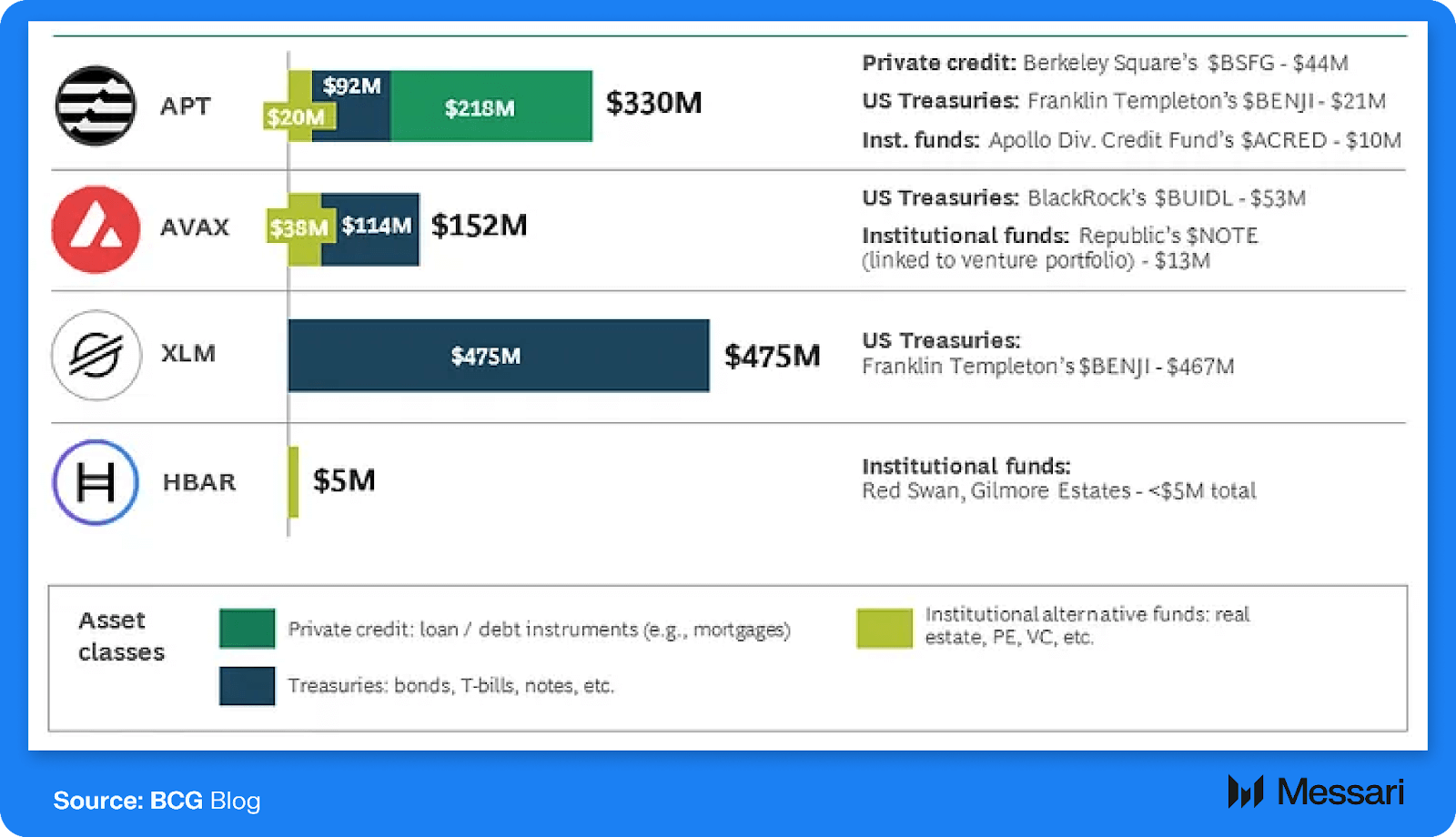
A BCG report from August found Aptos and Avalanche to be leading chains in RWA issuance due to their diverse and even distribution of asset issuance. Whereas the market cap of RWAs on other chains like Stellar is almost entirely U.S. Treasuries, the size of holdings is more balanced on Aptos across institutional investments, including private credit, institutional funds, and U.S. Treasuries. Moreover, at the end of September, tokenized investments and private market infrastructure provider Republic announced it had integrated Aptos, further expanding the diversity of offerings accessible via Aptos.
Other DeFi Updates
In addition to the stablecoin and RWA developments discussed above, a number of key updates relevant to Aptos’s DeFi ecosystem have taken place.
Chainlink’s Cross-Chain Interoperability Protocol (CCIP) went live on Aptos in September, marking the first Move-based integration of the standard. The integration unlocks access to more than 60 blockchains and institutional DeFi liquidity.
Merkle Trade, a permissionless perpetual futures contract trading protocol, released its mobile application in October.
Orderbook-based hybrid exchange Ekidenpartnered with Avail to support direct deposits from more than ten chains.
Prediction market protocol Kalshiadded support for deposits in Aptos-native USDC and APT.
Thala closed its auction for the RESERVE token, which represents shares of Thala’s treasury that accrues fees from ThalaSwap V3 that are then deployed into yield strategies such as APT loops, stablecoin farming, and BTCFi assets to generate sustainable book value. The auction closed roughly 782% oversubscribed, with $1.28M raised in 48 hours. Tokens are redeemable and liquidity is seeding on ThalaSwap V3, including an isolated Echelon Market for book-value borrowing.
Devnet launched for Shelby, the decentralized storage solution developed by Aptos Labs and Jump Crypto, on Oct. 16.
Conclusion
October was a significant turning point for Aptos. Oct. 18 marked three years since the network's mainnet genesis, while block time dropped below 70ms for the first time ever as the network moves towards its vision as the global trading engine. As a detailed roadmap is being implemented to technically realize this goal, real adoption and growth are happening now.
Aptos closed October with a record month-end stablecoin market cap of $1.49 billion, up 48.8% month-over-month (MoM) from $1.0 billion at the end of September following a $500 million jump in the market cap of BlackRock’s USD Institutional Digital Liquidity Fund (BUIDL) on Oct. 21. Moreover, this $500 million increase drove Aptos’ RWA market cap to an all-time high monthly close of $1.22 billion as Aptos RWA issuance stands out from competitors’ chains for its diverse and balanced distribution of institutional investments, including private credit, institutional funds, and U.S. Treasuries.
Amidst this growth, World Liberty Financial’s USD1 stablecoin launched on Aptos, while the launch of PayPal’s PYUSD0 is imminent. Monthly stablecoin transfer volume is near record highs, closing October at $62.73 billion, while the median transaction fee in October was $0.0005, demonstrating the network's scalability and user-friendliness as adoption grows. Aptos is poised for further payments adoption with recent integrations from payments providers, including Bitso for Latin America, Yellow Card for Africa, Coins.ph for the Philippines, and Sphere Pay. Finally, leading lending and borrowing protocol Aave launched on Aptos in August, making it the first instance of the protocol on a non-EVM blockchain. As implementations of Aptos's technical roadmap continue to be released to realize a global trading engine, the network is primed for continued increased stablecoin, RWA, and blue chip DeFi application usage.
This report was commissioned by Matonee Inc. All content was produced independently by the author(s) and does not necessarily reflect the opinions of Messari, Inc. or the organization that requested the report. The commissioning organization may have input on the content of the report, but Messari maintains editorial control over the final report to retain data accuracy and objectivity. Author(s) may hold cryptocurrencies named in this report. This report is meant for informational purposes only. It is not meant to serve as investment advice. You should conduct your own research and consult an independent financial, tax, or legal advisor before making any investment decisions. Past performance of any asset is not indicative of future results. Please see our Terms of Service for more information.
No part of this report may be (a) copied, photocopied, duplicated in any form by any means or (b) redistributed without the prior written consent of Messari®.
Matt is a Research Manager at Messari for the Protocol Reporting team. A generalist at heart, who's curious about anything and everything, and ultimately, on an adventure to find out what's true. He was an investigative reporter and multifamily/senior housing development associate before joining Messari in 2022.
Matt is a Research Manager at Messari for the Protocol Reporting team. A generalist at heart, who's curious about anything and everything, and ultimately, on an adventure to find out what's true. He was an investigative reporter and multifamily/senior housing development associate before joining Messari in 2022.