Analyst Notes: Fighting Coinbase FUD with Financials

Coinbase has been front and center in the headlines recently. In mid-May, they announced a sharply negative earnings report: a $430 million loss and 19% drop in monthly active users. This net loss was ten times worse than the market was anticipating. Revenue expectation missed by over $300 million. But even worse than the numbers was a disclosure that if Coinbase did go bankrupt investors’ crypto would be subject to bankruptcy proceedings. In other words, users would not have access to their funds and potentially have them taken completely or reduced.
At face value, this seems pretty bad.
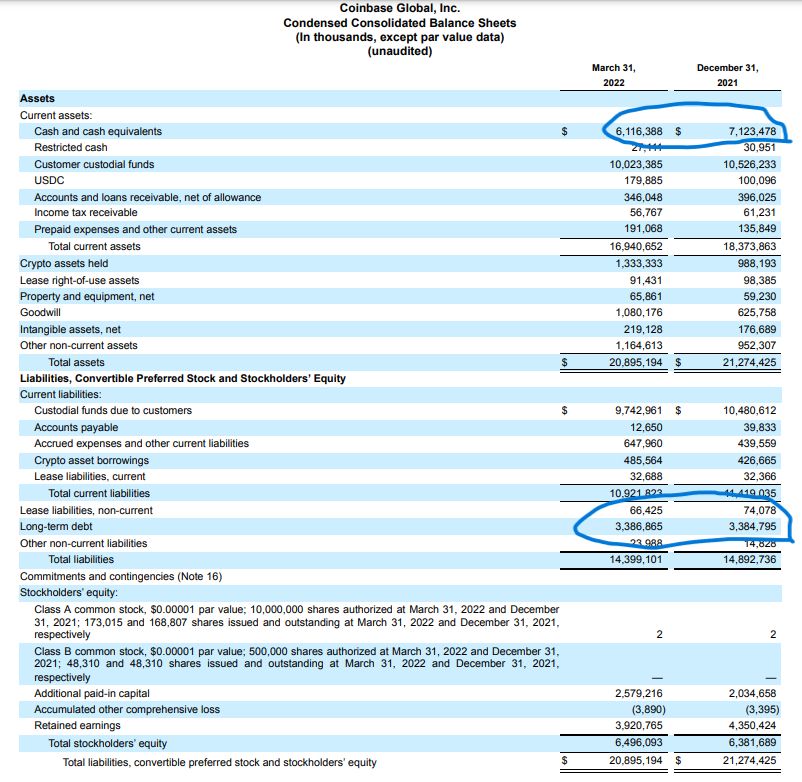
But digging a little deeper into the financials we can see that Coinbase is at almost no risk for bankruptcy despite the challenging broader market conditions. Not even close. They have double the cash ($6 billion) compared to their long-term debt ($3 billion). Well, okay,but maybe that’s high-interest rate debt, right?
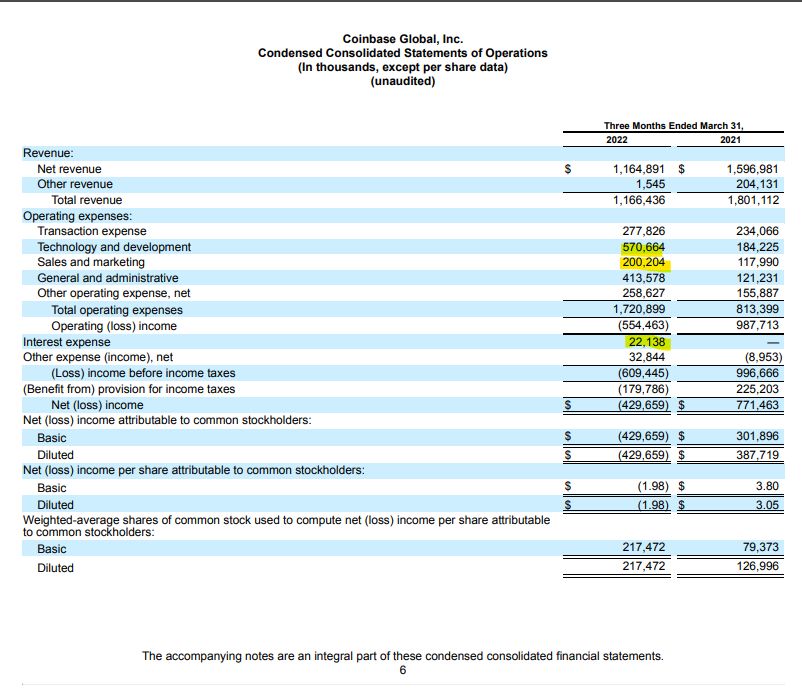
Looking at the income statement we see they are paying $22 million on that debt. That’s on revenue of $1.16 billion. Looking at other expenses, we seem plenty of fat to be trimmed even in the worst-case scenario. Line items like "technology and development" and "sales and marketing" could be reduced if and when there is an extended downturn.
None of this accounts for Coinbase’s impressive venture portfolio. There are 300+ investments in this portfolio, many made at attractive valuations post the 2017/2018 crash. Early investments in Compound, OpenSea, Polygon, Arweave, Starkware, Blockfi, and NEAR are likely much, much higher in valuation. The overall book is currently held at $350 million. I am no equity analyst, but folks who do this for a living put the real value of this portfolio between $6–17 billion. At the high end, the venture book alone might be worth the market cap of the company today.

Tom is a Sr. Research Analyst at Messari. His primary focus is on Layer-1's as well as the relationship between traditional finance and crypto. Prior to joining Messari, Tom worked in Investment Consulting at Meketa and Investment Management at SSGA. Tom studied Finance at Bentley University and earned his CFA and CAIA Charters.