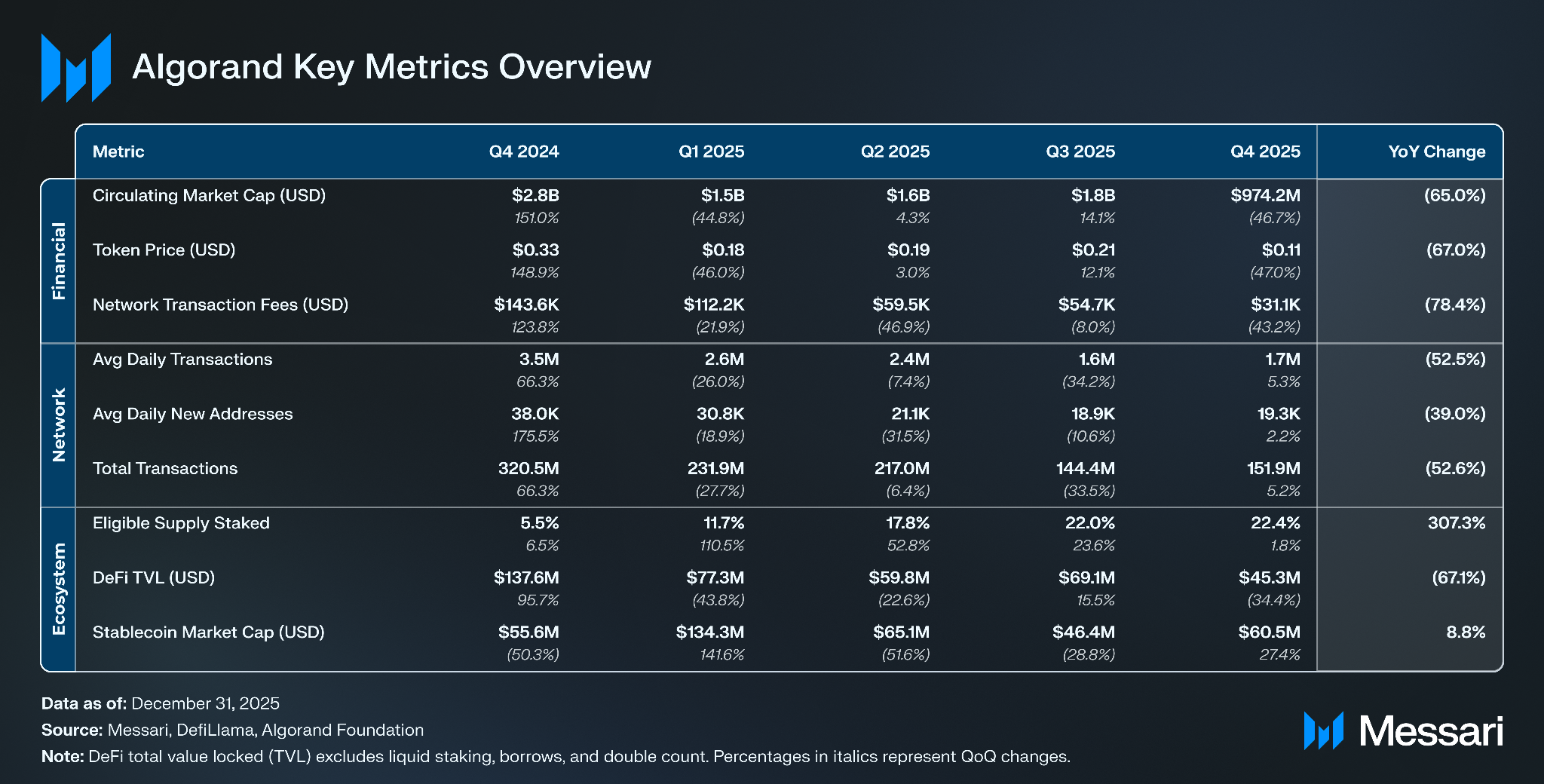
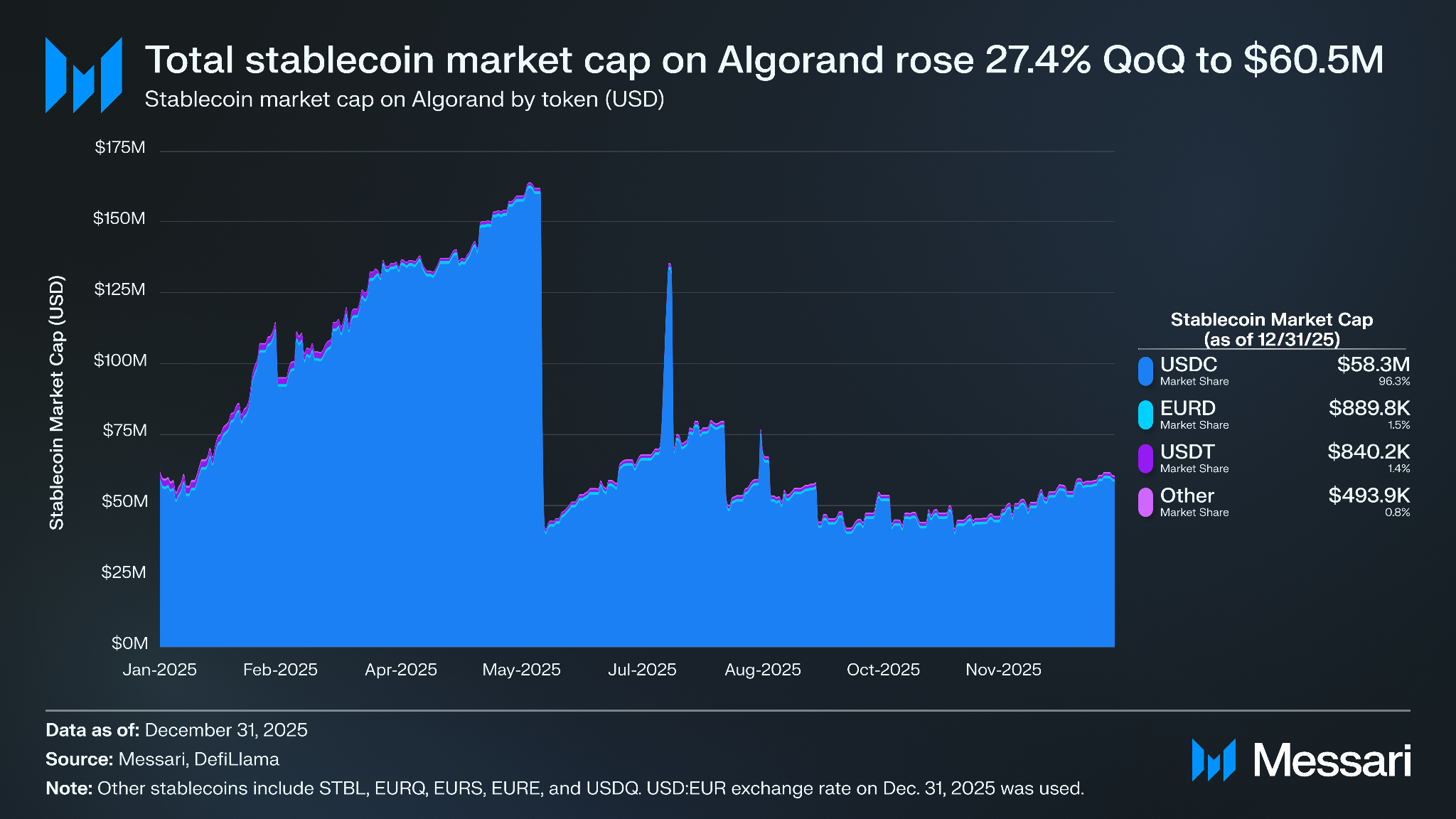
Total stablecoin market cap on Algorand grew 27.4% QoQ from $47.5 million to $60.5 million, driven by a 28.9% ($13.1 million) QoQ increase in USDC after crypto payments provider Coinify’s integration with Algorand.
Algorand’s circulating market cap decreased 46.7% QoQ from $1.8 billion to $974.2 million.
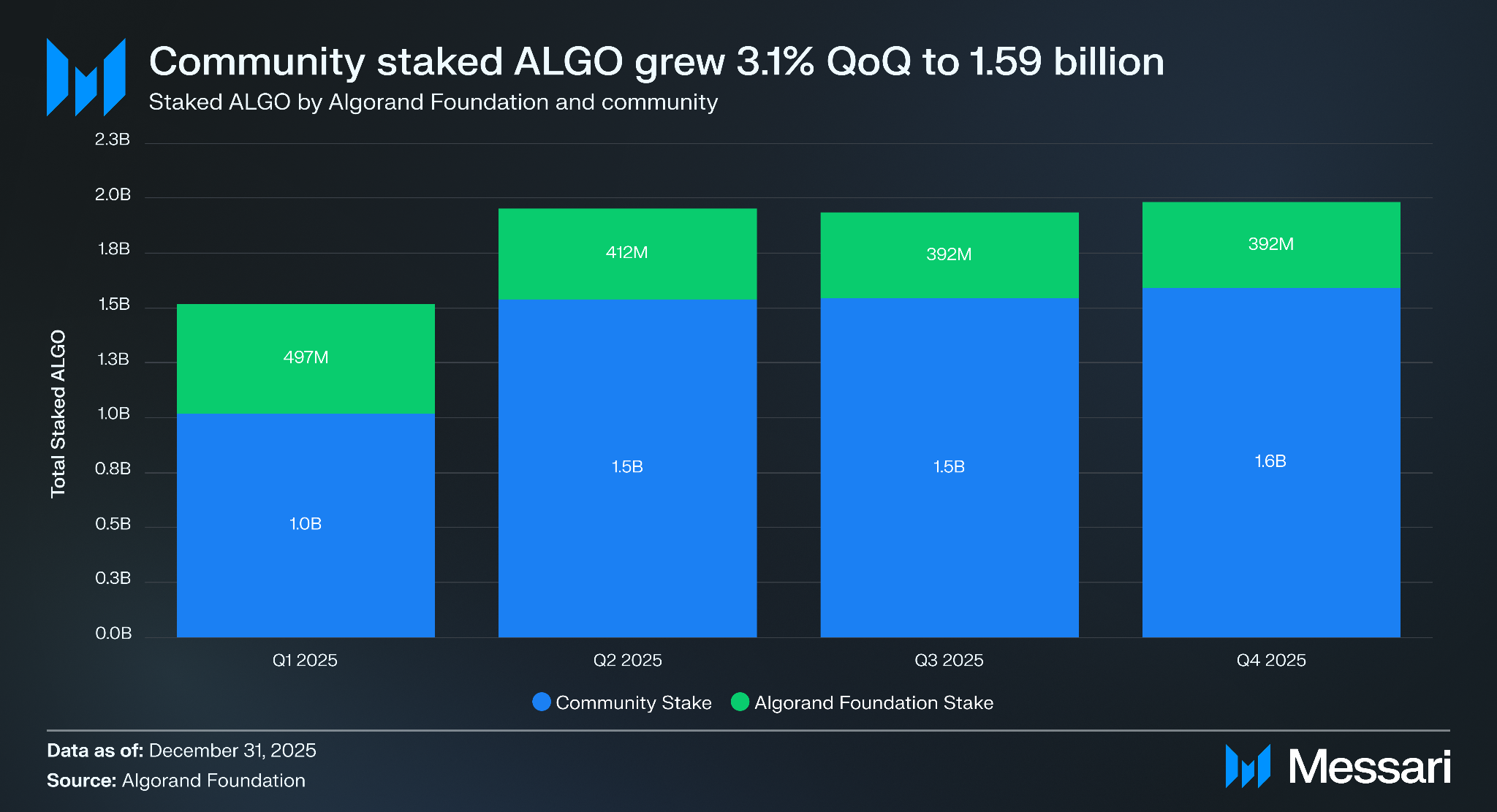
Total staked ALGO grew 2.5% QoQ from 1.9 billion at Q3-end to 2.0 billion at Q4-end, while community staked ALGO grew 3.1% QoQ from 1.54 billion to 1.59 billion.
Total daily transactions grew 5.2% QoQ from 1.6 million in Q3 to 1.7 million in Q4, however total fees declined 48.2% QoQ from $54,700 to $31,300.
In Q4, nine infrastructure projects received funding through the Algorand Foundation’s xGov mainnet, a governance tool for submitting and voting on grant proposals.
Primer
Algorand (ALGO) is a Layer 1 blockchain that uses the Pure Proof-of-Stake (PPoS) consensus mechanism, a process in which validators are randomly selected using a Verifiable Random Function (VRF), with each validator’s probability of selection proportional to their staked ALGO balance.
In January 2025, Algorand upgraded to v4.0, which allows wallets staking at least 30,000 ALGO to earn block rewards by running a node or wallets staking at least 10 ALGO to delegate their stake to a third-party node operator. Block rewards include 50% of transaction fees and 10 ALGO per block, decaying at a rate of 1% every million blocks until an estimated date of January 2027. Algorand distributes rewards without lockups, unbonding, or slashing. Instead, the protocol removes offline or malicious nodes from future validator selection.
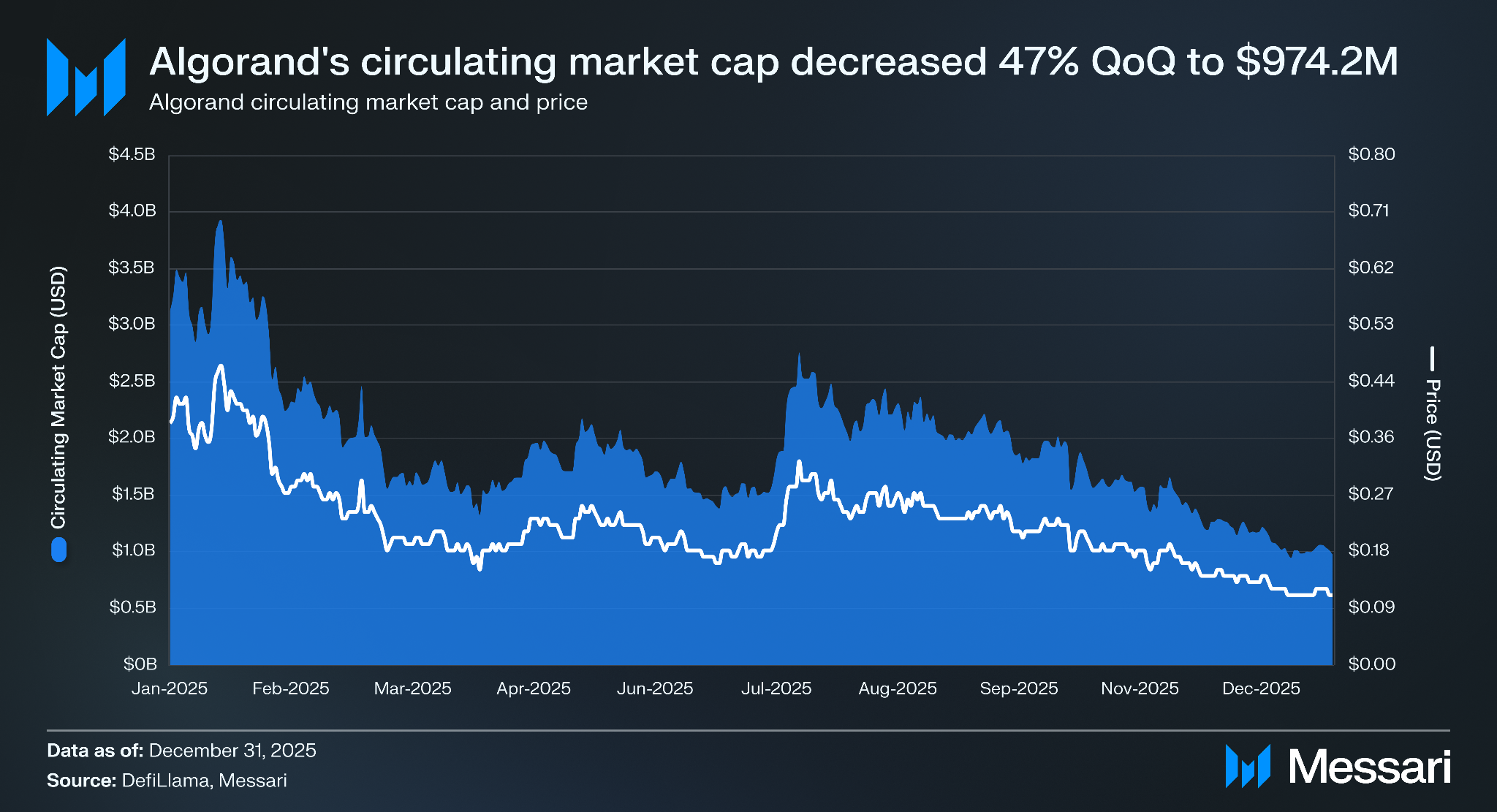
Algorand’s circulating market cap decreased 46.7% QoQ from $1.8 billion to $974.2 million, while ALGO’s price fell 47.0% QoQ from $0.21 to $0.11. Circulating supply increased 0.6% QoQ from 8.81 billion to 8.84 billion ALGO, which drove the divergence between price and market cap. Crypto’s total market cap fell 23.6% QoQ from $3.99 trillion to $3.05 trillion over the quarter.
On July 14, FedWire, the Federal Reserve’s settlement system for high-value transfers, began supporting ISO 20022, a global financial messaging standard designed to streamline cross-border payments. On July 17, ALGO’s circulating market cap surged to a Q3 peak of $2.8 billion, likely fueled by the announcement, as articles often cite Algorand as a potential candidate for future ISO 20022 compatibility.
In Q4, Algorand did not experience a comparable event or announcement that drove demand for ALGO.
Network Transactions
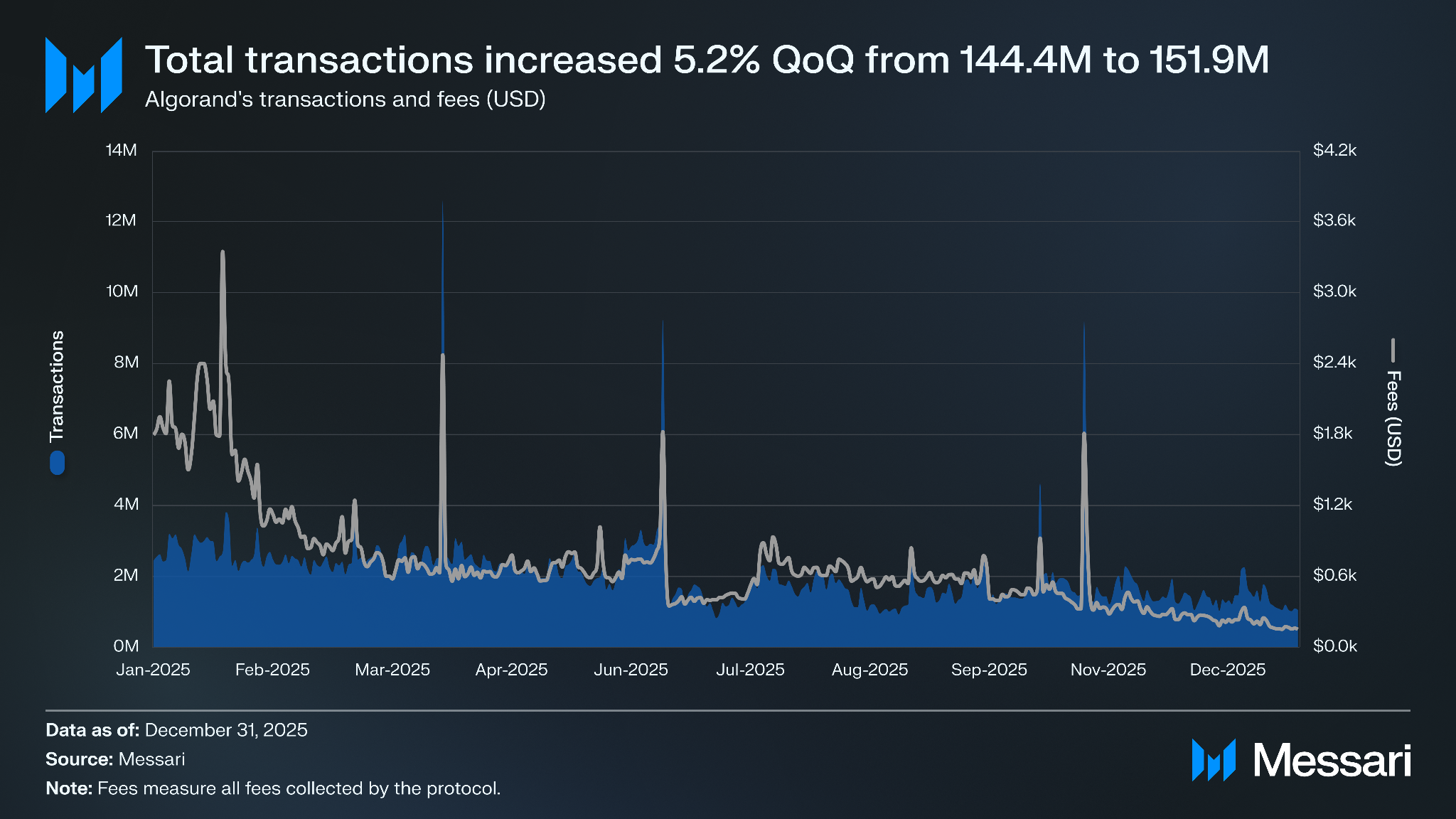
In Q4, average daily transactions increased 5.2% QoQ from 1.6 million in Q3 to 1.7 million, while total transactions grew 5.2% QoQ from 144.4 million in Q3 to 151.9 million. Over the same time frame, average daily fees declined 42.8% QoQ from $595 to $340, while total fees fell 42.8% from $54,700 to $31,300.
In Q4, the daily transaction count ranged from a high of 9.2 million to a low of 1.0 million, while daily fees ranged from a high of $1,809 to a low of $149. The daily fee high occurred on Oct. 24, driven by a new feature on Lofty, which had issues matching new limit orders with market orders.
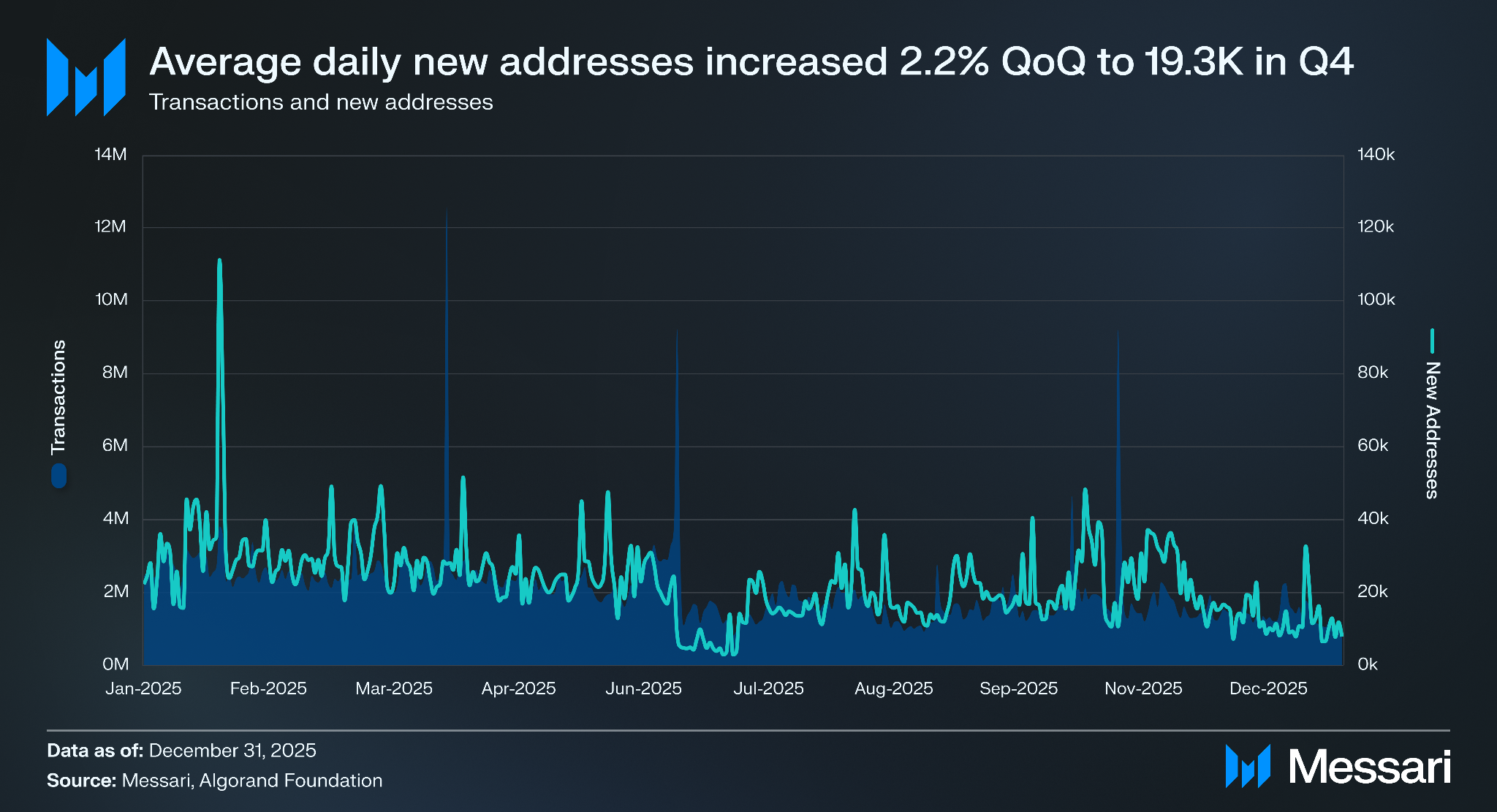
In Q4, average daily new addresses grew 2.2% QoQ from 18,900 to 19,300, and total new addresses by the same percentage QoQ from 1.7 million to 1.8 million. Daily new address creation ranged from a high of 48,300 to a low of 6,500, reflecting higher user acquisition and address growth.
Staked ALGO
In January 2025, Algorand upgraded to v4.0, which enabled wallets staking at least 30,000 ALGO to earn block rewards by running a node or wallets staking at least 10 ALGO to delegate their stake to a third-party node operator, such as Valar. Block proposers earn 50% of transaction fees from the blocks they create, plus a bonus reward funded by the Algorand Foundation. The bonus started at 10 ALGO per block and decays 1% every million blocks, with funding scheduled to decline toward fee-only issuance by January 2027. Algorand distributes rewards without lockups, unbonding, or slashing. Instead, the protocol removes offline or malicious nodes from future validator selection and requires them to pay a small fee to rejoin.
Total staked ALGO grew 2.5% QoQ from 1.9 billion at Q3-end to 2.0 billion at Q4-end, while community staked ALGO grew 3.1% QoQ from 1.5 billion to 1.6 billion over the same period. Algorand Foundation staked ALGO remained unchanged at 392.4 million.
As of Dec. 31, community-staked ALGO increased 245.0% YoY to 1.6 billion from 460.7 million. The increase followed the introduction of delegated staking and block proposer rewards, which lowered operational requirements for participation.
Stablecoins
The total stablecoin market cap on Algorand grew 27.4% QoQ from $47.5 million to $60.5 million. USDC accounted for nearly the entire increase, growing 28.9% QoQ from $45.2 million to $58.3 million. Conversely, EURD decreased 6.6% from $952,400 to $889,200. USDT remained unchanged at $841,400, while other stablecoins, comprising STBL, EURQ, EURS, EURE, and USDQ, increased slightly from $488,500 to $493,900. At the end of Q4, USDC made up 96.3% of Algorand’s stablecoin market cap, with others collectively accounting for 3.7%.
The majority of the USDC market cap increase occurred after Nov. 20, following crypto payments provider Coinify’s integration with Algorand. Algorand integrated Coinify’s payment gateway to support USDC payments and settlement. After the integration went live, customers using applications integrated with Coinify could select “USDC on Algorand” as a payment method at checkout, while merchants could receive settlement in USDC on Algorand when customers paid with one of 30 Coinify-supported tokens.
On July 11, 2024, Tether announced it would wind down support for USDT on Algorand by ending redemptions and freezing tokens starting Sept. 1. On Aug. 29, Tether reversed course on the freeze but confirmed that it would still stop issuing and redeeming USDT on Algorand from Sept. 1 onward. Smart contracts using USDT on Algorand remain active, and users can continue transferring tokens between wallets, though Tether no longer supports the asset.
DeFi
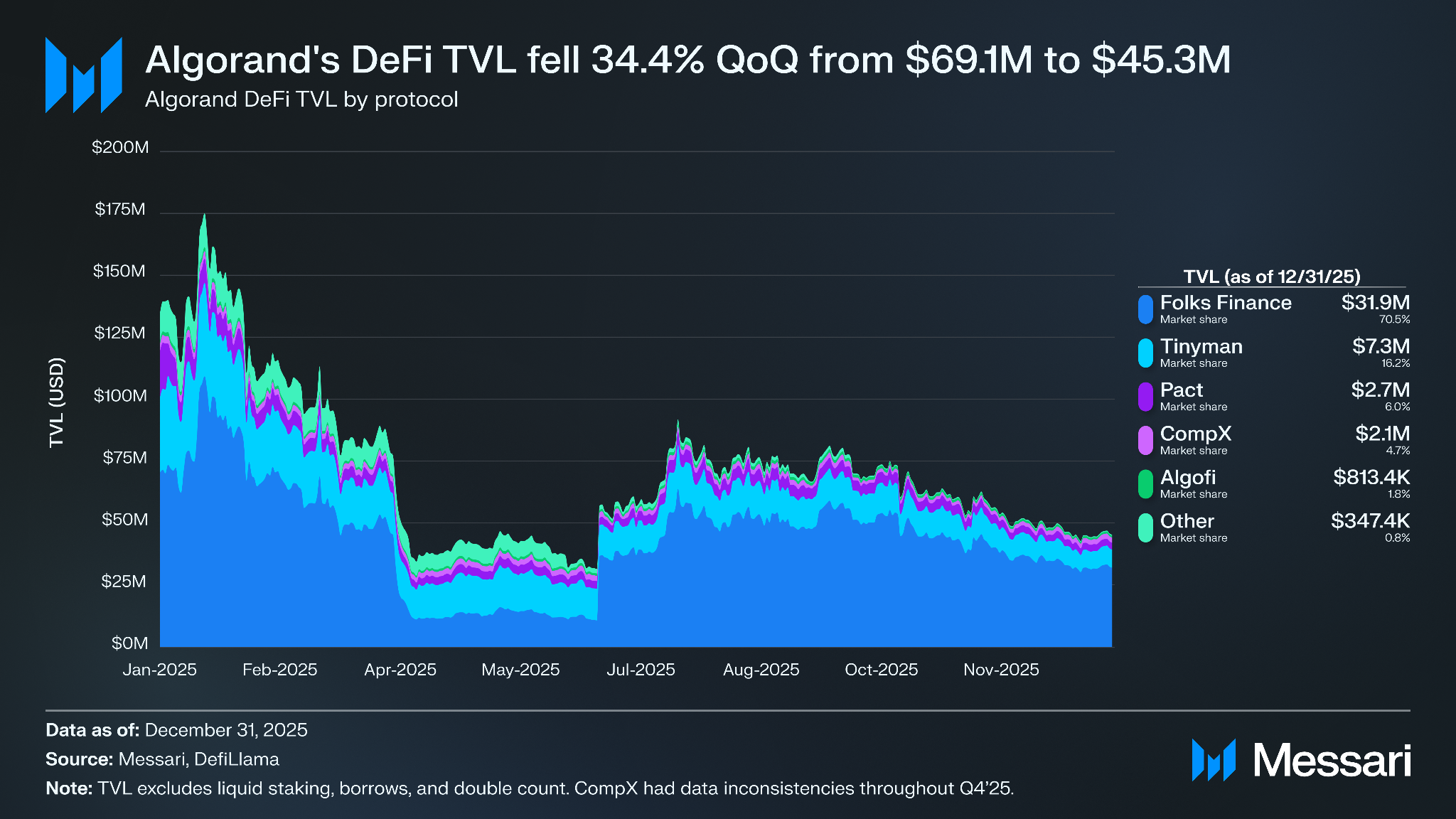
Algorand’s DeFi TVL fell 34.4% QoQ from $69.1 million to $45.3 million. Folks Finance, a lending protocol, decreased 36.6% QoQ from $50.2 million to $31.9 million and had a 70.5% market share of DeFi TVL at Q4-end. Tinyman, an AMM DEX, fell 38.2% QoQ from $11.9 million to $7.3 million yet remained the largest DEX on Algorand by TVL. Pact was the second-largest DEX, and decreased 34.8% QoQ from $4.2 million to $2.7 million.
Qualitative Analysis
xGov (Ecosystem Infrastructure Project Funding)
On Dec. 16, the Foundation launched xGov v2.0.0, which updated proposal voting periods to two weeks and set minimum voter participation requirements between 40% and 70% of eligible voters based on the requested grant amount. As of Dec. 31, there were 224 eligible xGov voters.
As of Dec. 31, nine proposals had received retroactive funding, four were in progress, and six were rejected, while the xGov treasury held 2.6 million ALGO (0.026% of the total token supply). Funk's Ultimate Node Controller (FUNC), a node-runner platform, and Folks’ smart contract library each received the largest approved grant at 200,000 ALGO. Use-Wallet, an open-source wallet integration library, received the third-largest grant at 175,000 ALGO.
On July 29, the Algorand Foundation launched the xGov mainnet, a governance tool that allows community members to propose and vote on funding for open-source infrastructure projects in the Algorand ecosystem. Proposers must complete KYC, create a profile on xGov, and pay a one-time account creation fee of 100 ALGO to be eligible. Proposers can request grants ranging from 5,000 to 400,000 ALGO for developing or maintaining SDKs, wallets, explorers, or telemetry tools. Proposers also pay 3% of the requested grant amount as ‘anti-spam’ collateral, which is refunded after voting unless the proposal violates program terms and conditions, in which case the xGov Council can slash it. Draft proposals are published to the Algorand Forum for discussion before being voted on by xGov voters.
Voters must pay a one-time enrollment fee of 100 ALGO, and are awarded voting power proportionally based on the amount of blocks produced on the Algorand network in the most recent 3 million-block observation window, updated at every millionth block. For example, if a proposer submits their proposal between blocks 55 million and 56 million, the voters would be counted in the observation window that includes blocks 52 million through 55 million.
Project King Safety
On July 31, the Algorand Foundation released an updated roadmap covering the network’s economic sustainability, decentralization, and governance. The Foundation introduced Project King Safety to address economic sustainability, a research initiative designed to replace Algorand’s current validator reward structure, which relies on declining Foundation-subsidized rewards and transaction fee revenue. As of Dec. 31, validators earned 9.03 ALGO per block, of which transaction fees contributed 0.05 ALGO, and the remainder came from Foundation-subsidized block rewards. The Foundation-subsidized portion declines by 1% every million blocks. Under the current reward schedule, validator rewards will continue converging toward fee-only issuance per block by January 2027, a level that does not provide sufficient economic support for long-term validator participation.
The Foundation outlined three potential options to adjust validator incentives, including fee-based rewards, MEV-based extraction, and inflationary incentives. It plans to release a position paper with further details and target implementation in 2026. The new reward structure will require approval from validators controlling 90% of online staked ALGO prior to implementation.
Peer-to-Peer Networking
On Dec. 9, Algorand launched peer-to-peer (P2P) networking on mainnet, introducing a new connection model that allows validators to connect to permissionless repeater nodes. Under this model, validators participate in consensus and produce blocks, and repeaters propagate blocks, transactions, and participation messages across the network.
The update removed Algorand’s architectural dependence on permissioned repeaters, which previously served as the primary data propagation layer, while allowing them to continue operating as optional infrastructure for performance.
At launch, P2P networking required nodes to opt in. By default, new nodes connect only to permissioned repeaters. At the same time, operators can enable Hybrid mode to connect to both permissioned and permissionless repeaters, or P2P-only mode to connect exclusively to permissionless repeaters. Before Q3 2026, Algorand plans to make Hybrid mode the default for new nodes, formalizing a network design in which permissioned repeaters support performance without serving as the sole data propagation layer.
Noah Partnership
On Nov. 18, the Algorand Foundation partnered with Noah, a financial services provider that operates cross-border payment infrastructure for converting fiat into stablecoins. The partnership gave Algorand developers access to Noah’s regulated payments stack, including virtual EUR and USD bank accounts, to accept bank transfers and move real-world assets onchain. Applications built on Algorand can route fiat payments from jurisdictions including the U.S. and Europe into onchain RWA workflows.
Closing Summary
In Q4, Algorand’s circulating market cap decreased 46.7% QoQ from $1.8 billion to $974.2 million, while ALGO’s price fell 47.0% from $0.21 to $0.11. Total staked ALGO grew 2.5% QoQ from 1.9 billion at Q3-end to 2.0 billion at Q4-end, while community staked ALGO increased 3.1% QoQ from 1.5 billion to 1.6 billion.
In Q4, average daily transactions grew 5.2% QoQ from 1.6 million in Q3 to 1.7 million in Q4, while total fees declined 48.2% QoQ from $54,700 to $31,300. The total stablecoin market cap on Algorand grew 27.4% QoQ from $47.5 million to $60.5 million. USDC accounted for most of the increase following Coinify’s integration of USDC payments and settlement on Algorand on Nov. 20.
In Q4, nine infrastructure projects received funding through the Algorand Foundation’s xGov mainnet, a governance tool for submitting and voting on grant proposals. The allocation of treasury capital through xGov, alongside increased validator participation and rising USDC circulation, points to Algorand moving toward greater self-sustainment in 2026.
This report was commissioned by the Algorand Foundation. All content was produced independently by the author(s) and does not necessarily reflect the opinions of Messari, Inc. or the organization that requested the report. The commissioning organization may have input on the content of the report, but Messari maintains editorial control over the final report to retain data accuracy and objectivity. Author(s) may hold cryptocurrencies named in this report. This report is meant for informational purposes only. It is not meant to serve as investment advice. You should conduct your own research and consult an independent financial, tax, or legal advisor before making any investment decisions. Past performance of any asset is not indicative of future results. Please see our Terms of Service for more information.
No part of this report may be (a) copied, photocopied, duplicated in any form by any means or (b) redistributed without the prior written consent of Messari®.
Austin is a Sr. Research Analyst for Messari’s Protocol Services team. He focuses on Prediction Markets, DeFi, & Interop. protocols. He previously worked on PwC's Digital Assets team.
Austin is a Sr. Research Analyst for Messari’s Protocol Services team. He focuses on Prediction Markets, DeFi, & Interop. protocols. He previously worked on PwC's Digital Assets team.