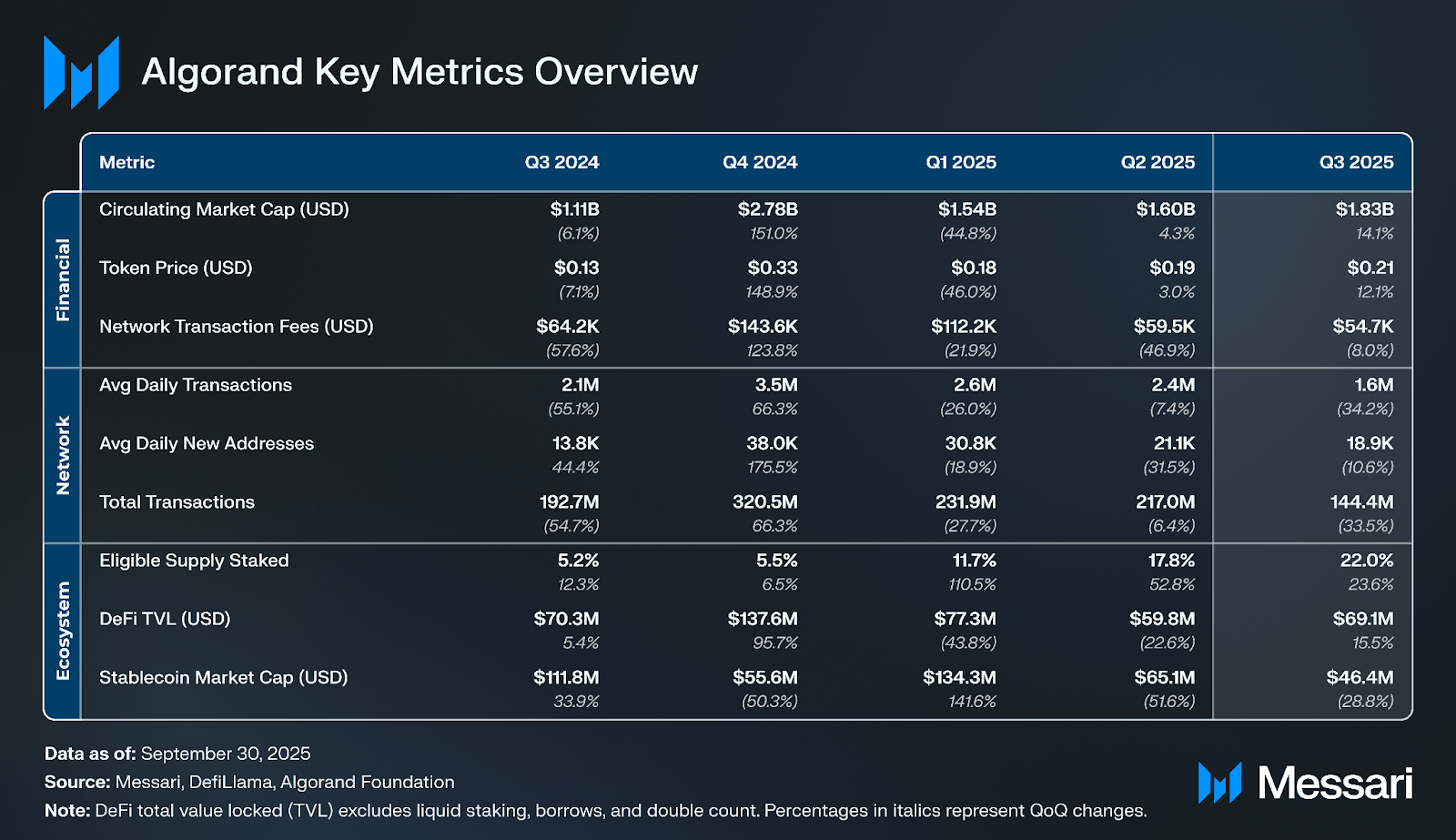
Algorand’s circulating market cap increased 14.2% QoQ from $1.60 billion at Q2-end to $1.83 billion at Q3-end.
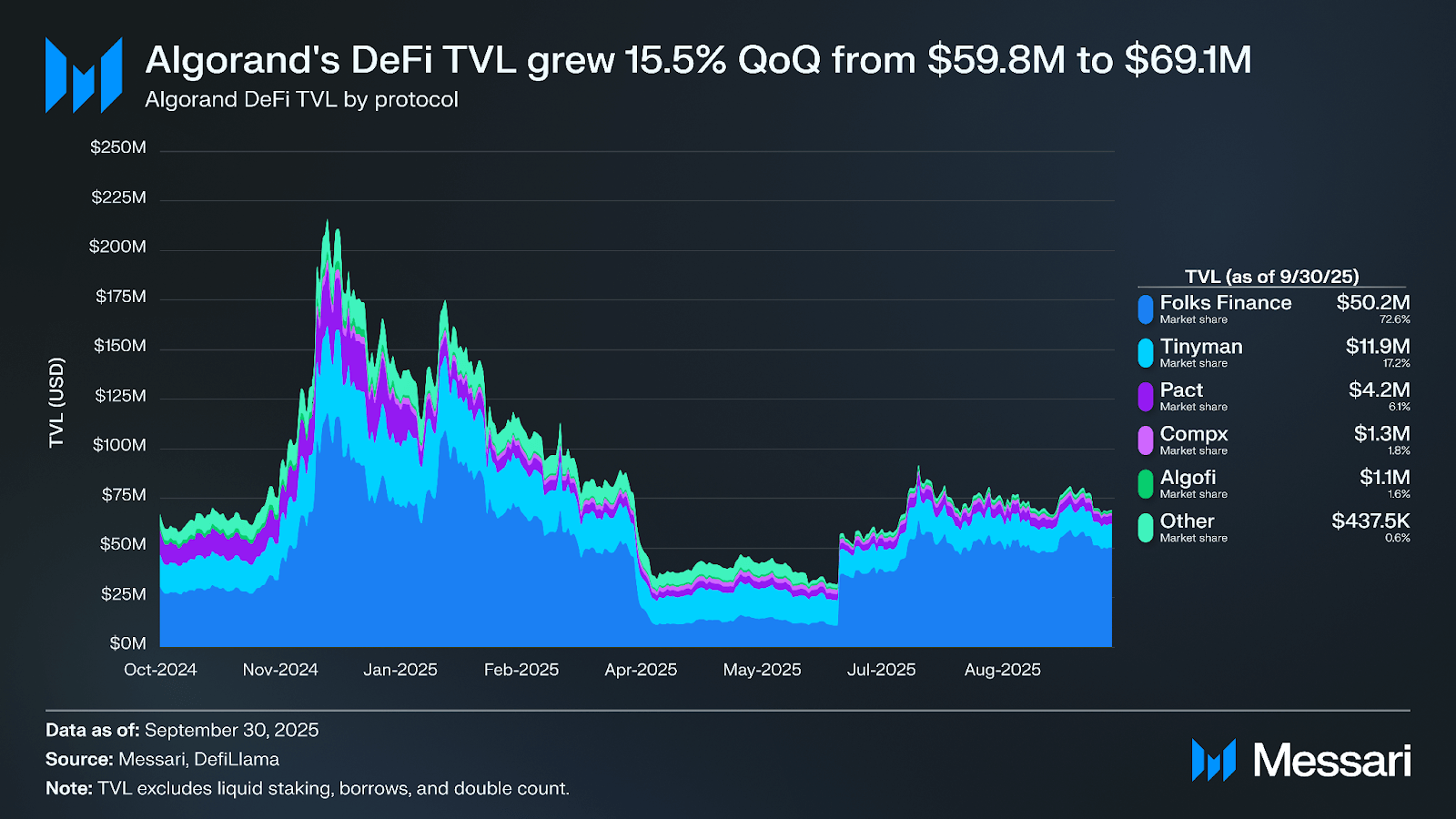
DeFi TVL increased 15.5% QoQ from $59.8 million to $69.1 million, driven by growth in lending protocol Folks Finance.
On July 29, the Algorand Foundation launched the xGov (Beta) mainnet, a governance tool for submitting and voting on grant proposals for infrastructure projects in the Algorand ecosystem.
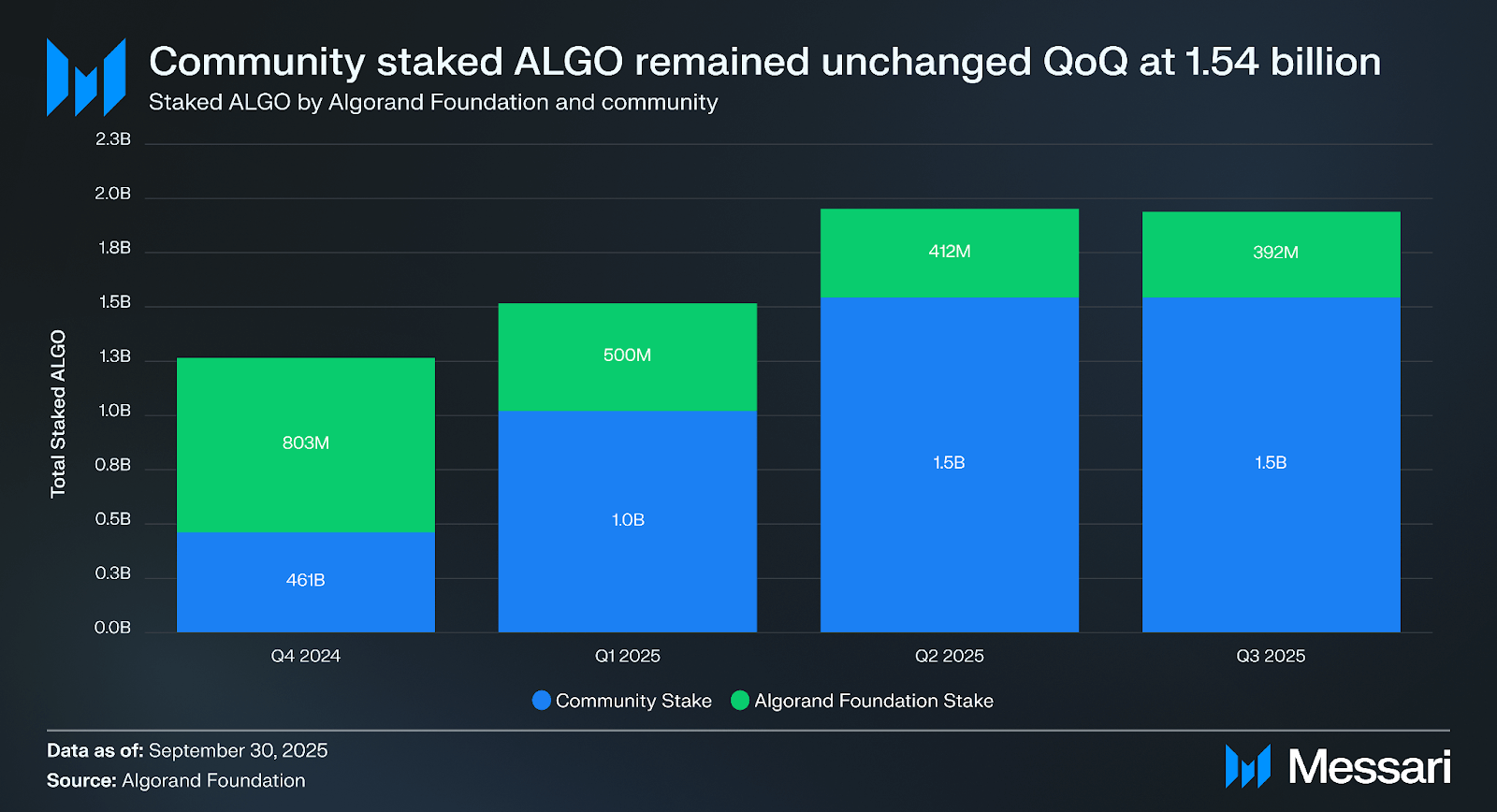
Total staked ALGO fell 0.9% QoQ from 1.95 billion at Q2-end to 1.93 billion at Q3-end, while community staked ALGO remained unchanged at 1.54 billion.
Total fees fell 8.0% QoQ from $59,500 to $54,700, while average daily transactions declined 34.2% from 2.39 million to 1.57 million.
Primer
Algorand (ALGO) is a Layer 1 blockchain that uses the Pure Proof-of-Stake (PPoS) consensus mechanism, a process in which validators are randomly selected using a Verifiable Random Function (VRF), with each validator’s probability of selection proportional to their staked ALGO balance.
In January 2025, Algorand upgraded to v4.0, which allows wallets staking at least 30,000 ALGO to earn block rewards by either running a node or delegating their stake to a third-party node operator. Block rewards include 50% of transaction fees and 10 ALGO per block, decaying at a rate of 1% every million blocks until an estimated date of January 2027. Algorand distributes rewards without lockups, unbonding, or slashing. Instead, the protocol removes offline or malicious nodes from future validator selection.
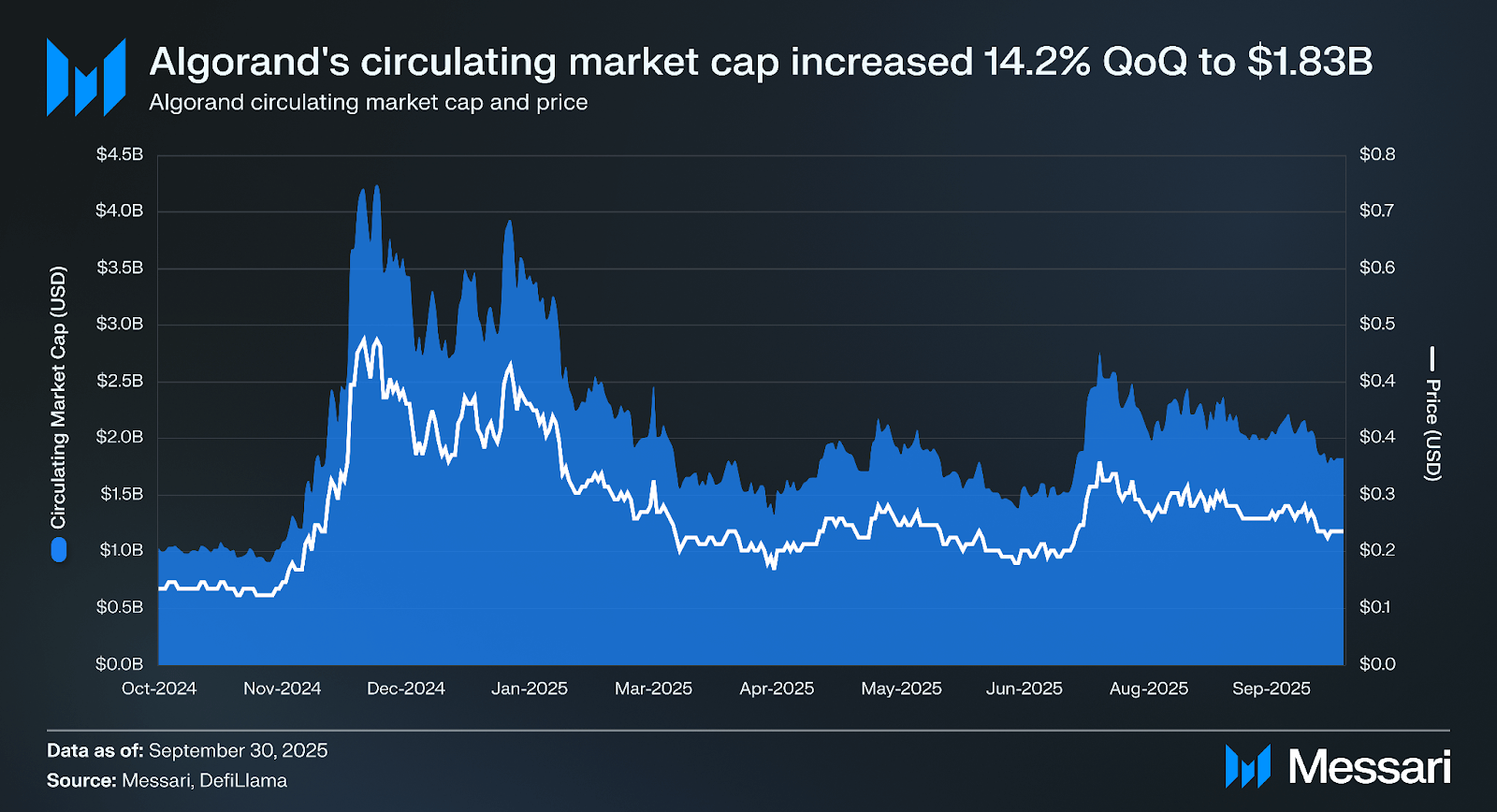
Algorand’s circulating market cap increased 14.2% QoQ from $1.60 billion at Q2-end to $1.83 billion at Q3-end, while ALGO’s price rose 9.5% QoQ from $0.19 to $0.21 in the same time frame. The difference was due to a 1.7% increase in circulating supply from 8.6 billion to 8.8 billion ALGO.
On July 14, FedWire, the Federal Reserve’s settlement system for high-value transfers, began supporting ISO 20022, a global financial messaging standard designed to streamline cross-border payments. On July 17, ALGO’s circulating market cap surged to a Q3 peak of $2.76 billion, likely fueled by the announcement, as articles often cite Algorand as a potential candidate for future ISO 20022 compatibility.
Network Transactions
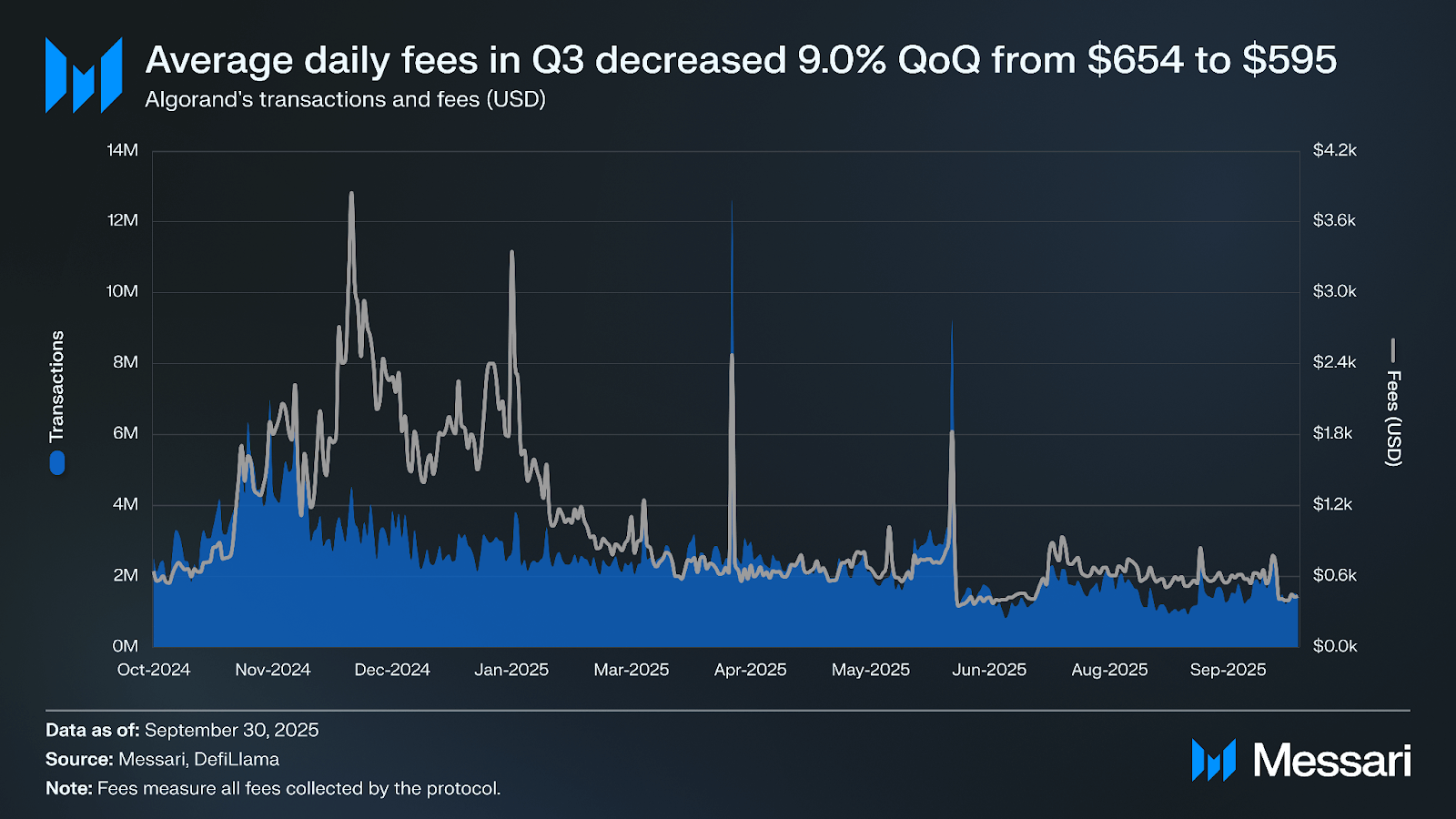
In Q3, average daily transactions fell 34.2% QoQ from 2.39 million in Q2 to 1.57 million, while average daily fees fell 9.0% QoQ from $654 to $595. Moreover, total transactions dropped 33.5% QoQ from 217.0 million in Q2 to 144.4 million, and total fees declined 8.0% QoQ from $59,500 to $54,700.
In Q3, the daily transaction count ranged from a high of 2.77 million to a low of 924,200, while daily fees ranged from a high of $932 to a low of $394. Although Q3 lacked the sharp activity spikes seen in prior quarters, the consistency indicates a stable floor in network usage.
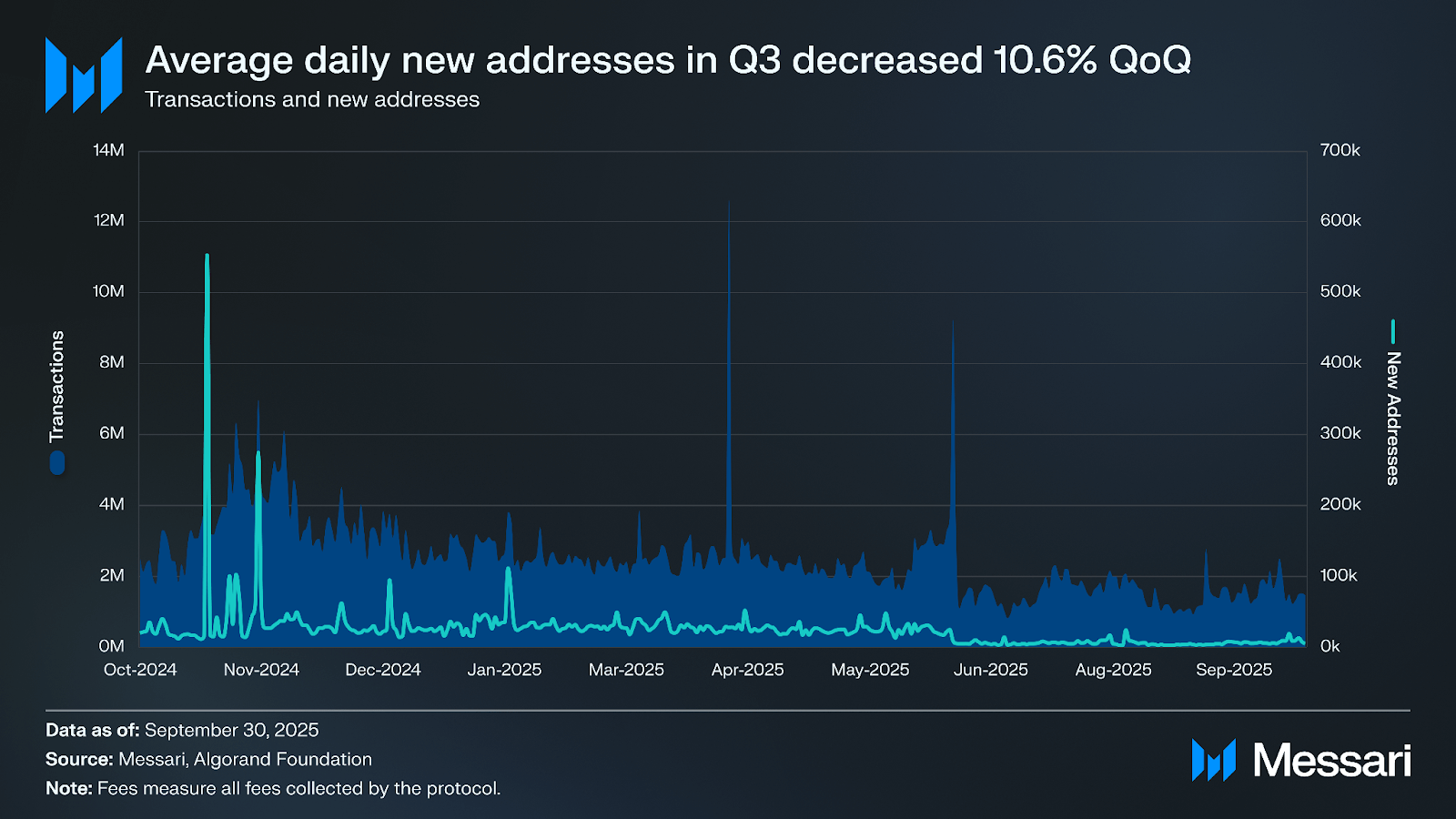
In Q3, average daily new addresses fell 10.6% QoQ from 21,100 to 18,900, and total new addresses declined 9.8% QoQ from 1.92 million to 1.74 million. Daily new address creation reached a high of 42,700 and a low of 10,800, reflecting lower user acquisition and address growth.
Staked ALGO
In January 2025, Algorand upgraded to v4.0, which enabled wallets that stake at least 30,000 ALGO to earn block rewards by either running a node or delegating their stake to a third-party node operator, such as Valar. Block proposers earn 50% of transaction fees from the blocks they create, plus a bonus reward funded by the Algorand Foundation. The bonus started at 10 ALGO per block and decays 1% every million blocks, with funding committed until an estimated date of January 2027. Algorand distributes rewards without lockups, unbonding, or slashing. Instead, the protocol removes offline or malicious nodes from future validator selection and requires them to pay a small fee to rejoin.
Total staked ALGO fell 0.9% QoQ from 1.95 billion at Q2-end to 1.93 billion at Q3-end, while community staked ALGO remained unchanged at 1.54 billion. Algorand Foundation staked ALGO decreased 4.8% QoQ from 412.0 million to 392.4 million.
To date in 2025, community-staked ALGO has increased 234.7% from 461 million at the end of 2024 to 1.54 billion at the end of Q3 2025. Although unchanged in Q3, maintaining the growth from earlier in the year shows sustained community participation in Algorand’s staking system.
Stablecoins
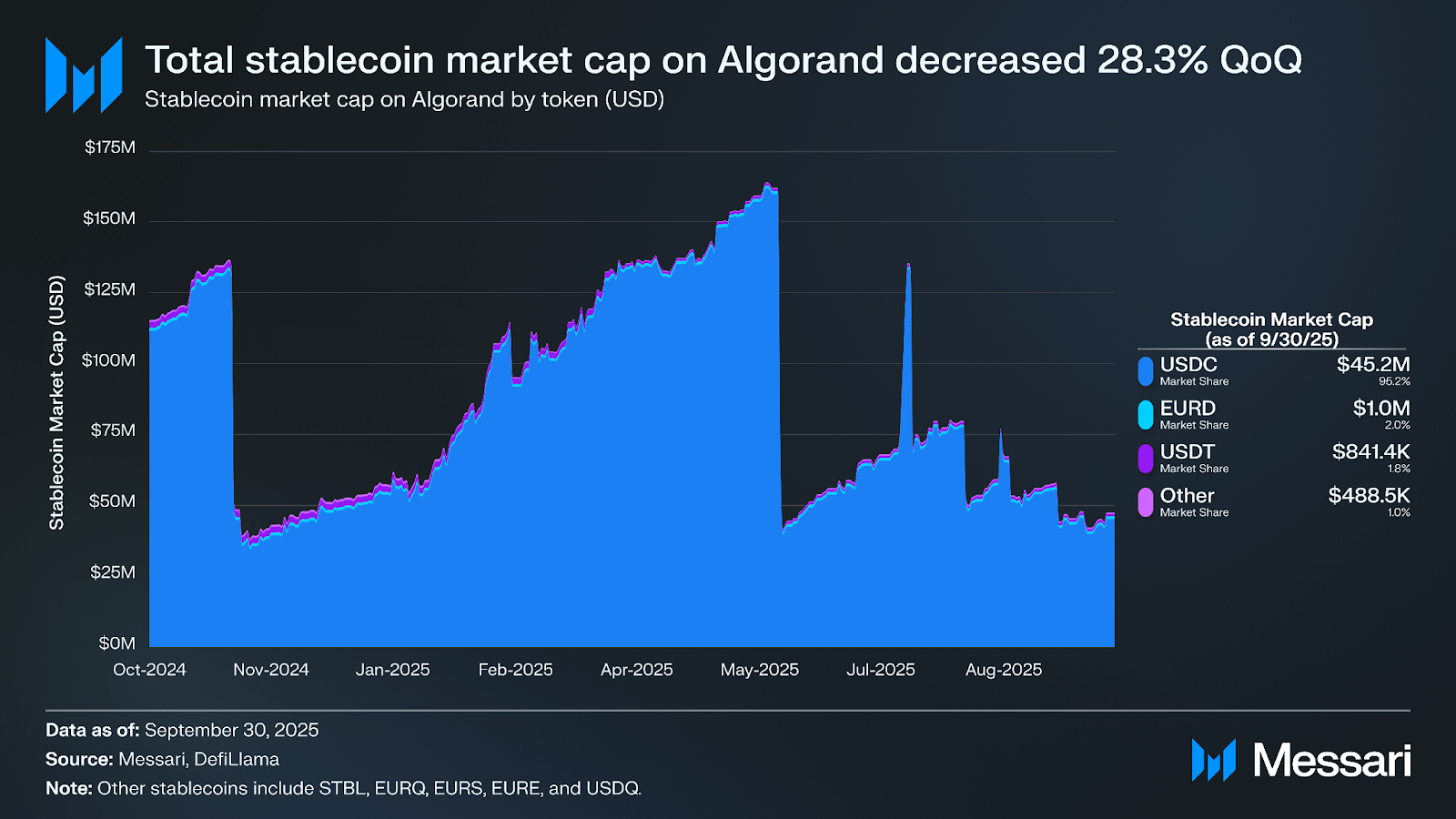
The total stablecoin market cap on Algorand fell 28.3% QoQ from $66.2 million at Q2-end to $47.5 million at Q3-end. USDC accounted for nearly the entire decline, dropping 29.3% QoQ from $63.9 million to $45.2 million, while EURD edged down 0.4% from $956,000 to $952,000. USDT remained unchanged at $841,400, while other stablecoins, comprising STBL, EURQ, EURS, EURE, and USDQ, decreased slightly from $488,900 to $488,500. At the end of Q3, USDC made up 95.2% of Algorand’s stablecoin market cap, with others collectively accounting for 4.8%.
On July 11, 2024, Tether announced it would wind down support for USDT on Algorand by ending redemptions and freezing tokens starting Sept. 1. On Aug. 29, the team reversed course on the freeze but confirmed that it would still stop issuing and redeeming USDT on Algorand from Sept. 1 onward. Smart contracts using USDT on Algorand remain active, and users can continue transferring tokens between wallets, though Tether no longer supports the asset.
DeFi
Algorand’s DeFi TVL rose 15.5% QoQ from $59.8 million to $69.1 million. Folks Finance, a lending protocol, grew 27.8% QoQ from $39.2 million to $50.2 million and had a 72.6% market share of DeFi TVL at Q3-end. Tinyman, an AMM DEX, fell 1.9% from $12.1 million to $11.9 million yet remained the largest DEX on Algorand by TVL, while Pact was the second-largest DEX, and grew 11.3% QoQ from $3.8 million to $4.2 million. CompX, a yield-aggregator, declined 31.9% QoQ from $1.9 million to $1.3 million.
Qualitative Analysis
Governance
xGov (Ecosystem Infrastructure Project Funding)
On July 29, the Algorand Foundation launched the xGov (Beta) mainnet, a governance tool that allows community members to propose and vote on funding for infrastructure projects in the Algorand ecosystem. Proposers must complete KYC, create a profile on xGov, and pay a one-time account creation fee of 100 ALGO to be eligible. Proposers can request grants ranging from 2,500 to 200,000 ALGO for developing or maintaining SDKs, wallets, explorers, and telemetry tools. Proposers also pay 3% of the requested grant amount as ‘anti-spam’ collateral, which is refunded after voting unless the proposal violates program terms and conditions, in which case the xGov Council can slash it. Draft proposals are published to the Algorand Forum for discussion before being voted on by xGov voters.
Voters must pay a one-time enrollment fee of 10 ALGO, and are awarded voting power proportionally based on the amount of blocks produced on the Algorand network in the most recent 3 million-block observation window, updated every million blocks. For example, if a proposer submits their proposal between blocks 55 million and 56 million, the observation window includes blocks 52 million through 55 million.
The Foundation set an initial 2025 xGov budget of 3 million ALGO (0.03% of the total token supply). Grant applications opened in September 2025, allowing proposers to request retroactive funding for open-source tools and infrastructure that supported the Algorand ecosystem.
Technical Advancements
On Aug. 5, Algorand released v4.2.1, which added privacy protection for peer-to-peer connections, adjusted relay prioritization, and reworked network maintenance.
On Sept. 16, Algorand released v4.3.0, which added SHA-512 hashing to block headers to improve resistance to future quantum attacks and upgraded the Algorand Virtual Machine (AVM). Node operators and indexer runners had to upgrade to avoid network stalls, while SDK users updated their tools to regain support for creating logic signatures.
Partnerships and Ecosystem Initiatives
Wormhole
On July 1, the Algorand Foundation partnered with the interoperability protocol Wormhole to support Native Token Transfers (NTT), which enables issuers to move tokens across other NTT-enabled chains without using wrapped assets. The NTT initiative was in collaboration with Folks Finance, the largest lending and liquid staking protocol by TVL on Algorand.
Hex Trust
On July 17, the Algorand Foundation extended their 2021 partnership with Hex Trust, a digital asset custody provider, to continue serving as a custodian of the Foundation’s digital assets. In addition to the original agreement, Hex Trust added access to Algorand staking pools for institutional clients, enabling clients to engage in onchain governance and generate ALGO rewards.
XBTO
On Aug. 27, the Algorand Foundation partnered with XBTO, a digital asset manager, for ALGO market making across “Tier 1 and Tier 2 exchanges.” XBTO also began using the Algorand network to transfer USDC between custody wallets and exchanges for rebalancing and treasury activity.
Gora Network
On Aug. 29, Gora Network, an Algorand-based oracle provider joined the Mastercard’s Sandbox as a Service, positioning it in a testing environment used by traditional financial institutions. The sandbox provides synthetic data and banking simulators, enabling developers to test payment and digital asset applications in a controlled environment.
Algoland
On Sept. 22, the Algorand Foundation launched Algoland, a 13-week onchain campaign that routes users through applications with weekly challenges and prizes. Algoland runs through Dec. 29, where users complete onchain tasks, such as token swaps or NFT mints, to earn points and qualify for prizes. The Foundation will announce winners on Jan. 4, 2026.
Roadmap
On July 31, the Algorand Foundation released its updated roadmap focused on the long-term economic sustainability of the Algorand network, its decentralization, and governance.
To address sustainability, the Foundation introduced Project King Safety, a research initiative focused on replacing the current reward structure with new incentive mechanisms. The existing system relies on supplemental staking rewards, which draw from a fixed supply of 10 billion ALGO, and does not generate sufficient fees to support long-term validator participation. The Foundation outlined three potential options to improve validator incentives, including fee-based rewards, MEV-based extraction, and inflationary incentives. It plans to release a position paper with further details by the end of 2025, and implementation targeted for 2026.
Algorand’s final milestone in its decentralization roadmap is to roll out a peer-to-peer gossip network, reducing reliance on relay nodes by allowing consensus messages to propagate directly between nodes. The foundation launched the P2P network as an opt-in feature and will transition to full deployment over time.
Closing Summary
In Q3, Algorand’s circulating market cap increased 14.2% QoQ from $1.60 billion at Q2-end to $1.83 billion at Q3-end, while ALGO’s price rose 9.5% from $0.19 to $0.21. DeFi TVL rose 15.5% QoQ from $59.8 million to $69.1 million, driven by Folks Finance, a lending protocol, which accounted for 72.6% of total DeFi TVL at Q3-end.
On July 29, the Algorand Foundation launched the xGov (Beta) mainnet, a governance tool for submitting and voting on ecosystem grant proposals. Earlier in the month, Algorand partnered with Wormhole to integrate NTTs, allowing issuers to transfer tokens across other NTT-enabled chains without wrapped assets. On Aug. 29, Gora Network joined Mastercard’s Sandbox as a Service, becoming the first Algorand-based application to join the institutionally focused testing environment.
Algorand ended Q3 with a larger validator set, an active onchain governance system, and continued growth in DeFi and community staking. These trends suggest a more self-sustaining ecosystem over time, with increased protocol usage and validator participation reducing reliance on Foundation-led incentives.
This report was commissioned by the Algorand Foundation. All content was produced independently by the author(s) and does not necessarily reflect the opinions of Messari, Inc. or the organization that requested the report. The commissioning organization may have input on the content of the report, but Messari maintains editorial control over the final report to retain data accuracy and objectivity. Author(s) may hold cryptocurrencies named in this report. This report is meant for informational purposes only. It is not meant to serve as investment advice. You should conduct your own research and consult an independent financial, tax, or legal advisor before making any investment decisions. Past performance of any asset is not indicative of future results. Please see our Terms of Service for more information.
No part of this report may be (a) copied, photocopied, duplicated in any form by any means or (b) redistributed without the prior written consent of Messari®.
Austin is a Sr. Research Analyst for Messari’s Protocol Services team. He focuses on Prediction Markets, DeFi, & Interop. protocols. He previously worked on PwC's Digital Assets team.
Austin is a Sr. Research Analyst for Messari’s Protocol Services team. He focuses on Prediction Markets, DeFi, & Interop. protocols. He previously worked on PwC's Digital Assets team.