Aevo: A New Beginning

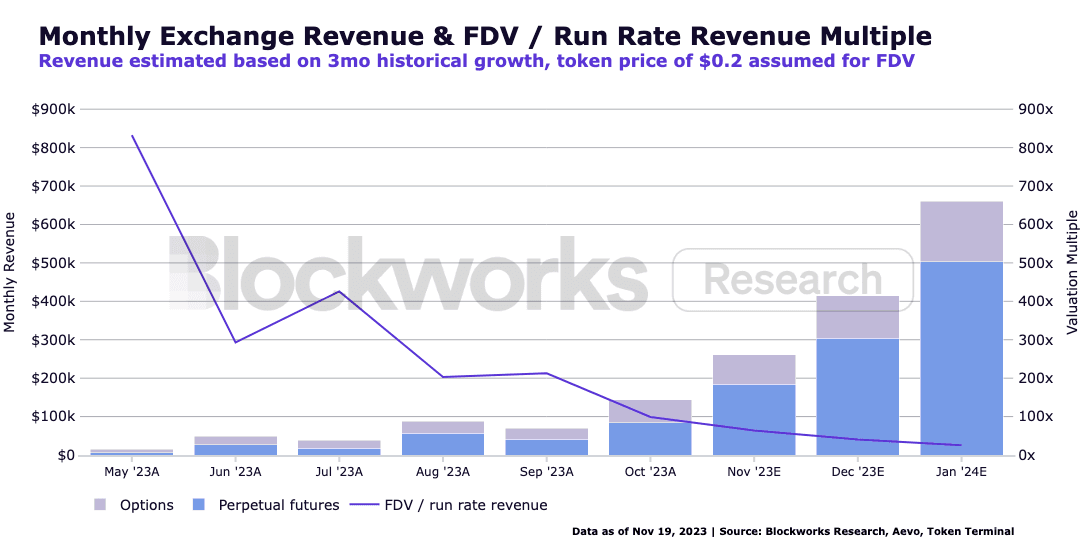
Aevo’s central limit order book (“CLOB”) exchange KPIs have grown notably during the past few months, but the token hasn’t reacted accordingly, with AEVO’s price demonstrating choppiness in the $0.15–$0.20 range since the beginning of September. The exchange’s weekly volume has increased from a steady level of ~$25M in September to ~$115M in November, while weekly unique wallets recently crossed the 4K mark, up ~2.5K from the beginning of October. Consequently, valuation multiples have steadily decreased, with FDV / run rate CLOB exchange revenue having dropped from ~832x at the end of May to ~99x at the end of October.
While it seems as if the market isn’t really paying attention to the project, this could change when the token rebrand becomes more actual and valuation multiples steadily improve. Furthermore, Aevo has begun pushing its perpetual futures product more effectively, quickly listing perps on long-tail assets that are gaining momentum, as well as being one of the few venues that offer pre-launch futures. Since the market follows perp DEXs more closely than options protocols and Aevo is well-positioned to capture volume from competitors, the aforementioned might increase Aevo’s mindshare. Lastly, the DAO Treasury controls ~114M RBN currently valued at ~$29M, which will be converted to AEVO at the TGE. Up to ~35% of AEVO in the DAO Treasury (~40M tokens) will be allocated for incentives, which will likely further increase trading activity on the exchange, at least in the short run.
Once AEVO becomes tradable, an AEVO-USDC Uni V3 pool will be the sole avenue for acquiring liquid tokens, as all other token holders have to wait for their sAEVO staking period to end. Up to ~20% of AEVO in the DAO Treasury (~20M tokens) will be used to seed the liquidity pool. Liquidity is already thin for RBN, with ~50% of the trading volume going through an RBN-USDC Uni V3 pool that holds ~4M RBN, while the rest of the liquidity is mostly located on Coinbase. In other words, if a narrative around Aevo starts building once the AEVO TGE has taken place, the price should move upwards relatively easily, while potential sell pressure is limited for the first 3 months.
However, since liquidity will be low, it’ll be difficult to scale into an adequately sized position. Of course, one could already begin scaling into a position now, but this comes at an opportunity cost if one wants to get exposure to AEVO’s price action following the TGE, as well as potentially high sell pressure if most RBN <> sAEVO swappers dump their tokens immediately once the 3-month staking duration is over. Finally, it’s worth noting that RBN might experience large price fluctuations during the TGE since liquidity is being pulled from the market, and there could be short periods of time when RBN is trading at a low valuation. But, again, one would have to go through the RBN <> sAEVO swap and wait for 3 months such that the position can be sold into a liquid market.

Brick leads coverage on Aevo, Chainlink, and MakerDAO. Previously he worked in investment banking as a sector-agnostic M&A and ECM advisor.