Aave V3 Hits Ethereum Mainnet

Aave has continuously been a cornerstone of DeFi, with over $6B of borrowed assets at the peak of the last bull market. Its latest iteration, Aave V3, builds off the previous models, improving user capital efficiency and protocol risk management. With V3, the peer-to-pool model remains unchanged; suppliers deposit assets into pools that borrowers can post collateral to draw loans from. The V3 upgrade brings new borrowing modes to users and introduces new risk management parameters to the protocol.
Aave V3 launched on Ethereum mainnet on January 27 after launching on Avalanche, Polygon, Arbitrum, and Optimism earlier in 2022. Aave governance elected to launch a new set of contracts instead of directly upgrading the Aave V2 contracts after weighing the tradeoffs highlighted by BGD Labs. V2 contract upgrades would provide an effortless transition for current Aave users, but additional security processes would have been required to ensure the upgrade ran as intended.
Consistent with its risk-minimized approach, Aave governance deployed V3 with just seven assets based on the Chaos Labs proposal. The initial assets were selected based on their ability to drive usage and revenue for the protocol. The DAO is actively listing new assets with USDT, cbETH, and rETH being added since launch. The activity of the Aave V3 deployment is not incentivized with the AAVE token, allowing migration to happen naturally. Just three weeks since launch, $67M has been borrowed from $205M of deposits. For comparison, Aave’s Ethereum V2 deployment launched in December 2020 and currently has $1.8B borrowed from $5.4B of deposits.
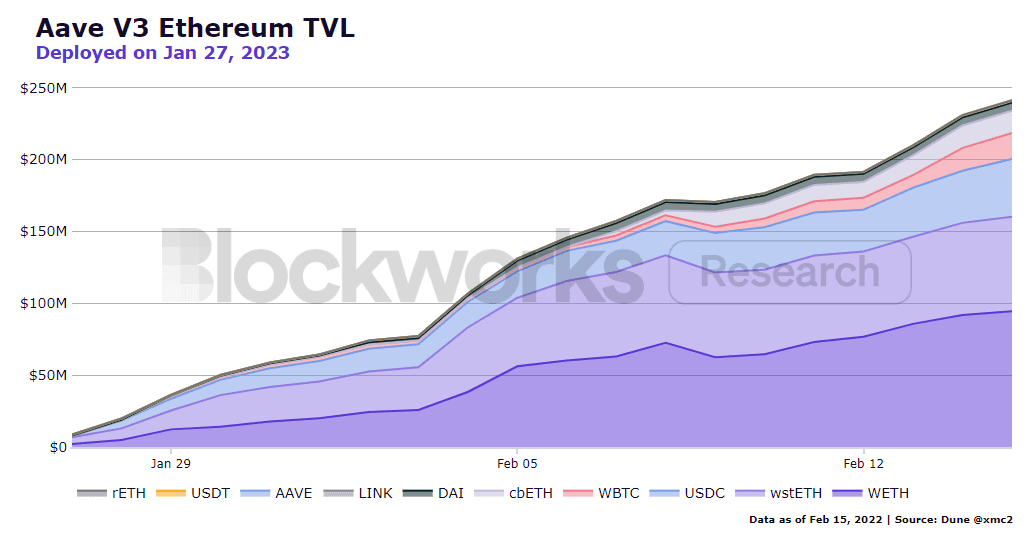
To assist with the organic migration, the team launched a migration tool that automatically moves open positions from V2 to V3. The tool has successfully moved $86.7M to the new deployment. Aave governance can pull additional levers to push liquidity into V3 that do not require token incentives, such as increasing the reserve factor or removing the security module protection of V2 markets.
Efficiency Mode (E-mode)
Digital assets can often be categorized by types, such as stablecoins or liquid staking derivatives (LSDs). High quality assets within a category generally have the same underlying asset and similar price action. Therefore, risk parameters can be loosened when borrowers post collateral in the same category as the asset they are borrowing. The maximum LTV, liquidation threshold, and liquidation penalty become more favorable to the borrower, increasing the attractiveness of utilizing Aave for certain strategies.

Dan leads the build out of the Analytics product, spending most of his time with onchain data.