Aave V3 Goes to Market on Ethereum

Top of Mind
DeFi lending protocol Aave launched its V3 on Ethereum on January 27. This comes after a series of V3 releases last March on other L1 and L2 networks: Polygon, Arbitrum, Optimism, Avalanche, Fantom, and Harmony.
Key V3 upgrades include higher borrowing capacity for correlated assets, an isolation mode for riskier collateral assets, and improved gas optimizations. While these features are not new to cross-chain Aave users given their availability on other networks, the inclusion of Ethereum is a major growth milestone for the protocol.
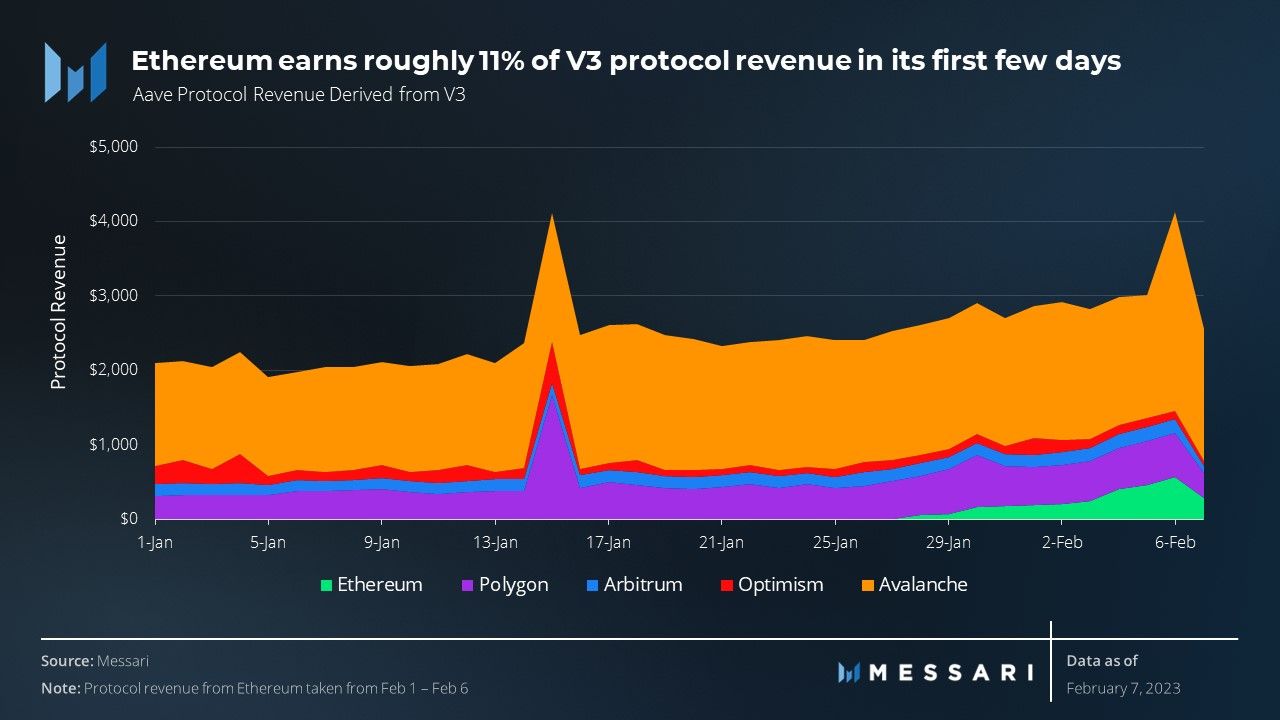
The top-line numbers highlight how Ethereum provides a significant boost to revenue derived from V3. Aave earned $304 per day on average between February 1 and February 6, the third-highest daily revenue source behind Avalanche ($1,907) and Polygon ($540). Arbitrum and Optimism lagged behind at $180 and $148, respectively. For the first week of February, Ethereum accounted for 11% of V3 revenue, a number that is expected to surpass both Avalanche and Polygon in the future.
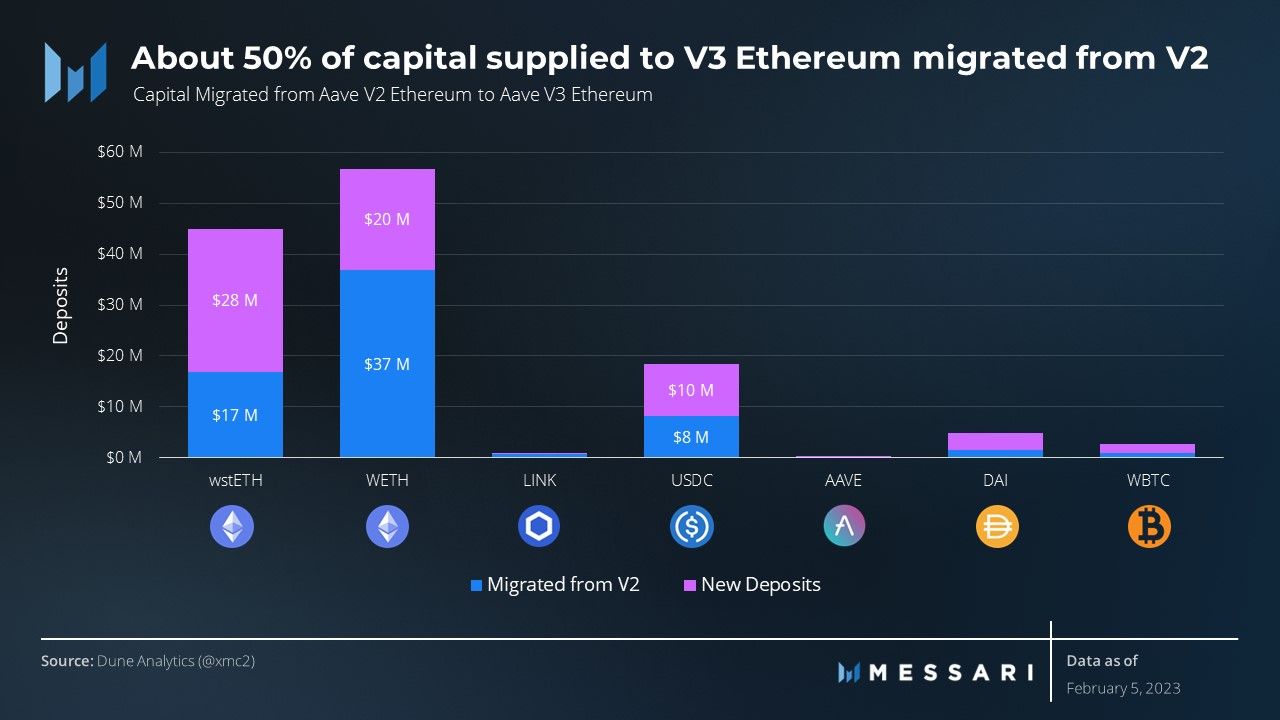
Aave’s most immediate focus is attracting liquidity to V3. To onboard capital, the protocol built a migration tool for depositors to move assets from V2, resulting in the transfer of $65 million from V2, i.e., roughly 50% of the $129 million currently deposited. The most migrated tokens were WETH and wstETH with a combined $54 million of capital compared to $48 million of fresh deposits. Combined, the migration equates to 78% of deposits as WETH or a liquid staking derivative (LSD) of WETH.

Jerry joined Messari as a Research Analyst after working in management consulting. He graduated with a B.S. in finance and a minor in computer science from Indiana University's Kelley School of Business.