0G is an AI-focused Layer-1 on which users can publish large datasets, run AI model inference and fine-tuning, and keep outputs available on a single, verifiable network.
0G offers three decentralized infrastructure services offered by independent providers but coordinated, verified, and settled through the 0G network. 0G Compute for inference and fine-tuning, 0G Storage for datasets, and 0G DA for publishing verifiable datasets.
The infrastructure stack centers on the 0G Chain for recording job intent, verifying receipts, and settling payments, with SDKs/CLI and hosted endpoints, and a parallel AI Alignment Node layer for operational oversight.
Validator participation surpassed 100 during testnet, including Google Cloud, AWS, Alibaba Cloud, NTT Docomo, and Blockdaemon. One week post-mainnet launch, stake has been distributed across 10 active validators.
The OG token launched on Sept. 22, 2025. The allocation at token genesis was 1 billion tokens split 56% to community and ecosystem and 44% to the core team and early investors. It is used for gas fees, to pay for compute, storage, and DA services, and for staking.
Primer
0G is an AI-focused Layer 1 (L1) network designed for publishing data, running AI models, and storing model files, inference results, and metadata. Data availability publishes and serves large artifacts, compute executes model jobs with results that can be verified and paid for, and storage keeps datasets and checkpoints online. The network retains EVM compatibility while tying these components together for routing, permissions, and payment as .0G identities allow humans and software agents to transact under human-readable names instead of raw addresses. 0G is infrastructure, not a model vendor. Users of the network can run inference and fine-tune external models and datasets with verifiable accounting.
The 0G Foundation operates an $88.88 million Ecosystem Growth Fund and an $8.88 million Guild on 0G program and accelerator. These programs incubate, fund, and advise early teams across agents, data tooling, and integrations.
0G’s mainnet and token launched on Sept. 22, 2025. The network coordinates artifact publication, a compute marketplace for running trained models, and distributed storage. A validator set that includes recognized operators reduces single-provider risk, and managed access shortens time to go live for teams that don’t run their own infrastructure. 0G’s vision is to create a competitive market for AI model inference and adaptation across diversified compute providers, with reproducible outputs and clear pricing.
0G is a modular L1 where developers can integrate compute endpoints, storage clients, and data-availability publishers from existing stacks. Developers use EVM tooling to set who can submit jobs, read/write datasets, and pay providers for metered work (per tokens processed, GPU time, or bytes stored/retrieved).
0G serves multiple user groups. This includes application developers that need verifiable AI model inference across the entire AI development pipeline and the ability to store, locate, and recall the files a model workflow depends on. Second are operators that supply GPUs or storage capacity. 0G routes requests to a registered compute provider, records the job and permissions onchain, stores outputs and checkpoints through 0G Storage, publishes references via 0G Data Availability, and settles payment to the provider’s .0G name when a signed receipt is returned. Additional participants include consensus validators, AI Alignment Node license holders and active operators, stakers and delegators, and end users who access AI features through integrated applications. Over time, retail usage is expected to account for a meaningful share of job submissions.
0G offers three core services, including compute, storage, and data availability, which applications can use individually or together. The services target three decentralized AI (DeAI) constraints at once: moving large data cheaply, running models on demand, and keeping response times fast. Each service is supplied by independent providers, allowing users to choose suppliers based on their needs, switch providers without redesigning their architecture, and ultimately pay providers on the L1.
This modular design allows teams to adopt a single layer or compose multiple layers as requirements evolve, rather than committing to a vertically integrated stack. Interfaces between compute, storage, and DA are standardized at the protocol level, enabling provider substitution and incremental integration without re-architecting applications. Few networks in the DeAI category expose interoperable compute, storage, and DA with onchain metering across all three, which makes 0G’s “mix-and-match” path notable from an implementation standpoint.
0G Compute: A marketplace where providers run inference and fine-tuning on already-trained AI models, and in the future, is planned to support models pre-training. Jobs run through contracts that escrow funds and auto-settle on receipt, and providers return cryptographically signed results. Inference Providers optimize for low latency and compatibility, while fine-tuning providers optimize for longer training runs that output new weights/adapters.
Application teams, such as agent platforms or analytics services, can call a supported model endpoint (such as Llama-3 70B or a domain-tuned variant). They then send inputs, receive a signed result, and settle payment onchain. Model inference can vary with hardware, software, or decoding parameters. Teams verify each run by recording a signed receipt and hashing the inputs, weights, and settings. Occasionally, cross-provider spot checks confirm that the result is consistent for the task.
This reproducibility lets users benchmark latency and price across multiple operators and switch without losing consistency. Thus, application and agent services can select the fastest or most cost-effective region, add capacity during demand spikes without bottlenecks, and rely on redundancy if a provider degrades, while maintaining comparable results across operators. Examples of agent-driven applications in the 0G ecosystem include identity-addressable agents via SPACE ID, private data access for agents with Beacon Protocol, and consumer agents that train and serve personal models from Flashback Labs.
0G Storage: A distributed layer that stores and serves datasets, checkpoints, and outputs across independent providers. Users use standard APIs, while replication and repair keep data available as nodes churn. This way, pipelines can move between operators or regions without breaking state, shared datasets don’t depend on a single host, and history remains auditable and reproducible. Clients select storage nodes via an Indexer and identify files by a Merkle-root hash. Downloads can include a Merkle proof to verify data correctness. SDKs are available in Go and TypeScript, with starter kits and a CLI for basic operations.
0G Data Availability: A publication layer for large, encoded data packages that users can verify and retrieve when needed. The encoding supports partial sampling and recovery, letting external verifiers confirm that data is truly available without downloading it in full. Using 0G DA as a neutral publication layer provides a shared source of truth across providers and chains, simplifying handoffs and avoiding single-gateway dependence. DA blobs are redundantly encoded and split into slices, which are signed by DA nodes staking 0G tokens. A blob is considered published when a quorum is reached. Ongoing sampling rewards nodes that continue to retain slices within the epoch window.
Chains can leverage 0G DA for their batch data. Integrations with OP Stack and Arbitrum Nitro allow chains to post data to 0G DA and make data available. Inference and Fine-tuning Providers can also use 0G DA to publish datasets, checkpoints, or model snapshots, allowing others to verify the data. Meanwhile, 0G Storage handles serving the files, and 0G Compute runs the jobs.
Ecosystem & Builder Programs
To drive usage of these services, the 0G Foundation operates an $88.88 million Ecosystem Growth Fund and an $8.88 million Guild on 0G program and accelerator. The programs provide grants, credits, and hands-on integration support to early teams building agents, data tooling, and service integrations. Dozens of projects have shipped through these programs, including agent frameworks that run inference on 0G Compute, storage clients that manage datasets and checkpoints on 0G Storage, and data pipelines that publish references on 0G Data Availability.
Incentives prioritize recurring workloads, cross-layer usage, and provider onboarding over one-time campaigns. Teams receive integration help and test credits to shorten the time to first workload, along with advisory support to reach mainnet. The goal is measurable adoption with verifiable accounting across compute, storage, and DA.
0G Infrastructure Stack
0G coordinates work on its L1 and names counterparties with .0G identities. The network records job intent, the data to use, receipts, and payments. Identities associate routing and permissions with identifiable entities rather than raw addresses. Together, they let many independent providers operate in a single, predictable network.
0G Chain: An EVM-compatible L1 network that connects requests, execution, and payment. Contracts record job intent, reference required data, verify receipts, and settle with the selected provider. This flow makes workloads auditable and repeatable while staying compatible with standard tooling and wallets. As usage spreads across operators and regions, onchain coordination eliminates the need for specialized middleware.
.0G Identity: Human-readable names for onchain addresses that resolve across chains for both humans and AI agents. These names attach routing and permissions to identifiable entities, which shortens setup, reduces misroutes, and ties disputes to a specific party. In practice, users discover providers by name, apply allowlists and roles, and settle to the same named entity regardless of which chain a workflow touches. Workflows may start on another chain but still call 0G Compute, Storage, or DA, with work and payment for these services occurring on 0G Chain. The cross-chain resolution ensures consistency with the counterparty when a workflow spans multiple ecosystems. Used together, the 0G Chain and .0G Identity give DeAI participants a common surface to find each other, agree on work, and complete payment without relying on intermediaries.
0G’s utility lies in how well workflows route to identifiable counterparties, large files are published and retrieved without friction, and model jobs finish within stable time windows across multiple providers. .0g identity supplies the naming needed for that routing with names resolving across chains, so permissions and payments attach to a persistent entity instead of a raw address. This reduces setup time, cuts misroutes, and ties any dispute to a specific counterparty with an auditable history.
Integration & Access:Standard entry points allow teams to connect from Web2 or other chains and expand usage without a rebuild. Client libraries and a command-line interface (CLI) cover model requests, data publication, and storage I/O. SDKs in common languages keep initial changes small and allow incremental rollout. For groups that do not run nodes, hosted endpoints provide access without the need for hardware procurement or maintenance cycles. Providers handle uptime, scaling, and upgrades; applications keep control of keys, .0G names, and onchain settlement. EVM compatibility and .0G Identity keep wallets, RPC tools, and monitors consistent across environments. The result is a predictable operational surface for connecting, routing to named providers, and settling, with room to reconfigure as latency, cost, or policy needs change.
AI Alignment Nodes:A set of independent verifiers that oversee validator, storage, DA, and compute operators. They evaluate AI outputs for drift or policy violations. Alignment nodes are not consensus validators re-executing blocks, but a parallel watchdog layer that provides an extra set of checks. Ownership and operation of AI Alignment Nodes are split, and rewards are shared between license holders and active operators pursuant to 0G’s distribution schedule. This design incentivizes license holders to keep nodes healthy by self-operating or contracting reputable node operators. This shifts incentives from passive holding to active monitoring and widens the pool of parties monitoring the system. This widens participation without requiring license owners to run their own infrastructure.
An AI Alignment Node incentive program is set to distribute 15% of the total supply of 0G (150 million 0G) to 175,500 licenses. Each license maps to at least 854.7 tokens with an initial unlock followed by 36 months of vesting. Active operators are eligible for ongoing rewards, contingent on meeting operational criteria such as running at least one active node and staking Notably, 37.4 million tokens from unsold licenses are to be redistributed, with 33% going to owners that delay claims in year one and 67% to owners that run at least one active node and stake.
Payment for Network Services (0G Storage, Compute, and DA): 0G is the payment token for work performed across 0G. Developers and end users pay with 0G tokens for core infrastructure and application-layer services. On the infrastructure side, payments cover storage of datasets, compute for fine-tuning or inference, and data availability publication and retrieval. All payments settle onchain to providers’ .0G name with metering by usage unit. For example, per 1,000 AI model tokens processed, per GPU hour, per GB stored, or per GB published.
Payment for Gas: 0G is the gas token for transactions on 0G Chain. Every onchain action incurs a fee in 0G. Gas fees compensate validators for processing and recording transactions, and anchor demand for the token beyond marketplace payments. As workloads on 0G involve large artifacts or high-frequency model calls, gas pricing and throughput will be central to whether applications scale cost-effectively compared to centralized methods.
Staking: 0G secures the network through staking. Validators stake to participate in network consensus and operate the DA pipeline, while delegators can allocate stake to validators. Stake being delegated across validators raises the cost of coordinated failure. Staking rewards stem from transaction fees and ongoing block emissions drawn from the ecosystem allocation, while misbehaving validators can be slashed. The emissions are scheduled unlocks that route to the staking module and supplement fees in early mainnet, then decline over time. Managed access options allow users to delegate while retaining control of 0G tokens. Notably, AI Alignment Nodes earn from a separate reward pool and do not draw from staking emissions.
The 0G Chain validator set passed 100 during testnet with a mix of professional and independent operators. Named participants included AWS, Google Cloud, Alibaba Cloud, NTT Docomo, Blockdaemon, Figment, Coinbase Cloud, Alchemy, Hex Trust, Staked (Kraken), QuickNode, P2P.org, Stakin, Chorus One, and Everstake.
Upon mainnet launch, 0G tokenholders could stake or delegate, resulting in stake being spread across 10 validators while more continue to come online and raise the bar against coordinated control or censorship. Jobs can settle through independent endpoints, block production is less likely to bottleneck at a single provider, and localized slowdowns are less likely to disrupt the network as a whole.
Token Allocations
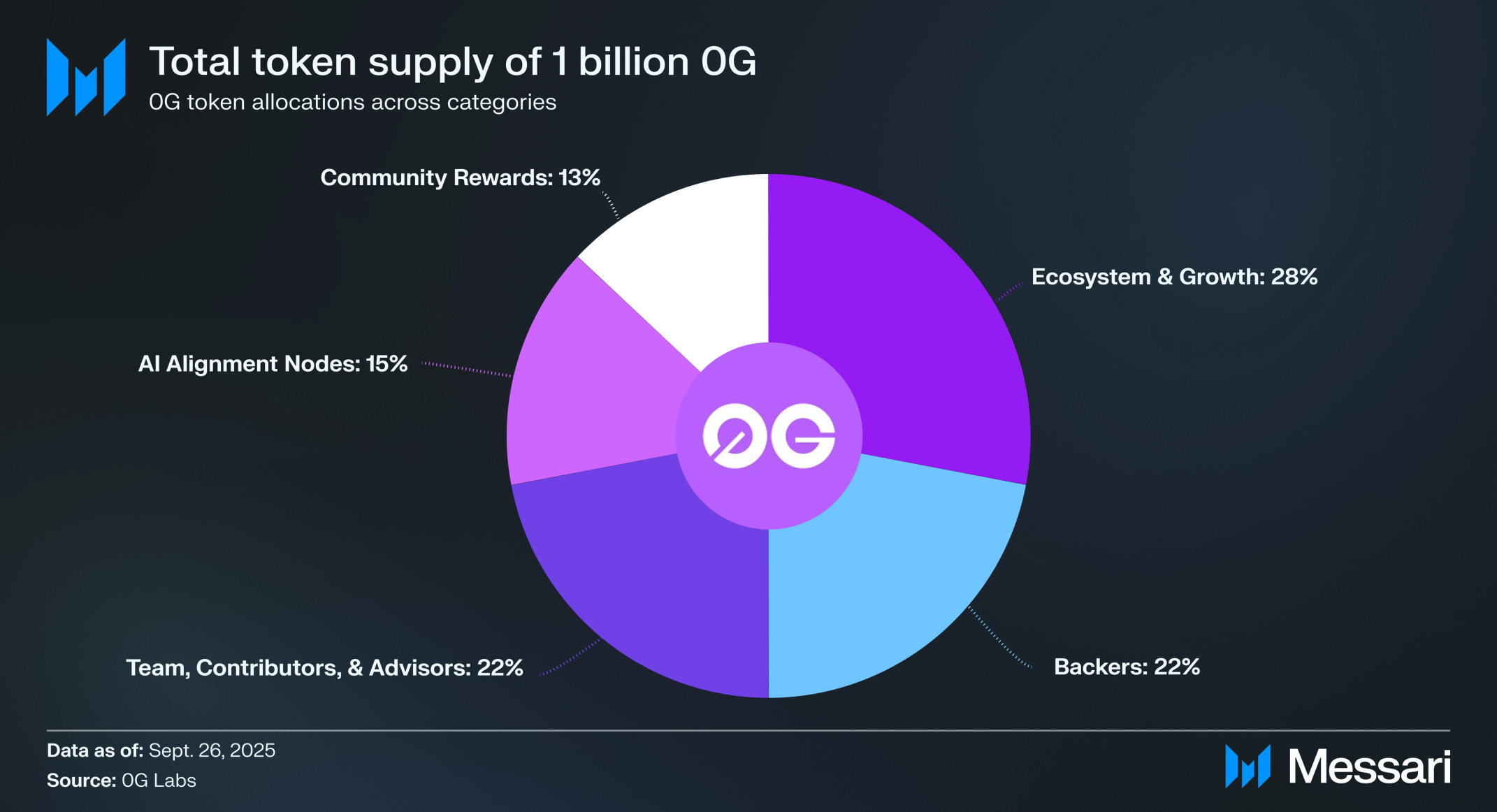
While the core team has not specified how each token allocation will be used, the total supply of 1 billion 0G tokens was distributed in the following manner:
Community and ecosystem (56%)
Ecosystem (28%)
AI Alignment Node (15%)
Community Rewards (13%)
Team and early backers (44%)
Team, Contributors, Advisors (22%)
Backers (22%)
0G aims to generate active participation across staking, delegation, and regular use of its compute, storage, and DA services. To grow the supply side, the core team is supporting testnet validators in transitioning to mainnet, adding providers through managed access, and expanding Alignment Node participation through the license program. To grow the demand side, 0G is attempting to convert tokenholders into stakers, delegators, and job submitters, supporting partner apps with SDKs, and using the community and ecosystem allocation for incentives that target recurring workloads rather than one-off campaigns.
A share of the community and ecosystem allocation funds the Ecosystem Growth Fund and the Guild on 0G program and accelerator. Incentives prioritize recurring jobs, dataset publication and retrieval, and provider onboarding over one-time campaigns.
At TGE, 21.3% of the total supply will be unlocked, entirely from the Community allocation, to fund Alignment Nodes, ecosystem development, and participation rewards. Team and investor allocations are locked for 12 months after TGE, followed by linear vesting over 36 months. The remaining 62% of the Community allocation vests gradually over 24 to 36 months.
The emissions schedule is intended to support long-term network usage by aligning token distribution with measurable activity. Near-term unlocks fund onboarding and early workloads. Deferred unlocks and multi-year vesting concentrate incentives on sustained contributions, such as validator uptime and performance, delegated stake participation, job submission frequency, and storage under management.
If 0G can scale both supply and demand, network usage will be evidenced by an increase in active validators with dispersed stake, regular compute jobs being run, and storage under management rising.
Closing Summary
0G has launched a modular network that supports decentralized AI (DeAI) in operating at scale. The network offers a marketplace for three core services: a compute marketplace for model fine-tuning and inference, distributed storage for durable data access, and a data availability layer. The EVM-compatible 0G Chain and its .0G identity feature coordinates work across these services, while AI Alignment Nodes enhance network resilience through independent oversight. Early program activity shows the stack in use across agents and data products, with workloads that touch compute, storage, and data availability.
The 0G token launched on Sept. 22, 2025, with 56% of the supply going to the community and ecosystem, and 44% was allocated to the core team and early investors. 0G’s testnet phase garnered over 100 validators. Upon launch, tokenholders can use the token to transact on the network, stake, and pay for 0G services. The token also serves as gas and the unit of account for metered usage across 0G Compute, Storage, and DA.
0G’s future will depend on how it can scale its supply and demand. How the network incentivizes a growing supply of Inference Providers and Fine-tuning Providers, while finding demand for its compute, storage, and data availability services, will be the project’s key challenge post-mainnet launch. If it finds success, 0G could find a place as core DeAI infrastructure.
More broadly, 0G enters a landscape where AI infrastructure remains highly centralized, raising concerns around verifiability, accessibility, and control. By embedding compute, storage, and consensus on a single network, 0G aims to provide a reproducible and transparent foundation for AI workflows. In doing so, it addresses an emerging gap at the intersection of crypto and AI: the need for decentralized infrastructure capable of supporting open, accountable AI systems.
This report was commissioned by 0G Labs. All content was produced independently by the author(s) and does not necessarily reflect the opinions of Messari, Inc. or the organization that requested the report. The commissioning organization may have input on the content of the report, but Messari maintains editorial control over the final report to retain data accuracy and objectivity. Author(s) may hold cryptocurrencies named in this report. This report is meant for informational purposes only. It is not meant to serve as investment advice. You should conduct your own research and consult an independent financial, tax, or legal advisor before making any investment decisions. Past performance of any asset is not indicative of future results. Please see our Terms of Service for more information.
No part of this report may be (a) copied, photocopied, duplicated in any form by any means or (b) redistributed without the prior written consent of Messari®.