Blockworks AI
What are KZG Commitments?
What are KZG Commitments?
Overview
KZG commitments—named after their inventors Kate, Zaverucha, and Goldberg—are a cryptographic technique enabling someone to commit to a polynomial in a succinct and verifiable manner1234. In blockchain systems, KZG commitments are primarily used for efficient data integrity proofs and are critical for advanced scalability solutions like Ethereum’s Proto-Danksharding and many zero-knowledge proof systems (PLONK, zk-SNARKs)35.
How KZG Commitments Work
- Polynomial Commitment: Instead of committing to each piece of data individually, systems can encode data as a polynomial and use the KZG scheme to commit to the entire polynomial using a single elliptic curve group element34. The process is enabled by elliptic curve pairings.
- Succinctness: Both the commitment and the proof of any single value evaluated at a point are constant-size, making KZG far more efficient than alternatives like Merkle trees or other polynomial commitments (e.g., FRI used in STARKs)56.
- Trusted Setup: Before using KZG, a one-time 'trusted setup' must be performed, where cryptographic parameters are generated in a special ceremony. This setup is reusable but requires participants to discard certain secret information to ensure trustworthiness37.
- Opening a Commitment: When someone wants to prove that a particular value is part of the committed data, they can provide a short "opening" proof, which anyone can verify against the commitment.
Why Are KZG Commitments Important in Blockchains?
1. Data Availability and Integrity
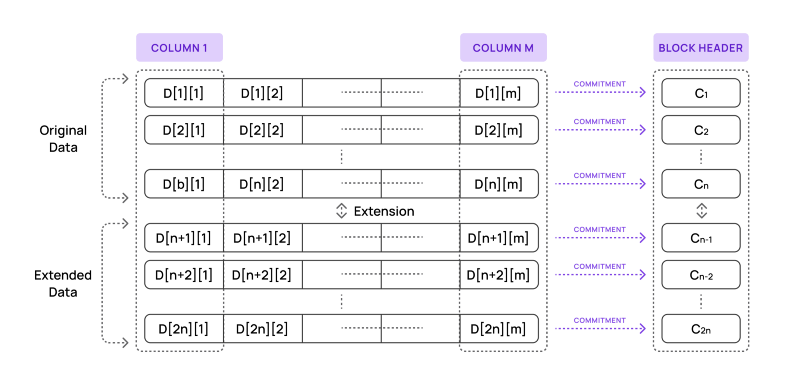
- KZG commitments are used to commit to large amounts of data (like "blobs" in Ethereum’s sharding proposal) by committing to rows or columns represented as polynomials. This allows validators or light clients to check data integrity with minimal data894.
- For example: In Danksharding, data is arranged in a 2D matrix, encoded with erasure coding, and each row’s polynomial representation is committed via KZG. This ensures that data can’t be hidden or faked without a high probability of detection894.
2. Zero-Knowledge Proof Systems
- KZG commitments are foundational for succinct SNARKs (PLONK, pairing-based schemes), enabling the creation of tiny proofs (~200 bytes) that are quick to verify56. This is crucial for scaling blockchain verification and privacy.
3. Security Guarantees
- The cryptographic "binding" property: it is computationally infeasible to create two different polynomials with the same commitment. This eliminates the need for fraud proofs regarding data inclusion129.
Comparison to Other Schemes
| Scheme | Commitment Size | Proof Size | Trusted Setup | Quantum Resistant? | Used In |
|---|---|---|---|---|---|
| KZG | Constant | Constant | Yes | No | Ethereum sharding, PLONK |
| Merkle Tree | Logarithmic | Logarithmic | No | Yes | Classic blockchains |
| FRI (STARKs) | Large | Large | No | Yes | Some zk-rollups |
Note: KZG is less future-proof due to quantum attacks and requires trusted setup, but is extremely succinct and efficient for current blockchain scaling needs.56
Visual Explanation
KZG commitments essentially let the blockchain "vouch for" large datasets (as polynomials) using a tiny cryptographic object. Light clients or smart contracts can interact with these commitments by requesting short proofs that a specific value existed in the original dataset, without downloading all the data81011.
Key Takeaways
- KZG commitments allow blockchains to efficiently commit to and later verify the integrity of large structured data, using tiny and verifiable cryptographic objects.
- Main uses: Data availability proofs (e.g., sampled verification in sharding), zero-knowledge proof systems, succinct light client verification.
- Trade-offs: Requires a trusted setup and is not quantum-resistant, but is currently the most efficient scheme for succinct commitments and proofs at scale.
Further Reading
You're viewing a shared conversation. Your questions will start a new chat.