Value capture in the age of DeFi aggregation


The 21st century is dominated by aggregators. If you’re buying a consumer good, you’re probably shopping on an aggregator like Amazon. If you need a ride to the airport, you’re probably hailing a ride via an aggregator like Uber. If you’re looking to binge-watch a tv show, you’re almost certainly watching one using a video aggregator like Netflix. The list goes on.
Nearly all online activity is intermediated by aggregators, and there are good reasons for this. Aggregators are defined as platforms that have direct relationships with users, experience zero marginal costs in serving them, and decreasing acquisition costs by way of the virtuous cycle between supply and demand. This dynamic results in extreme network effects that create winner-take-all scenarios. For these winners, this means massive value accrual to the tune of trillions of dollars.
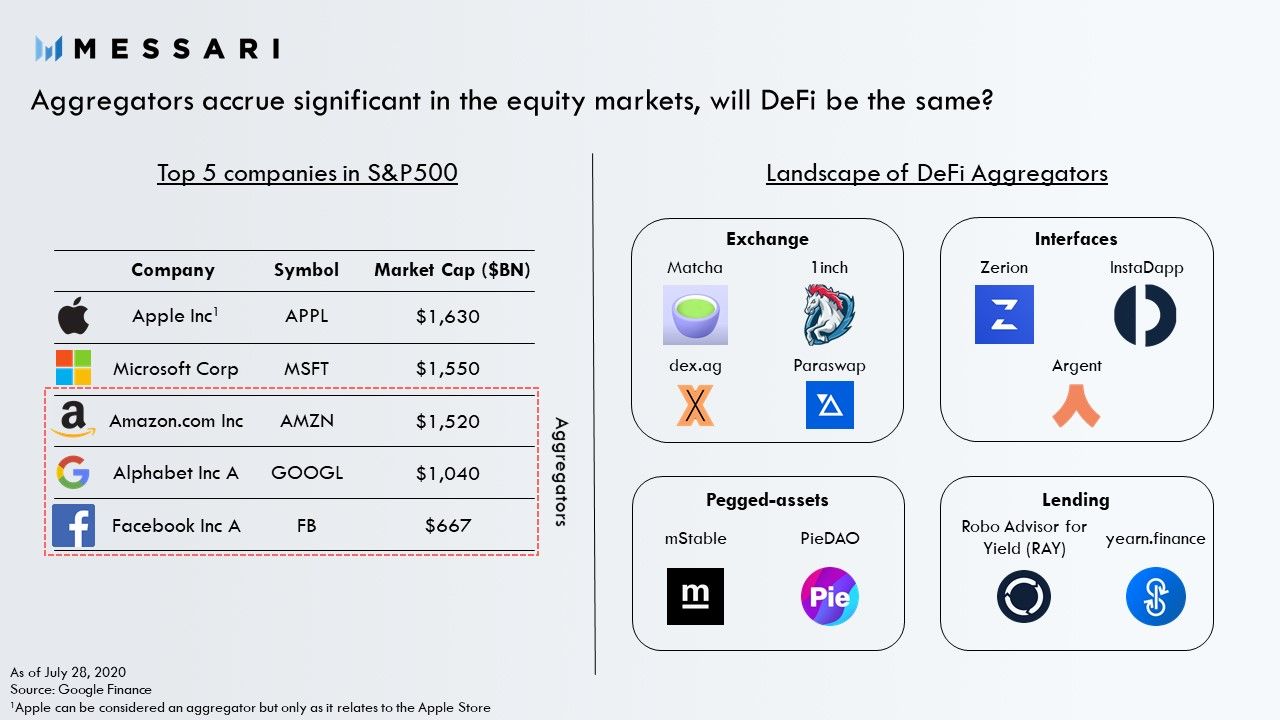
Defi projects have clearly been taking notes. Although it's early, we’re already seeing first attempts at aggregation in DeFi across various sub-sectors. Yield-optimizers are automatically rebalancing user deposits across interest-bearing platforms. Smart order routers are providing traders best price execution across various DEXs. Meta-assets are sprouting up to combine assets with one another (like USD stablecoins) to reduce the idiosyncratic risk of any individual one. And finally, interfaces are packaging all of DeFi into a more user-friendly application giving them access to more advanced features or portfolio management tools. The key thread is these projects aggregate user demand and funnel it into DeFi protocols.
But will these DeFi aggregators become the giants we see in the real world?
Value prop of aggregation in DeFi
Crypto moves at a breakneck pace. What’s hot one day may be irrelevant the next. Little known projects can become the talk of the town in an instant. All of these fluctuations have dramatic effects on the market infrastructure as a whole which can make it extremely difficult to keep up with (even for those working full-time in the industry).

Ryan Watkins was a Senior Research Analyst at Messari. Previously, he worked at Moelis & Company as an Investment Banking Analyst where he worked on deals in the technology, telecom, and fintech sectors. Ryan graduated Magna Cum Laude from the Gabelli School of Business at Fordham University.