The Polkadot & Kusama Ecosystem

This is the second part of our Polkadot explanation piece. Please see part one here: Polkadot Primer
Polkadot and Kusama are launching their parachain auctions in a time when cross-chain composability and scalability have never been more important. In this report, we take a quick recap of what Polkadot is, the upcoming parachain auctions on Kusama and Polkadot, and then cover the largest projects vying for a parachain slot over the coming weeks.
Polkadot seeks to be a multi-chain platform - in other words a meta-protocol or protocol of protocols. It’s a Layer 0 solution that can connect other Layer 1 blockchains (internal like Acala or external like Bitcoin or Ethereum) and their applications. Polkadot sits underneath these networks, facilitating cross-chain interactions and allowing connected chains to process transactions in parallel.
Kusama and Polkadot will soon be auctioning “Parachain” slots (short for parallel chains since they run in parallel), about once every two weeks. A parachain is equivalent to a blockchain (Layer 1) -- likened to a computer core dedicated to run a specialized task. Parachains typically have one specific function -- say Synthetics, Identity or Oracles -- with its own specialized characteristics and even governance structure. For example, a decentralized oracle network would have its own parachain that would be able to query data from the separate Synthetics and Identity parachain. Similar to other blockchains, each parachain will have its own applications, users, and liquidity. They will also be interoperable with other parachains through Polkadot and external blockchains through bridges.
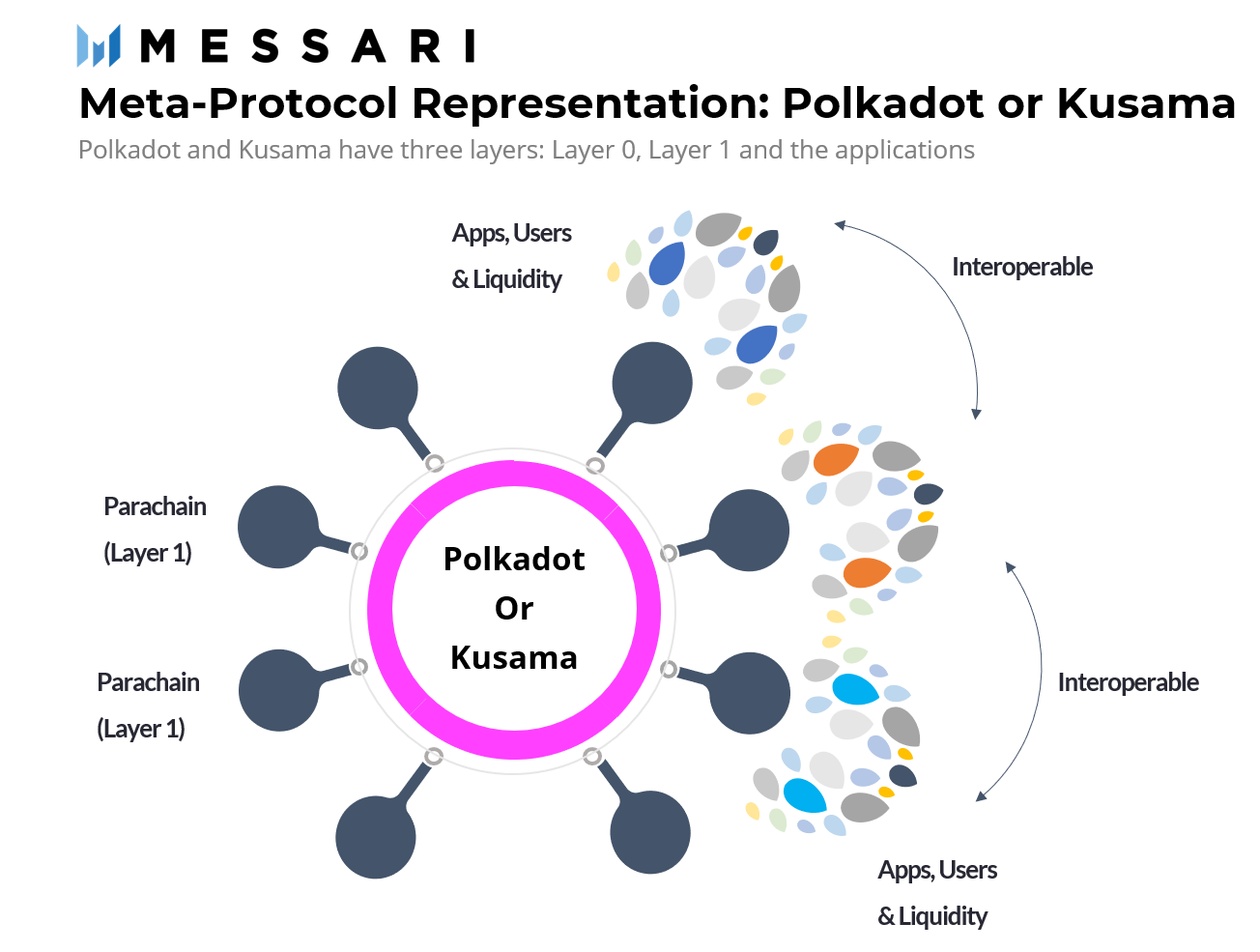
The benefits of connecting to the Polkadot or Kusama network includes enabling a cheap but secure way for blockchains and apps to launch with forkless upgrades, scalability, and some governance structure. Within the network and bridges, projects can leverage the security and inter-parachain communication offered by Polkadot or Kusama. Projects don’t need to spend the time and money establishing a validator set and building up enough economic security to make attacks cost-prohibitive. Polkadot and Kusama are plug-and-play options for developers looking to launch new networks.
While Kusama is seen as a low-value version of Polkadot, it plays an important role in the Polkadot ecosystem. It can serve as a testbed for projects with aspirations to launch a parachain on Polkadot, but Kusama comes with real economic benefits and consequences. Winning a Kusama parachain is, therefore, an important stepping stone. To win a parachain slot, the project must participate in a parachain auction. In the auction, they will submit the bid amount (in DOT or KSM) and also the desired slot duration (6 to 24 months). In the future, projects may also rent or buy the slot from the secondary market.

Mira was a Senior Research Analyst at Messari. Prior to joining Messari, Mira was a Senior Portfolio Manager for a US$6 billion Asia Pacific equities fund at APG Asset Management. Mira received a BA in Economics and Mathematical Methods in the Social Sciences from Northwestern University.