The opportunity for Proof of Stake networks

Staking has vaulted into prominence over the past year. Cosmos and Algorand hitting the market, exchanges expanding to staking services with Tezos at the forefront, and Ethereum continuing its methodical march towards its next iteration have all fueled the narrative that PoS will come to define the next stage of the crypto industry.
Despite the hype, PoS chains account for only a small portion of the overall crypto market in dollar terms. According to Staking Rewards, the combined market capitalization of staking networks amounts to ~$13.6 billion, just 5% of the global market. This total is not insignificant, considering Bitcoin’s market dominance tops 71%, and Ethereum takes up another 9%. But one would expect PoS chains to make more of an impact with the rising demand for staking yields.
Market dominance is an imperfect metric, however, and it fails to show how PoS has become the preferred consensus mechanism for new projects. Over the last three years, most layer-1 networks have opted for a staking based incentive mechanism for validating transactions, even though PoW offers the more battle-tested security model for blockchains.
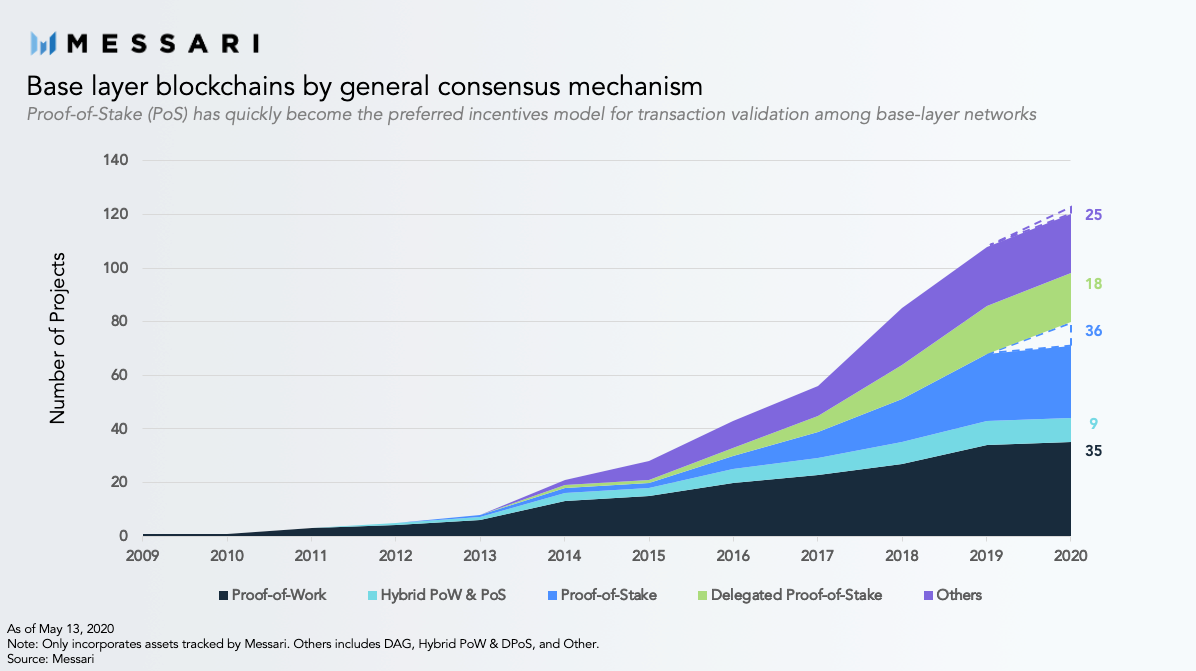
While PoS comes with new and less obvious attack vectors, projects often turn to PoS for its perceived efficiencies in terms of energy expenditure and transaction execution. Staking could also be an effective method for bootstrapping participation, hence the recent skew towards PoS. The obvious tradeoff is early participants in PoS networks receive a higher base percentage claim on future seigniorage compared to laggards. This issue is not as applicable to PoW chains.
A potential opportunity
New projects could also be considering the potential market opportunity. Even though the concept is now almost eight years old, PoS is still very early in its lifecycle (much like the rest of crypto) and should continue to influence the growth trajectory of the entire industry. This growth could eventually translate to PoS networks, a market that has arguably not shown a clear frontrunner to this point.

Wilson Withiam was a Senior Research Analyst at Messari. Previously, he worked at Circle Research where he conducted research on cryptoassets. He graduated with a B.Sc. in Kinesiology and Exercise Science before studying computer science and economics at UConn.