The Flippening of ETH: The Rise of Stablecoins on Ethereum

The Problem
Since the early days of Bitcoin users have been faced with dual problems. No one wants to spend their cryptocurrencies if they believe the future value will be higher, and on the flip side, no one wants to accept them as payment due to their nascency and volatility. Instead, the primary use case for many cryptos today is speculation.
Nevertheless, there are numerous applications of cryptocurrency that cannot wait for this phase to pass. Not limited to provisioning scarce monetary assets, blockchains also enable people to create a wide variety of decentralized applications (dApps) that rely on blockchains’ credible neutrality. Many of these applications involve storing and transferring substantial amounts of value, yet historically have been limited to doing so in the volatile native assets of the blockchains they’ve built on.
The Solution
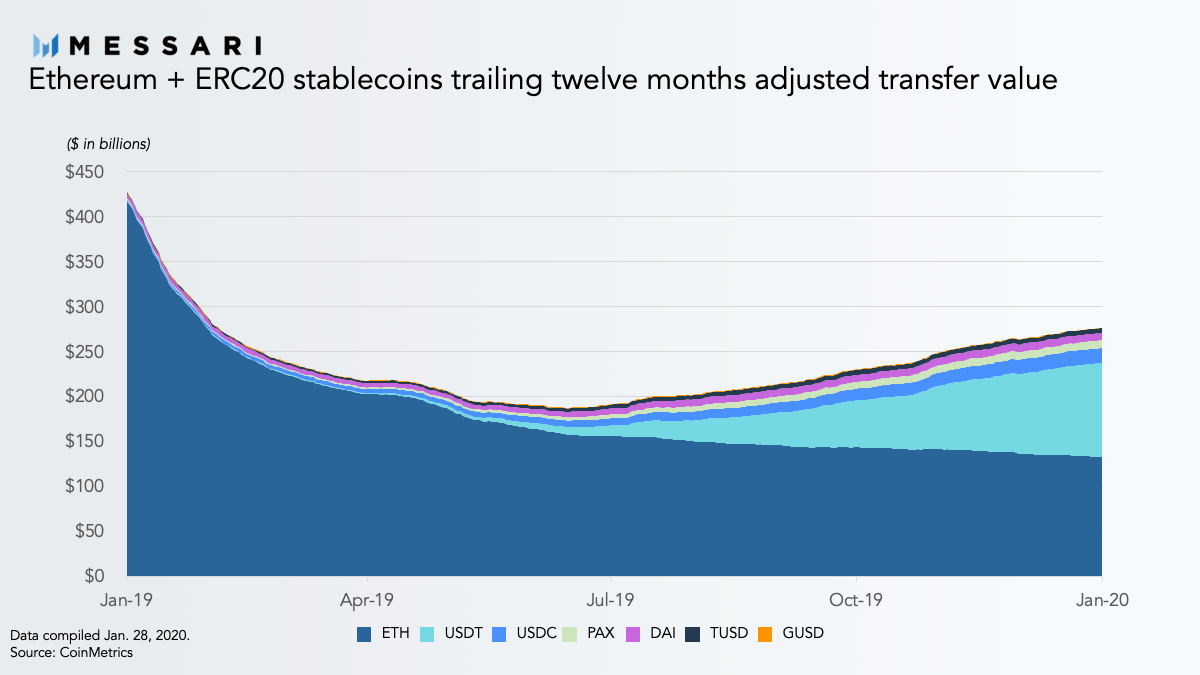
Stablecoins, whether backed by fiat or crypto collateral, answer this volatility problem. Ethereum, the largest smart contract and dApp platform by market cap, has become the dominant platform for stablecoins due to its robust smart contracting capabilities, conducive token standards, and lively project ecosystem. It is for these reasons that stablecoins have seen a Cambrian explosion on Ethereum since 2017.
These experiments have been so successful that there is now more stable value being transferred on Ethereum than ETH.

Ryan Watkins was a Senior Research Analyst at Messari. Previously, he worked at Moelis & Company as an Investment Banking Analyst where he worked on deals in the technology, telecom, and fintech sectors. Ryan graduated Magna Cum Laude from the Gabelli School of Business at Fordham University.